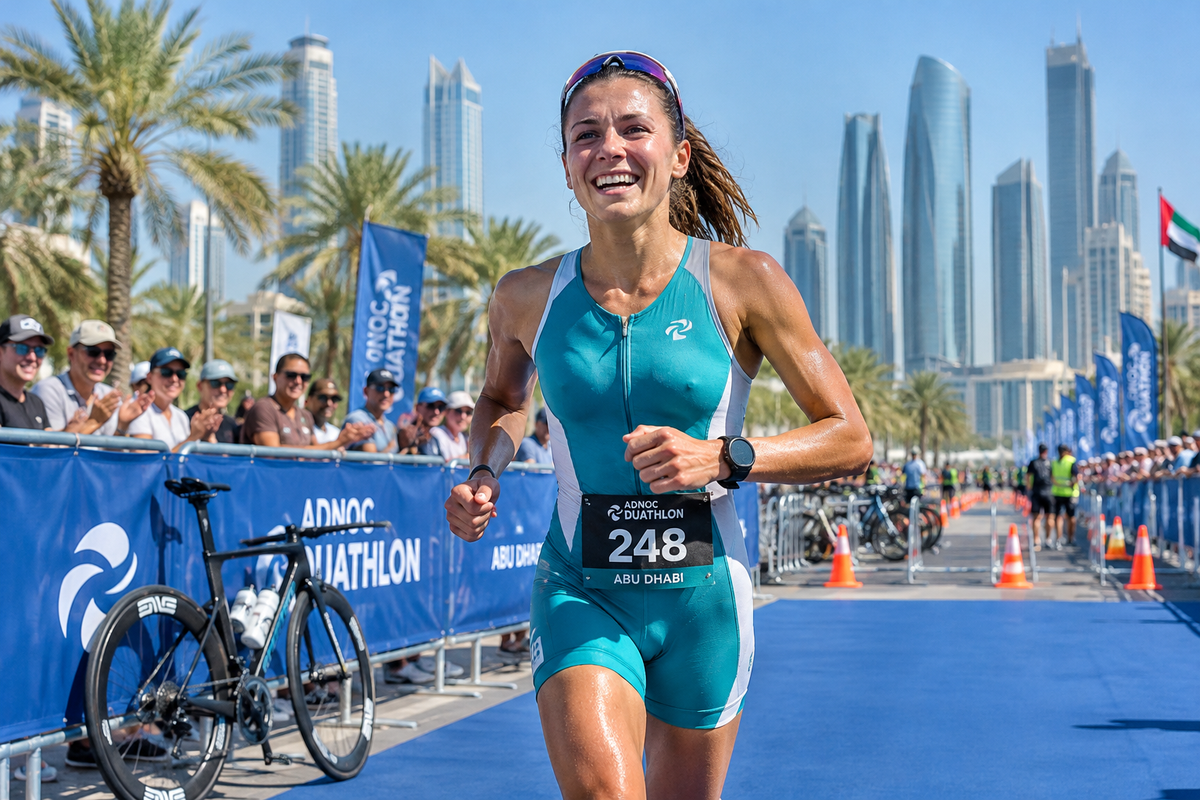
In the final 200 meters of the World Duathlon Championship in Abu Dhabi, Germany’s Lisa Tertsch pulled clear of Russia’s Diana Isakova to win the women’s title. It was a thrilling sprint at a world championship, and the field was large: just under 800 athletes—apparently the biggest field of any event at the Multisport World Championships.
Yet outside the multisport community, hardly anyone seemed to notice.
That gap between exciting racing and limited attention is the subject of a recent Slowtwitch opinion column by Kevin Mackinnon (Nov. 17, 2026), along with the lively forum discussion that followed. One reader even asked years ago whether duathlon was “the Bernie Sanders of endurance sport.”
In this post, we’ll explore why run-bike-run racing struggles to attract attention, what athletes think might help, and what it could mean for you. If swimming is the main thing keeping you from the triathlon start line, duathlon could be a great way into multisport racing.
The Event That Got Lost in the Shuffle
Kevin Mackinnon has raced since the 1980s and coached many athletes who began with duathlon. Even so, he admits he has played a part in the sport’s lack of coverage: “I have to plead guilty at not helping matters.” By the time he gets to the race report, he says, he has already spent most of his column discussing why nobody covers duathlon.
So let’s give the Abu Dhabi racing its due.
What happened in Abu Dhabi
The World Triathlon Multisport World Championships began in Penticton, Canada, in 2017. Today, the event brings several world championships together: duathlon, cross triathlon, cross duathlon, aquathlon, long-distance triathlon, and long-distance aquabike.
Organizers reportedly expected more than 4,000 athletes. Mackinnon counted the names on the start lists and estimated the actual number was closer to 2,000, which he attributed to the war in Iran. Even with that lower estimate, duathlon had the largest field of the weekend.
Men’s race: Italy’s Davide Menichelli broke away on the bike with Belgium’s Martin Oldenhove. They reached T2 about a minute ahead of the rest of the field, and Menichelli ran away with the win.
| Pos | Athlete | Nation | Total |
|---|---|---|---|
| 1 | Davide Menichelli | ITA | 1:10:04 |
| 2 | Martin Oldenhove | BEL | 1:10:39 |
| 3 | Adrien Pilleux | FRA | 1:10:44 |
Women’s race: Tertsch finished five seconds ahead of Isakova. Jasmijn Bakker of the Netherlands took third.
| Pos | Athlete | Nation | Total |
|---|---|---|---|
| 1 | Lisa Tertsch | GER | 1:22:03 |
| 2 | Diana Isakova | RUS | 1:22:08 |
| 3 | Jasmijn Bakker | NED | 1:22:27 |
2X2 Mixed Relay: Russia’s Valentina Riasova and Dmitry Karpeev won in 1:18:31, almost a minute ahead of the Netherlands, with France in third. Each athlete completed a 2 km run, 6 km bike, and 1 km run, twice. The result followed World Triathlon’s decision to lift its ban on Russian athletes in mixed relays after the IOC changed the Russian Olympic Committee’s status.
The formats, in plain language
If you haven’t raced a duathlon before, these were the distances:
- Pros: 5.1 km run, 29.5 km bike, 5.1 km run
- Age-group Sprint: 5.1 km run, 20 km bike, 2.5 km run
- Age-group Standard: 10 km run, 41 km bike, 5 km run
Para athletes raced the Sprint course.
These are approachable distances, and the racing itself has plenty to offer. The bigger challenge is getting more people to see it—and that’s what we’ll look at next.
The Exposure Problem
“There’s no two ways about it – there’s just not the same exposure for the racing without a swim.” — Kevin Mackinnon
For many people, he says, duathlon is “what they do when race organizers are forced to cancel a swim.” That’s a tough label for a sport with its own world championship.
Why duathlon feels like the B-side
Mackinnon points to several reasons duathlon races receive less attention:
- No Olympic spotlight. Triathlon has one; duathlon doesn’t.
- Long-distance triathlon dominates the conversation. It has a major place in endurance sports culture.
- Fewer marquee events. Zofingen in Switzerland remains the main exception.
- Less money for pros. Fewer sponsors and smaller prize purses make it harder for elite athletes to build a career in the sport.
- Age-group athletes follow the crowd. There are more triathlons to enter, and their friends may be more interested in triathlon.
A forum commenter named monty shared a fan’s perspective: “As fans, we don’t know who the hell is even competing.” If viewers can’t connect with athletes beyond the top names, it’s difficult for those athletes to build a following.
The crossover curse
Some of duathlon’s best-known athletes are more often remembered for their success in another sport. Mackinnon names three:
- Natascha Badmann: three Zofingen wins, but best known for six long-distance triathlon victories in Kona.
- Olivier Bernhard: eight Zofingen wins, but now better known as a founder of On running shoes and as a five-time long-distance triathlon champion in Switzerland.
- Lori Bowden: one Zofingen win, alongside two Kona titles.
Their duathlon achievements become part of their triathlon stories. It’s harder for duathlon to develop its own stars when its top athletes become famous elsewhere.
The Swim Barrier and the Bike-Run Ratio Debate
Duathlon can be especially appealing if you’re new to multisport. Mackinnon notes that many people see swimming as the biggest obstacle to trying triathlon. If that sounds familiar, duathlon can be a natural way to get started.
Duathlon as a bridge
Forum member adaykin took that route: “I did duathlons before I learned to swim in my early 30s.” Another commenter, Triingtotrain, said there should be more duathlon options for people who don’t enjoy swimming. As they put it, “I don’t do things I don’t like to do anymore. Life is too short.”
Mackinnon has seen a similar pattern with athletes he coaches. Many duathletes soon ask for swim lessons so they can try triathlon. For a coach, that makes duathlon a useful stepping stone—even if the athlete eventually moves on.
If you’re curious about multisport but nervous about open water or the pool, our race-season essentials collection can help you prepare for your first event. And if you’re racing in Mexico or elsewhere in Latin America, a duatlón can get you to the start line without needing pool access first.
Is the ratio right?
The forum discussion also turned to how a duathlon should balance the bike and run legs. Burnthesheep argued that triathlon “gets the sport ratio right” and that many duathlons are “running events with a bike afterthought.” Their rule of thumb is a bike-to-run ratio of at least 3:1 by distance, and ideally 4:1. They entered a local duathlon because it used a 4:1 ratio.
Their counterpoint helps explain why that format may be uncommon: more people run than race bikes, so organizers often build events to attract runners.
Another commenter, pk, looked at the question through the lens of a full-distance triathlon: 3.8 km swim, 180 km bike, and 42.2 km run. The bike-to-run ratio by distance is about 4.3:1. But using pk’s example finishing times—roughly five hours on the bike and three and a half hours running—the ratio by time is closer to 1.5:1. Their conclusion: in terms of time spent, it’s “basically a duathlon.” These are one commenter’s illustrative times, not survey data, but they show how the answer changes depending on whether you measure distance or time.
Shonak offered a cultural take on why running-and-cycling events can feel different: “The charm of triathlon always lay in combining three sports, not two.” RandMart put it more playfully: take one sport out of a triathlon and “people will think you’re even weirder.”
There’s no single right answer. The bike-run ratio can influence whether cyclists see a duathlon as a race for them. It’s also a helpful reminder for your own training: running after a hard bike leg takes practice, whatever the event’s distances.
Sport Culture, Bucket Lists, and the Path Forward
Endurance sports are growing, partly because more people are taking on challenges they want to check off their bucket lists. Mackinnon notes that those lists often include long-distance triathlons, marathons, long bike rides, and trail races. Duathlon rarely gets the same attention.
Lessons from duathlon’s past
Community memories show that major duathlon events can attract interest—but they can also fade:
- Desert Princess / Coors Light Biathlon (Southern California): a 13.1-mile run, 100-mile bike, and 13.1-mile run. Forum member monty remembers prize money, sponsors, and top athletes, but says the “shelf life of a race like that is very limited, unless you offered a million dollar purse.”
- World Endurance Duathlon (Harrison Hot Springs, BC): a 21 km run, 180 km bike, and 21 km run that one commenter describes as “totally niche.” The event was discontinued.
- Dan Honig’s New York series: one commenter says these races made great spring tune-ups. Their plan was a few 5Ks and 10Ks, then two or three duathlons by June, to be ready for the race season.
- San Diego-area events today: KoZ races, Lake Hodges Trail Fest, TriJEX, and TCSD winter club races.
One commenter jokingly blames Slowtwitch itself for the old duathlon.com site shutting down. Mackinnon’s admission that he could do more to cover the sport fits right in.
Ideas from the community
Readers suggested several ways to help duathlon races grow:
- Hold an off-season invitational “shootout.” Cyclocross gives cyclists a way to race during the off-season, and duathlon could offer something similar for multisport athletes.
- Offer a major prize purse. As one forum member put it, “If there’s some $ at stake, names will follow, and popularity may be generated.”
- Create more duathlon options when swims are canceled. Triingtotrain’s suggestion is to make duathlon a planned option, not just a consolation prize when conditions prevent a swim.
What This Means for You
If you’re an athlete:
Try a duathlon in the spring or off-season. It can be a useful tune-up before triathlon season or a lower-pressure way to try multisport if swimming is holding you back. Check our race-season essentials for the basics, and explore cycling gear and running gear for the two legs of the race.
If you’re a coach:
Ask athletes who feel unsure about swimming whether duathlon could be a good first step. They may be able to race sooner, build confidence, and approach swim lessons with more motivation.
If you’re a race organizer:
Consider testing a seasonal or invitational format with clear branding and prize money. Think carefully about the bike-run ratio, too: it helps signal who the event is designed for.
The Takeaway
Duathlon’s challenge is largely about exposure, prize money, and cultural prestige, not the format itself. The racing in Abu Dhabi was fast and exciting, with nearly 800 athletes and only five seconds between the top two women. Questions about swimming barriers and bike-run ratios are real, but there’s no simple answer to either one.
The opportunity is clear. Duathlon could extend the race season, welcome athletes who feel nervous about swimming, and add an exciting option during the off-season. If the sport received even a fraction of triathlon’s attention, it could help grow the wider multisport community.
Have you raced a duathlon? Share your story in the comments, or join the conversation in the Slowtwitch Forum thread. If you’re planning your first multisport event, explore our gifts for triathletes or browse everything we carry.
Source: Kevin Mackinnon, “Why Don’t We Care About Duathlon Races?”, Slowtwitch, Nov. 17, 2026, with reader replies from the Slowtwitch Forum. This post is an adaptation and commentary, not a reproduction.
Frequently Asked Questions
What is a duathlon? A duathlon is a multisport race that combines running and cycling, usually in a run-bike-run order. It leaves out the swim, which is why some athletes see it as an easier way into multisport.
Do I need to know how to swim to race one? No. That is a big part of the appeal. A duathlon can get you to a start line without pool time or open-water practice, and some athletes use it as a stepping stone before they take swim lessons and try triathlon.
Is a duathlon a good tune-up for triathlon season? Many athletes in the forum discussion think so. It gives you a chance to practice pacing, transitions and running on tired legs after a hard bike leg, which takes practice whatever the event distances are.
Does the bike-to-run ratio matter? It can. The ratio signals who an event is designed for, and cyclists may look for races with a longer bike leg. Check the distances before you register so the format suits your strengths and goals.
What is a duathlon?
A duathlon is a multisport race that combines two runs with a bike segment in between. Unlike a triathlon, it does not include swimming.
Why might duathlon appeal to athletes who do not swim?
Duathlon offers a way to compete in multisport without swimming, which can be a barrier for people considering triathlon. It may also give athletes an option to keep racing when swimming is not practical or a race swim is canceled.
Why does duathlon receive less attention than triathlon?
The article suggests that duathlon has less media exposure, fewer prominent events and less opportunity for professional earnings. Triathlon also benefits from Olympic visibility and the strong profile of long-distance triathlon, while many athletes and their peers are more drawn to triathlon.
What distances did elite athletes race at the 2026 World Duathlon Championship in Abu Dhabi?
Elite athletes raced a 5.1 km run, a 29.5 km bike, and a second 5.1 km run.
What duathlon distances were available to age-group athletes in Abu Dhabi?
Age-group athletes could choose the Sprint distance of 5.1 km running, 20 km cycling, and 2.5 km running, or the Standard distance of 10 km running, 41 km cycling, and 5 km running. Para athletes competed on the Sprint course.
Who won the elite races at the 2026 World Duathlon Championship?
Germany’s Lisa Tertsch won the women’s title, edging out Diana Isakova by five seconds. Italy’s Davide Menichelli won the men’s title after breaking away on the bike; Martin Oldenhove finished second and Adrien Pilleux third.
Who won the 2X2 Mixed Relay at the Abu Dhabi multisport championships?
Russia’s team of Valentina Riasova and Dmitrii Karpeev won the relay in 1:18:31, finishing nearly a minute ahead of the Netherlands. France placed third.
What are some reasons the article gives for duathlon’s limited popularity?
The article points to limited exposure, fewer high-profile races and financial opportunities, and the fact that many athletes view triathlon as more appealing. It also notes that duathlon may be less likely to feature on endurance-sport bucket lists than events such as long-distance triathlons and marathons.
#Duathlon #MultisportRacing
Source: https://www.slowtwitch.com/triathlon/why-dont-we-care-about-duathlon-races/
Discover unique triathlon-themed merchandise, including stylish t-shirts, stickers, phone cases, and home decor - perfect for endurance sports enthusiasts and athletes. Shop now
 Nov 29, 2026Challenge Florianópolis
 Dec 5, 2026IRONMAN 70.3 Oman
 Dec 6, 2026IRONMAN 70.3 La Quinta
 Dec 6, 2026IRONMAN 70.3 Veracruz
 Dec 6, 2026IRONMAN 70.3 Western Australia
 Dec 11, 2026IRONMAN 70.3 Bahrain