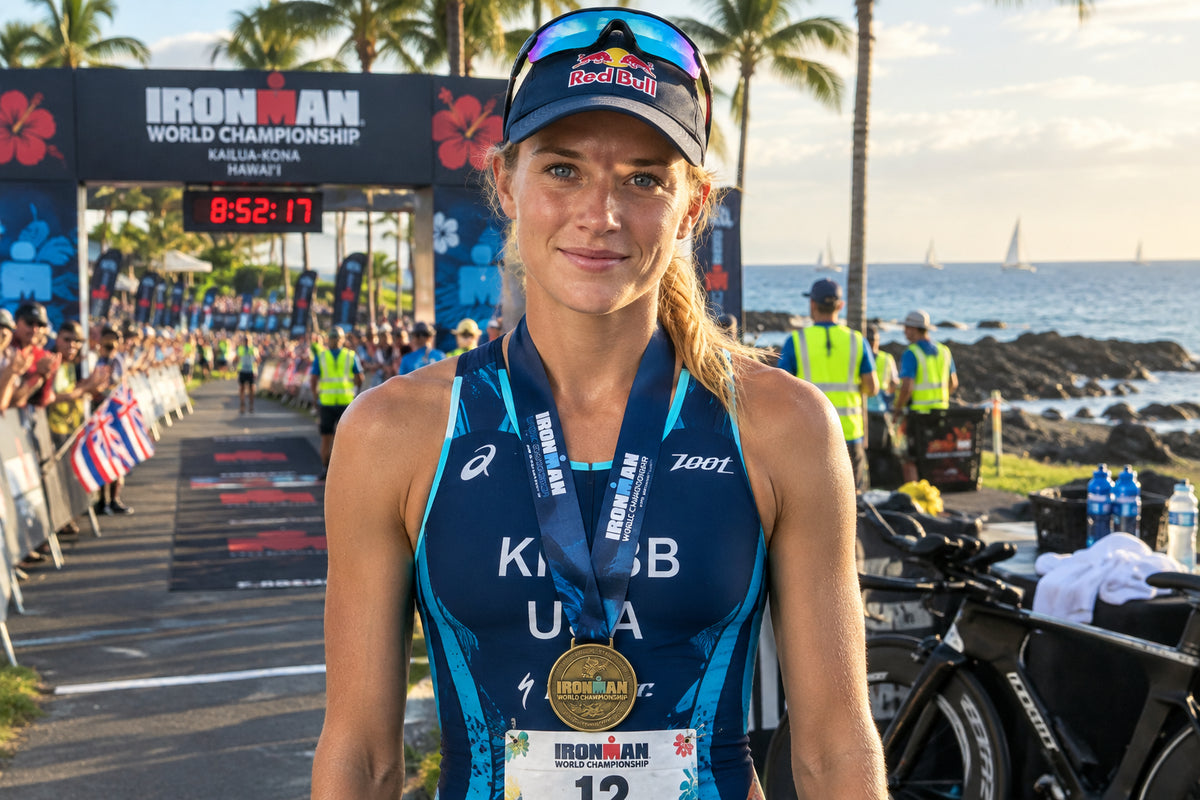
Only three women in history have won both the 70.3 World Championship and the long-distance world title in Kona in the same year. In 2026, Taylor Knibb became the third.
That achievement alone would make her season remarkable. She also won a short-course World Cup race, took the Gold Coast T100, and claimed the US national time trial title. Between her two world championship wins, she placed 13th in the individual time trial at the UCI Road World Championships.
Just 12 months earlier, Knibb had collapsed from heat-related issues in Kona’s closing miles. This is the story of how she came back—and what other triathletes can learn from her season, whether they’re chasing a podium or preparing for their first finish line.
This article draws on a feature by Brit Cooper in Triathlon Magazine (Canada), published October 31, 2026, with interviews from Knibb and commentary from Daniela Ryf and others.
Joining the Double Club
Before 2026, only two women had won both the 70.3 and long-distance world titles in a single year:
- Leanda Cave (2012)
- Daniela Ryf (2015, 2017, and 2018)
- Taylor Knibb (2026), now the third member
Few athletes know what this takes better than Ryf. She described the double as “an incredible achievement, not just physically but also mentally.” The Nice 70.3 adds two overseas flights to the challenge, alongside the work of preparing for two very different races.
Ryf also reflected on how Knibb appeared to handle the pressure: “From the outside, it almost looks like she doesn't feel it, but with Kona being such a big dream and coming so close last year, I'm sure she did. It reminds me a little of my own journey from 2014 to 2015.”
What Ryf admired most was that Knibb “genuinely enjoys racing and [doesn't let] the pressure take the joy away.” That idea of finding joy in the sport comes up throughout Knibb’s story.
A quick distance refresher
- 70.3-distance race: 1.9 km swim, 90 km bike, 21.1 km run
- Full-distance race in Kona: 3.8 km swim, 180.2 km bike, 42.2 km run
A Season Built on Versatility
The two world titles are only part of the story. Here’s a snapshot of Knibb’s 2026 triathlon season:
| Result | Format |
|---|---|
| First career World Cup win | Short-course |
| Gold Coast T100 victory | Elite short-course series |
| US national time trial champion | Cycling |
| 13th, UCI Road World Championships individual time trial | Cycling |
| 70.3 World Champion (Nice) | Half-distance |
| World Champion (Kona) | Full-distance |
Knibb combined short-course speed, time-trial power, and long-distance endurance in one calendar year. The magazine asked, “Has any triathlete ever assembled such a diverse collection of victories in a single season?” Its answer was that this “may be the most remarkable display of versatility the sport has ever seen.” That’s the publication’s opinion, but it’s a hard one to dismiss.
Gwen Van Lingen summed up her reaction to the two world titles with an emphatic “Un-[expletive]-believable… you are a generational athlete.”
For newer triathletes, there’s a reassuring lesson here: you don’t have to specialize early. Knibb’s experience across different race formats may have helped her grow stronger in each one.
The Road Back to Kona
Knibb came agonizingly close to winning Kona in 2025 before withdrawing in the closing miles. After her heat-related collapse, she also had concerns about possible long-term effects. Returning to the same course took more than physical preparation. It meant rebuilding confidence, one step at a time.
Her description of the process was simple: “It was like a series of 'firsts' in terms of regaining confidence.”
Her confidence milestones
- Second place at the 70.3 World Championship in Marbella the previous fall. This was her return to top-level racing. Knibb said second place was probably what she could expect after doing little training between Kona and Marbella.
- Runner-up at a full-distance race in Texas. It was her first completed long-distance race since Kona and secured her qualification for the next Kona race. “I called Dan [Lorang] at the finish there to let him know I finished,” she recalled.
- A short-course block. With her Kona qualification secured, she raced in Alghero, Tiszaújváros, Edmonton, and London. She earned points toward LA 2028 qualification and won her first World Cup race along the way.
By the time she reached Kona, something had shifted. “I had actually forgotten my anxieties about finishing in Kona as the final milestone to really get past last year!”
There was still a very human moment of doubt when she arrived. Knibb and her mom went straight to a grocery store after landing. In a video that circulated on Instagram, her mom asked, “Is this where you went down last season?” It wasn’t quite the reminder Knibb needed.
Is Kona’s heat reasonable?
Knibb raised a pointed question about the conditions. Ask elite marathoners how they’d feel about running a hilly marathon in that heat, with a noon start, and you’d probably get an “outburst.” Yet triathlon not only accepts these conditions; the sport has come to revere them.
If you train in hot, humid places like much of Mexico, Central America, or Brazil, you already know that heat management is a skill you build—not something you can leave to chance. You can take a gradual approach too: start with a hot long run and a solid fueling plan, then work toward your first race in the heat.
Race Day: Disbelief, Guilt, and a Balancing of the Universe
Knibb’s race wasn’t a smooth, dominant performance. It was messy, and her reflections make that feel relatable.
She was throwing up again while running down Palani, after already being sick with 12 km to go. When someone told her that defending champion Solveig Løvseth was “stumbling” and that the race was hers, Knibb didn’t believe it. “I actually cannot control the vomit coming out of me! What world are we in that I'm suddenly going to turn this around and run a three-minute kilometre?”
Løvseth made it inside the final kilometre before faltering and lying down on the pavement. Knibb only knew the world title was hers after she ran past and saw what had happened.
As she turned onto Ali'i Drive, Knibb had one word for the moment: “It was surreal.” In her immediate post-race interview, she struggled to find more: “I'm stunned.”
Handling the guilt
“It was a little bittersweet because of how it happened… there [was] a little bit of guilt. There has to be a little bit of guilt, like, someone's race fell apart for this to happen.”
Mark Matthews offered a perspective that helped. He said it wasn’t karma, because that would suggest Knibb and Løvseth were bad people. Instead, it was “almost like a balancing of the universe.”
Knibb’s finish-line summary held both wonder and humor: “I couldn't have scripted that!” and “Solveig and I need to stop doing this!”
It was a shared moment between two athletes who understand how brutal the course can be. Feeling bittersweet about a win doesn’t make the achievement any less deserved.
The Team Behind the Win
Knibb was quick to credit the people who helped her, starting with her nutrition partner. “Allen [Lim] of Skratch produced 415 iterations of a gel just for me to finally find one that works! Not only that, but he actually made it on the Island.”
Gut issues have been a recurring part of her racing. Compared with past races, a little vomiting was, in her words, “a significant improvement.”
She also recognized the rest of her team:
- Lawrence and Gwen van Lingen: “They do more for me than I can explain.”
- Matt Bottrill: aerodynamics
- Julie Dibens: swimming
- Dan Lorang: coach and the running joke of the season
Lorang wasn’t in Kona this year, and Knibb joked that he brings bad luck. She began crashing in the Paris Olympic individual time trial just as his plane landed. He left for an altitude camp, and she performed well in the mixed relay. Before Kona, he told her it was a lose-lose situation: if she won while he was away, he could never come back. Knibb’s solution? “I told him he can come to a low-pressure race, and if things go well, we can build from there.”
Finding her why
“Everyone says you have to have a 'why.' And I think I found my 'why' during the race because I wanted to stop so bad, so many times… What really kept me going was how many people believed in me.”
You don’t need a perfect reason to begin. Sometimes your reason finds you at kilometre 35—and often, it has a lot of faces.
What’s Next: Follow the Excitement
Kona 2027 wasn’t originally part of Knibb’s plan. “When I thought I was coming second [in Kona], I knew I wouldn't be racing in 2027,” she explained. A runner-up finish would have meant qualifying again, which would have conflicted with her other goals. Winning earned her automatic qualification, making a title defense a realistic option.
She isn’t rushing to decide. A close friend has always encouraged her to follow the excitement, and what excites her can change. Knibb would love to return to the Olympics for an individual race she feels good about, and she loves Kona too.
Her philosophy is straightforward: “If something can fit into my schedule, and it brings me joy, why not.”
On being the greatest
Asked whether she’d like to be remembered as the greatest generational athlete of her time, Knibb gave an answer worth holding onto:
“I don't think you ever want to be the greatest, because if you are the greatest, period, hard stop, and no one better comes after you, you didn't do your job well… If someone can take [what you've done] and have a better career and just absolutely demolish everything you did, that's what you want.”
Your Takeaways From Knibb’s Season
You don’t need to be a world champion to use these ideas in your own triathlon career:
- Rebuild confidence in small steps. After a withdrawal, injury, or difficult race, set a series of achievable “firsts” instead of one huge comeback goal.
- Try different formats if you want well-rounded fitness. Short, fast races can sharpen your long-distance engine, and long-distance training can build your endurance for shorter events.
- Treat your support network as a performance tool. Let the people around you know what you’re working toward.
- Treat race-day adversity as information, not a verdict. Knibb threw up twice and still won.
- Keep the joy. Ryf noticed that Knibb’s enjoyment of racing is part of what keeps her coming back to compete.
Planning your own race season? Explore our race season essentials and race day travel gear for help with the logistics. If you’re new to triathlon, take a look at the first triathlon kit. Shopping for a training partner? Browse triathlon training gifts or gifts for triathletes. You can also explore triathlon lifestyle apparel.
Share your favorite Knibb moment or your own why in the comments. We’d love to hear it.
Reader FAQ
- Will Knibb defend her Kona title in 2027?
- It’s undecided. Her win gives her automatic qualification, which makes a return much more realistic, but she says 2027 is “very much to be determined.”
- Can you race short-course and long-distance in the same year?
- Knibb just did it at the highest level. For most age-group athletes, the key is to plan training builds and recovery windows carefully.
- How did she win Kona after finishing second in Marbella?
- Marbella was her first step back after a period of limited training. Over the following year, she completed a long-distance race in Texas, won a World Cup, and arrived in Kona with her confidence rebuilt.
What major titles did Taylor Knibb win in 2026?
Knibb won both the 70.3 World Championship in Nice and the long-distance world championship in Kona. She also won a World Cup race, the Gold Coast T100 event she contested, and the U.S. national time trial championship.
How rare is winning the 70.3 and long-distance world championships in the same year?
It is a rare achievement. Before Knibb’s 2026 double, Leanda Cave had achieved it in 2012, and Daniela Ryf did so in 2015, 2017, and 2018. Knibb became the third woman to join this group.
How did Taylor Knibb return to racing after her 2025 Kona collapse?
Knibb rebuilt her confidence in stages. She returned with a second-place finish at the 70.3 World Championship in Marbella, completed her first full-distance race since Kona in Texas, and then resumed short-course racing.
How did Taylor Knibb qualify for the 2026 long-distance world championship in Kona?
Her runner-up finish at the long-distance race in Texas secured her qualification for Kona, allowing her to focus on short-course racing afterward.
What other cycling achievements did Taylor Knibb have in 2026?
Knibb won the U.S. national time trial championship and finished 13th in the individual time trial at the UCI Road World Championships.
Will Taylor Knibb race in Kona again in 2027?
Knibb has not confirmed her 2027 plans. Her 2026 win gave her automatic qualification to return to Kona, making a title defence possible, but she said she would decide based on what fits her schedule and brings her joy.
What did Daniela Ryf say about Taylor Knibb’s world championship double?
Ryf called the achievement an incredible physical and mental accomplishment. She praised Knibb’s ability to handle pressure while continuing to enjoy racing and push the boundaries of the sport.
#TaylorKnibb #TriathlonWorldChampionships
Source: https://triathlonmagazine.ca/feature/taylor-knibb-a-champion-in-a-class-of-her-own/
Discover unique triathlon-themed merchandise, including stylish t-shirts, stickers, phone cases, and home decor - perfect for endurance sports enthusiasts and athletes. Shop now
 Dec 6, 2026IRONMAN 70.3 La Quinta
 Dec 6, 2026IRONMAN 70.3 Veracruz
 Dec 13, 2026IRONMAN 70.3 Florida
 Jan 23, 2027Tri Estacas
 Mar 6, 2027Triatlón La Paz
 Mar 14, 2027IRONMAN 70.3 Dallas-Little Elm