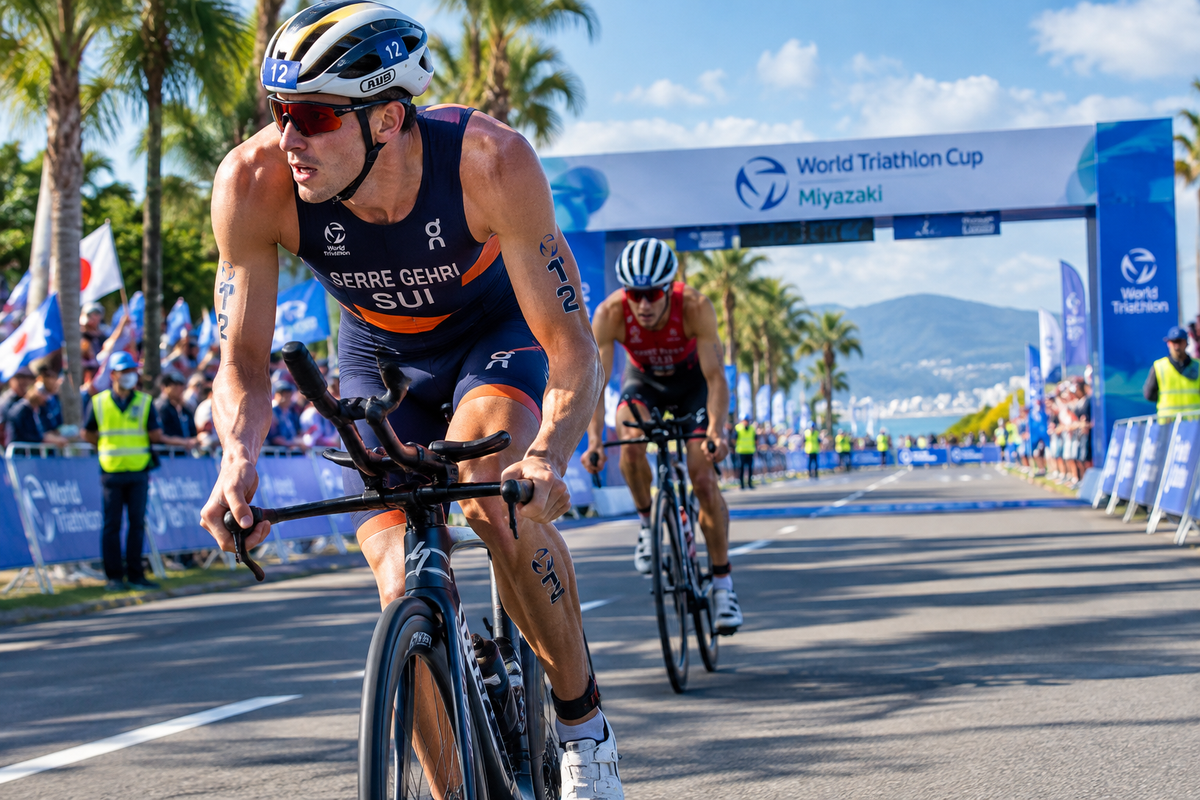
Seventh. Fifth. Second. First. That’s how Nils Serre Gehri (FRA) progressed through his first four World Cup races after making his World Cup debut in Miyazaki, Japan, a year ago. On 14 November 2026, he returned to the same course and won again. It was his second consecutive victory, one week after his race win in Hong Kong.
You don’t have to race at the elite level to learn from this Triathlon World Cup. Serre Gehri didn’t win by being the fastest swimmer or cyclist. He stayed in contact with the lead group, moved quickly through transition, and trusted a finishing strategy that had worked before. Those skills can help whether you’re lining up for your first sprint triathlon or your tenth.
Here’s how the race unfolded and what you can take into your next event.
The Race at a Glance
| Detail | Info |
|---|---|
| Event | 2026 World Triathlon Cup Miyazaki |
| Venue | Miyazaki Seaside Park, Japan |
| Date | 14 November 2026 |
| Swim | 750m |
| Winner | Nils Serre Gehri (FRA) |
| Silver | Izan Edo Aguilar (ESP) |
| Fastest swim | Takuto Oshima (JPN), 8:16 |
| Fastest bike | Toby Powers (AUS), 28:41 |
Race details are from World Triathlon’s official race report by Ben Eastman.
Section 1: A Rapid Start and Settling Into the Lead Pack
The Swim: Lose a Little, Stay in the Game
Takuto Oshima (JPN) set the pace, leading out of the 750m swim in 8:16. Serre Gehri exited the water 15 seconds behind, but still placed among the first ten athletes into T1.
That’s an encouraging reminder for newer racers: a 15-second swim gap doesn’t have to decide your race. In a short event, the goal is to stay close enough to the athletes you want to race with—not necessarily to lead the swim.
The Bike: Pack Racing at Pace
The first bike lap was described as “blistering.” A lead group formed quickly, including:
- Takuto Oshima (JPN)
- Nils Serre Gehri (FRA)
- Takumi Hojo (JPN), the Asian Games winner
- Xirui Zhang (CHN), a Beijing World Cup medallist
- Izan Edo Aguilar (ESP)
Toby Powers (AUS), an Asunción World Cup medallist, made what the race report called a “mammoth effort” to bring himself and others to the front. He recorded the fastest bike split of the day at 28:41.
For newer athletes: elite World Triathlon events are draft-legal, so athletes can legally ride together in a pack. Most age-group races are non-drafting, which means you need to maintain the required distance from the rider ahead. Check your event’s rules before race day. Staying connected to the right group matters in both formats, even though the rules change how you do it.
Serre Gehri said he didn’t feel at his best on the bike: I felt during the bike I was not 100%.
Even so, he made the lead group and stayed with it.
Section 2: T2 and the Run: Positioning for the Finish
Transition Speed Is Free Time
Sebastian Wernersen (NOR) led the group into T2. Serre Gehri then recorded the fastest T2 of the field, starting the run “right on Wernersen’s shoulder.”
Transitions are an often-overlooked place to save time. Serre Gehri didn’t need to run faster than anyone to gain this position. A quick, tidy T2 helped him turn his bike position into a strong start on the run.
Sitting In and Waiting
As Wernersen faded, Edo and Zhang became Serre Gehri’s main challengers. Edo increased the pace until Zhang was dropped, leaving two athletes at the front.
Serre Gehri didn’t surge past. He stayed on Edo’s heels. Following a rival lets you use their pace while saving energy for the moment that matters. It takes patience and trust in your own finishing speed—especially when your instinct is telling you to attack.
Section 3: The Finish: A Repeat of the Hong Kong Tactic
Clamped on “Like a Limpet”
As the finish approached, Serre Gehri stayed glued to Edo “like a limpet.” He had been in the same position a week earlier in Hong Kong, where he beat Callum McClusky (AUS) in a sprint finish. The race report summed up his approach simply: If it ain’t broke, don’t fix it.
Here’s how the finish played out:
- He rounded Edo at the start of the blue carpet.
- He checked over his shoulder.
- He accelerated, and Edo couldn’t match him.
Edo took silver, matching his best World Cup finish. Zhang crossed 9 seconds later to earn his second career medal on the circuit. Powers finished 4th, ahead of a tight group of Peter Luftensteiner (AUT), Carter Stuhlmacher (USA), Chase McQueen (USA) and Wernersen.
The Lesson: Repeatable Beats Flashy
The key takeaway: a finish you’ve practised and trust can be a real weapon. Serre Gehri didn’t need to improvise; he used a plan that had worked seven days earlier. Fitness can get you to the front, but a repeatable plan can help you win a close race.
Section 4: Racing Through Fatigue
After the race, Serre Gehri spoke openly about how he felt:
“I'm super happy with the win. I think I did a correct race, but I felt during the bike I was not 100%, I think I'm a bit fatigued with all the races from the season. So I just tried to do the best result possible with the shape of the day.”
Even a World Cup winner doesn’t always feel great on race day. What stands out is his mindset: do the best you can with the shape of the day. He didn’t chase a perfect performance. He raced the body he had.
If you’re juggling a busy triathlon season, that’s worth remembering. These are general coaching principles, not statements from the athlete:
- Set a realistic goal for the day. Sometimes “stay in the pack and finish strong” is the right target.
- Plan recovery time between big events, especially when you’re travelling to race.
- Pack smart for travel weeks. Our race-day travel gear can make back-to-back race weekends easier to manage.
Section 5: A Double Day for France
Serre Gehri’s race victory came on the same day as Ilona Hadhoum (FRA) won her first World Cup in the women’s race. Both athletes are World U23 champions, giving France a double victory in Miyazaki.
What You Can Borrow for Your Next Race
You don’t need an elite field to try these ideas:
- Stay in contact with the first group out of the water. You don’t need to win the swim. Focus on staying in touch.
- Practise T2. Set up your shoes properly, rehearse your run-out and save seconds in training. If you’re building your setup, our first triathlon kit collection can help you cover the basics.
- Sit in before you strike. In the last kilometre, follow a rival running just a little faster than you, then choose your moment.
- Rehearse your finish. Add short sprint-finish efforts to your run sessions so your kick is a skill, not a hope.
- Race the day you have. Fatigue is part of a season. Adjust your goals instead of abandoning them.
Building your season? Browse race season essentials for gear that can support a long calendar, or find triathlon training gifts for a training partner.
Quick Answers
- What is a World Cup in triathlon?
- It’s a tier of World Triathlon racing below the World Championship Series and an important step for emerging elite athletes.
- What does “back-to-back” mean here?
- Serre Gehri won two consecutive World Cup races: Hong Kong on 7 November, then Miyazaki on 14 November.
- What is a “limpet” tactic?
- It’s when an athlete stays close behind a rival until the final sprint, saving energy before making a late move.
- Why sit on a rival’s pace?
- Following lets the athlete in front do the pacing work while you save energy for the finish.
Conclusion: The Streak Is the Story
Seven days, two wins, and the same finishing plan both times. Serre Gehri’s progress from 7th to 1st wasn’t built on one lucky day. It came through steady improvement, quick transitions, smart positioning and a finish he trusted.
You can use these ideas whether you’re racing in Miyazaki, Asunción or your local park. World Triathlon’s race report is also available in Español on its site. And with Spain’s Izan Edo Aguilar taking silver, there was plenty to celebrate across the Spanish-speaking triathlon community.
Your next step: choose one skill from this article—T2, a finishing kick or a recovery plan—and work on it in your next training week. Then tell us in the comments: what’s your go-to finish-line strategy?
Shopping for a fellow triathlete? Browse our gifts for triathletes or explore everything.
#MiyazakiWorldCup #NilsSerreGehri
Source: https://triathlon.org/news/nils-serre-gehri-goes-back-to-back-with-miyazaki-win
Discover unique triathlon-themed merchandise, including stylish t-shirts, stickers, phone cases, and home decor - perfect for endurance sports enthusiasts and athletes. Shop now
Who won the men’s 2026 World Triathlon Cup Miyazaki race?
Nils Serre Gehri of France won the race, earning his second consecutive World Cup victory.
Who finished second and third in Miyazaki?
Izan Edo Aguilar of Spain took second, and Xirui Zhang of China finished third. Zhang crossed the finish line nine seconds after Edo.
How did Nils Serre Gehri secure the win?
Serre stayed close to Edo during the final run, then made a late sprint on the blue carpet to pass him near the finish.
What was Nils Serre Gehri’s progression at Miyazaki before this victory?
Since his World Cup debut in Miyazaki one year earlier, Serre had finished seventh, fifth, second and then first on his return in 2026.
Who recorded the fastest bike split in the race?
Toby Powers of Australia recorded the fastest bike split, finishing the leg in 28 minutes and 41 seconds. He placed fourth overall.
Where and when was the 2026 World Triathlon Cup Miyazaki held?
The event took place at Miyazaki Seaside Park in Miyazaki, Japan, on 14 November 2026.
 Nov 15, 2026IRONMAN 70.3 Qatar
 Nov 15, 2026IRONMAN 70.3 San Salvador
 Nov 29, 2026Challenge Florianópolis
 Dec 5, 2026IRONMAN 70.3 Oman
 Dec 6, 2026IRONMAN 70.3 La Quinta
 Dec 6, 2026IRONMAN 70.3 Veracruz