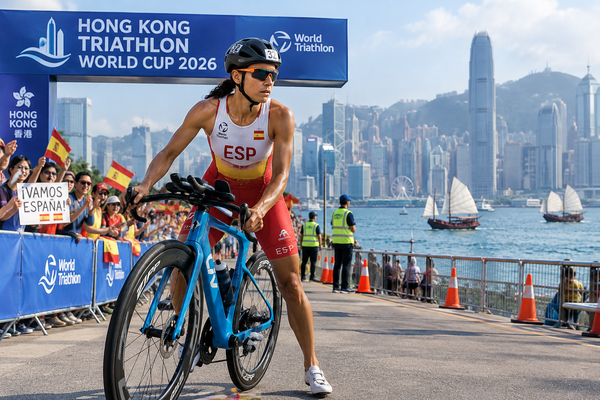
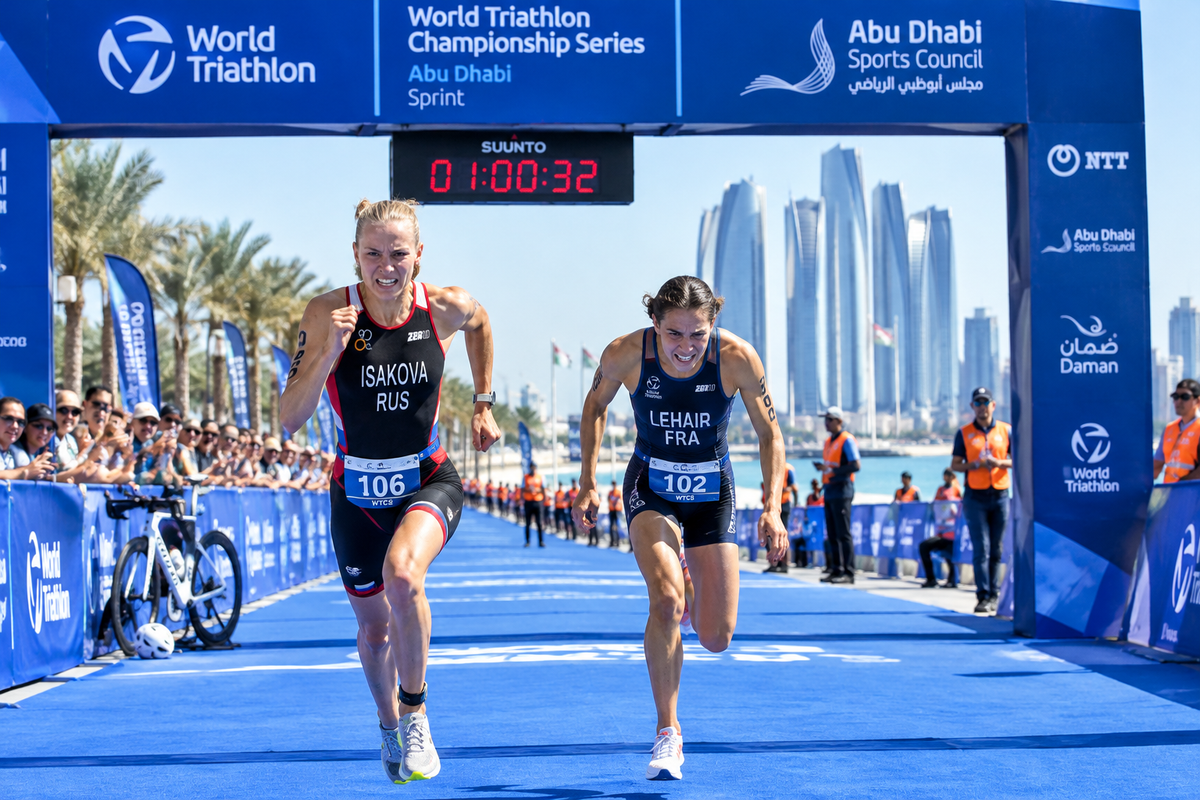
Diana Isakova won the women’s elite race at WTCS Abu Dhabi, outsprinting Jeanne Lehair to cross the line in 55:55. It was a repeat of their recent World Triathlon Cup Hong Kong showdown, where Isakova also edged Lehair in a sprint finish. Lehair came to Abu Dhabi hoping to change the outcome. She came up three seconds short.
WTCS stands for World Triathlon Championship Series, the top tier of World Triathlon racing. This Abu Dhabi event, held in the UAE, was originally scheduled for earlier in 2026 but postponed because of unrest in the Middle East. Athletes had to adjust their plans as well as prepare for a demanding race.
Here’s how the triathlon unfolded, from a current-swept swim to a nail-biting finish, plus practical lessons age-group athletes can use in their own racing.
Race details come from the Triathlon Today race report, linked at the end.
A Rough Start in Abu Dhabi
A rescheduled race can challenge athletes before the start. Many build their season around key events, so a postponement can mean adjusting training and deciding when to aim for peak fitness.
The swim brought another challenge: a strong current from the start. Brazil’s Vittoria Lopes handled the conditions well, led a strung-out field and was first out of the water.
Takeaway: Open-water skills matter most when conditions become unpredictable. Lopes turned a challenging swim into an early advantage.
Nine Leaders Build a Gap on the Bike
The race began to take shape almost immediately on the bike, as nine women formed a lead group:
- Vittoria Lopes
- Eve Whitaker
- Diana Isakova
- Ana Carballo Gómez
- Laura Lindemann
- Jeanne Lehair
- Angelica Prestia
- Sophie Evans
- Sara Guerrero Manso
Across five windy laps, the group worked together smoothly. Its lead over the chasing pack grew from around ten seconds to well over thirty seconds by T2. T2 is the second transition, where athletes change from cycling to running.
It’s a bit like a paceline on a group ride: when everyone takes a fair turn, the group can move faster than any one rider could alone. In windy conditions, that cooperation can make an even bigger difference—and gave the nine leaders a strong chance at a podium finish.
The Run Begins and the Field Splits
With five kilometers to run, Isakova—fresh off her Hong Kong win—immediately took the initiative. Whitaker and Lehair followed closest. Both tried to close the gap in the opening kilometers, but Isakova kept a cushion of about four seconds.
Then the field began to split:
- Whitaker was the first to fade under Isakova’s pace.
- Lehair caught Isakova at the halfway point.
After bridging the gap, Lehair tucked into Isakova’s slipstream: the space directly behind another runner, where an athlete may save energy by reducing wind resistance. The race report suggests Lehair may have been conserving energy—or simply responding to a relentless pace.
One moment caught the eye. Lehair motioned several times to the lead motorbike to move forward and leave more distance between it and the two frontrunners. The report doesn’t explain why, so the reason remains unclear. It may have been a request for more room as the race approached its finish.
The Final Kilometer Showdown
The last kilometer was a thriller. The two athletes ran shoulder to shoulder, then single file.
After losing to Isakova in the Hong Kong sprint, Lehair wanted a different result. She launched the first surges—short, sharp accelerations designed to disrupt a rival’s rhythm. Isakova matched each one and stayed in control.
Before they reached the blue carpet of the finishing chute, Isakova opened a gap of a few meters. That proved decisive.
Final result:
| Place | Athlete | Gap |
|---|---|---|
| 1 | Diana Isakova | 55:55 |
| 2 | Jeanne Lehair | +0:03 |
| 3 | Gwen Jorgensen | +0:28 |
Jorgensen secured third after an excellent run, finishing 28 seconds behind the winner.
What Comes Next
Isakova has now beaten Lehair in consecutive races: first in Hong Kong, then at WTCS Abu Dhabi. Lehair continues to compete near the front, so this women’s triathlon rivalry may have more chapters ahead.
4 Lessons Age-Group Athletes Can Take From Abu Dhabi
You don’t need a pro triathlete’s engine to use these ideas on race day.
- Cooperate when it helps everyone. Taking fair turns in a group can be more efficient than riding alone, as long as your event’s drafting rules allow it. Check the rules before race day.
- Be patient, then bridge. Lehair didn’t panic when Isakova opened a gap. She caught her at the halfway point and used the slipstream to save energy.
- Practice your finish. The race came down to a final kick. Try adding a few strides or short surges at the end of some hard run sessions.
- Stay flexible. Race postponements happen. A backup training plan can help you adapt and stay ready.
Building your first race kit? Our triathlon gear collection is a place to start, while race season essentials covers gear for the rest of your event prep. For run-focused options, see running gear gifts.
Resumen rápido en español
Para nuestra comunidad en México y Latinoamérica: Diana Isakova ganó el WTCS Abu Dhabi con un tiempo de 55:55, tras superar a Jeanne Lehair por tres segundos en el sprint final. Gwen Jorgensen terminó tercera, a 28 segundos. La brasileña Vittoria Lopes lideró la natación, marcada por una fuerte corriente.
Conclusion: Same Finish, Higher Stakes
Isakova delivered another decisive sprint finish against Lehair. The nine-woman lead group built its advantage through teamwork on the bike, while Lehair tried patience and repeated surges to change the script. She still finished just three seconds behind the WTCS Abu Dhabi winner.
Who do you think will win the next Isakova–Lehair showdown? Share your prediction in the comments.
For more triathlon news and short course racing, read the original race report, the men’s WTCS Abu Dhabi recap and the Hong Kong results on Triathlon Today. For a Latin American race recap, check out Maria Velasquez's sprint win over Taylor Knibb at World Triathlon Cup Iquique. And if you’re preparing for your own season, browse our gifts for triathletes.
Source: Triathlon Today, “Sprinting Diana Isakova beats Jeanne Lehair again to win WTCS Abu Dhabi” (Tim Moria, November 13, 2026). Photo credit: World Triathlon.
Frequently Asked Questions
What does WTCS stand for, and who won in Abu Dhabi? WTCS stands for World Triathlon Championship Series, the top tier of World Triathlon racing. Diana Isakova won the Abu Dhabi sprint in 55:55. Jeanne Lehair finished three seconds behind, and Gwen Jorgensen took third, 28 seconds back.
How was the race decided? A nine-woman lead group worked together on the bike and built a gap of well over thirty seconds by T2, the second transition from bike to run. On the run, Lehair caught Isakova at the halfway point and tucked into her slipstream. She surged in the final kilometer, but Isakova matched every move and opened a few meters before the blue carpet of the finishing chute.
What can age-group athletes take from it? Take fair turns in a group when your event's drafting rules allow it, and check those rules before race day. Stay patient when a rival opens a gap, add a few strides or short surges at the end of some hard run sessions, and keep a backup training plan in case your race is postponed, as this one was.
Whether you race a sprint or work toward a long-distance triathlon, the same basics apply: handle the swim, cooperate where it's legal, and save something for the finish. Have a question we didn't cover? Leave it in the comments.
Who won the women’s race at WTCS Abu Dhabi?
Diana Isakova won the women’s race at WTCS Abu Dhabi, finishing in 55:55.
Who finished second and third at WTCS Abu Dhabi?
Jeanne Lehair finished second, three seconds behind Isakova, and Gwen Jorgensen took third, 28 seconds behind the winner.
How did Diana Isakova secure the win?
Isakova pulled clear of Lehair in the final kilometer after matching her surges, then maintained the advantage to win the sprint finish.
How did Jeanne Lehair challenge Isakova during the run?
Lehair bridged the gap to Isakova around halfway through the five-kilometer run, stayed close, and launched several surges in the final kilometer. Isakova responded to each one.
What were the conditions like at WTCS Abu Dhabi?
The athletes faced a strong current during the swim and windy conditions across the five bike laps. The race had also been postponed from earlier in the year because of unrest in the Middle East.
Who led the swim at WTCS Abu Dhabi?
Brazil’s Vittoria Lopes led the swim and was first out of the water, navigating the strong current effectively.
Which athletes formed the leading group on the bike?
The nine-rider group included Vittoria Lopes, Eve Whitaker, Diana Isakova, Ana Carballo Gómez, Laura Lindemann, Jeanne Lehair, Angelica Prestia, Sophie Evans, and Sara Guerrero Manso.
Did Isakova and Lehair race each other recently before Abu Dhabi?
Yes. Isakova had also beaten Lehair in a sprint finish at the recent World Triathlon Cup Hong Kong, making the Abu Dhabi result a repeat of their close battle.
 Jan 30, 2027Challenge Sir Bani Yas
 Nov 15, 2026IRONMAN 70.3 Qatar
 Nov 15, 2026IRONMAN 70.3 San Salvador
 Dec 5, 2026IRONMAN 70.3 Oman
 Dec 6, 2026IRONMAN 70.3 La Quinta
 Dec 6, 2026IRONMAN 70.3 Veracruz