Marten Van Riel's Lake Placid 2026 Triumph: A Masterclass in Long-Distance Triathlon
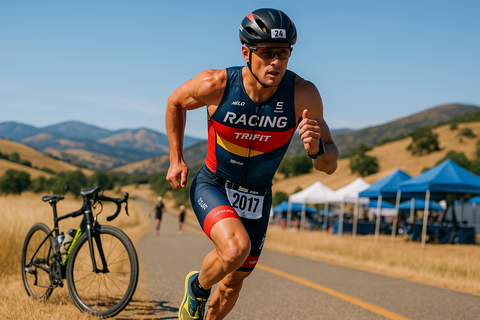
Belgian triathlete Marten Van Riel didn't just win at Lake Placid — he delivered a performance that announced his arrival as a genuine contender for the long-distance triathlon world title. From the opening strokes in Mirror Lake to the final meters of the marathon through New York's Adirondack Mountains, Van Riel controlled every phase of the race with the kind of calm authority that separates champions from contenders.
His winning time of 7:41:57 — a new course record — came in his first-ever full-distance (3.8km swim / 180km bike / 42.2km run) victory, making it all the more remarkable. If you're a triathlete yourself, whether you're chasing your first finish line or your fastest one, what unfolded at Lake Placid is worth studying closely. This wasn't just elite sport — it was a clinic in race strategy, energy management, and mental resilience.
Setting the Tone — Swim Dominance and Early Control
The Four-Man Lead Group Breaks Away
Long-distance triathlon can be won or lost in the swim — not because the fastest swimmer automatically wins, but because position dictates everything that follows. Van Riel understood this perfectly on Sunday.
In the warm but slightly choppy waters of Mirror Lake, four men separated themselves from the field almost immediately: Van Riel (BEL), Fraser Minnican (GBR), Tom Gordon (USA), and Ben Kanute (USA). The two Europeans set a blistering pace at the front, and by the halfway point — a brief "Aussie exit" where athletes touch land before re-entering — the lead group had already built an advantage of more than 90 seconds over the chasing pack.
Behind them, a nine-man American contingent including Matt Shafer, Matthew Marquardt, Jason West, and Rudy Von Berg worked hard to close the gap, but the damage was already done. By the time they exited the water, Shafer and Marquardt were +2:40 behind the leaders, while Von Berg, West, and Matt Collins trailed by approximately three minutes.
Swim splits at a glance: Van Riel 47:05 | Kanute 48:05 | Marquardt 49:49 | West 50:11
The Minnican Surprise — and What It Tells Us
Despite leading nearly every stroke of the swim, Van Riel wasn't the first athlete to exit the water. In a moment of tactical theater, Minnican surged past the Belgian in the final meters to exit in 47:04 — just one second faster. It was a small victory that would prove completely irrelevant within the first kilometer of the bike.
What the swim exit did confirm was this: Van Riel arrived at T1 (Transition 1 — swim to bike) with his body fresh, his rivals behind him, and his race plan perfectly intact. Aggressive but not reckless is exactly how you'd describe his approach to the water.
The Outlier That Raised Eyebrows
One name was conspicuously absent from the front of the swim field: Trevor Foley (USA). The Pro Series two-time winner in 2026 exited in 21st place, nearly four minutes down, with his deficit growing to more than eight minutes by T1. For anyone watching the race in real time, it looked like Foley's day might be over before it had truly begun. As we'll see, that assumption was premature.
The Bike Leg — Where Dominance Became Undeniable
Van Riel Retakes Control Immediately
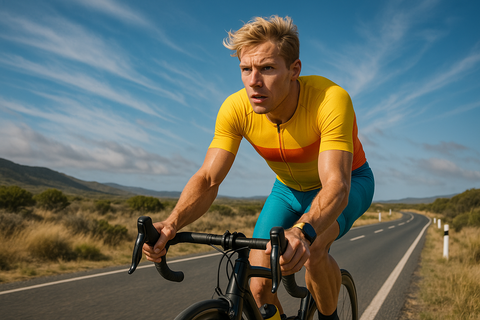
The hilly Adirondack Mountains bike course is no place for the faint-hearted. Winding through 180km of challenging terrain, it rewards power, technical skill, and intelligent pacing — exactly the kind of athlete Van Riel proved himself to be.
He retook the race lead from Minnican almost immediately after T1 and set about building a commanding advantage. The Briton, who had battled so gamely in the water, now began to fall back through the field at an alarming rate. By the 75km mark, Minnican had dropped from 1st to 12th place, nearly ten minutes behind — a dramatic reminder that a strong swim and a strong bike are entirely different disciplines.
Meanwhile, Kanute, Marquardt, and Von Berg moved up steadily, hunting the leaders with calm efficiency.
Foley's Remarkable Resurrection
Here's where the race became genuinely gripping. Foley — written off by many after his swim struggles — began weaving through the field like a heat-seeking missile. By 75.5km, he was in fifth. By 87km, he was fourth. The gap to Van Riel was still healthy at around six minutes, but the trajectory was unmistakable.
Foley was posting some of the fastest bike splits in the entire field. His final bike time of 4:14:06 was marginally faster than Van Riel's 4:14:46 — a jaw-dropping turnaround from a man who had left T1 in 18th place. A poor swim doesn't have to end your race. What you do on the bike and run is what ultimately determines the result.
The Marquardt Threat Builds
As Foley climbed through the standings, Marquardt quietly became the most dangerous man in the field. Starting the bike leg +2:44 behind Van Riel, the American chipped away steadily and relentlessly. The gap between them exceeded three minutes at one stage, but Marquardt never panicked and never let the Belgian disappear.
Van Riel appeared to ease his effort noticeably in the final 20km of the bike — whether as a deliberate energy-management strategy or a minor response to fatigue, the effect was the same. Marquardt surged. By T2 (Transition 2 — bike to run), the gap had shrunk to just +1:18.
The race was on.
T2 positions: Van Riel 1st | Marquardt 2nd (+1:18) | Foley 3rd (+7:24) | Kanute 4th (+7:29) | Von Berg 5th (+10:48) | Wurf 6th (+11:12)
The Marathon — Sealing the Record Books
Van Riel Shows He Still Had Plenty Left
When two athletes emerge from T2 separated by less than 90 seconds in a long-distance race, anything can happen. Marquardt had the momentum. He'd been faster on the bike. And with his strength as a runner — he would ultimately clock 2:37:24 — he had genuine reason to believe the win was within reach.
It wasn't.
From the early kilometers of the marathon, it became clear that Van Riel's bike "slowdown" hadn't been weakness — it had been chess. He was running in complete control, not pressed, not suffering. Marquardt tried to close the gap and briefly narrowed it to +1:22, but Van Riel had an answer every time the American pushed. By the 16km mark, the gap had grown back out to two minutes.
Van Riel went on to run 2:34:49 — a new Lake Placid course record — and crossed the finish line in a total time of 7:41:57, also a new course record. The margin of victory over Marquardt (who finished in 7:46:11) was 4 minutes and 14 seconds. Decisive, but not so overwhelming as to suggest a weak field. This was a champion beating genuinely strong competition.
The Battle for Third — Drama Included
While the top two positions were being settled, the race for third became one of the day's most compelling storylines.
Foley, who had appeared on course for a remarkable podium finish after his extraordinary bike leg, began to struggle on the run. At 35km, he was seen clutching his left hamstring and walking — a sight familiar to anyone who has pushed too hard on a long-distance bike and then asked their legs to run a 42.2km marathon immediately afterward.
Into the gap stepped Jason West — arguably the fastest runner in the field on the day. Starting the run in 8th place, more than 16 minutes behind Van Riel, West tore through the field. By 35km, he had powered all the way up to 3rd, overtaking both Foley (hamstring) and a fading Kanute. A first-ever full-distance podium looked certain.
Then came the heartbreak. West — who had DNF'd in his two previous long-distance starts — was seen lying in the road, apparently trying to stretch out cramping muscles. He got up and continued, but the damage was done. Kanute, buoyed by his rival's collapse, found a second wind and surged back to reclaim third place, crossing the line at +16:25 behind Van Riel. West held on for fourth.
It was a brutal, beautiful, and deeply human illustration of what long-distance triathlon can do to even the fittest athletes in the world.
Race Results and Pro Series Standings
Full Top-10 Results — Lake Placid 2026
| Pos. | Athlete | Nat. | Swim | Bike | Run | Total |
|---|---|---|---|---|---|---|
| 1 | Marten Van Riel | BEL | 47:05 | 4:14:46 | 2:34:49 | 7:41:57 |
| 2 | Matthew Marquardt | USA | 49:49 | 4:13:56 | 2:37:24 | 7:46:11 |
| 3 | Ben Kanute | USA | 48:05 | 4:21:44 | 2:43:48 | 7:58:23 |
| 4 | Jason West | USA | 50:11 | 4:28:11 | 2:37:19 | 8:00:44 |
| 5 | Rudy Von Berg | USA | 50:10 | 4:22:51 | 2:44:54 | 8:03:02 |
| 6 | Frederic Funk | GER | 51:27 | 4:27:53 | 2:39:00 | 8:04:29 |
| 7 | Cameron Wurf | AUS | 55:22 | 4:17:59 | 2:49:21 | 8:07:24 |
| 8 | Trevor Foley | USA | 55:21 | 4:14:06 | 2:55:34 | 8:09:52 |
| 9 | Dominik Sowieja | GER | 55:23 | 4:30:14 | 2:43:21 | 8:14:30 |
| 10 | Kristian Høgenhaug | DEN | 53:28 | 4:23:33 | 2:53:42 | 8:16:21 |
Pro Series Standings — Updated
Van Riel's victory earned him 5,000 Pro Series points, vaulting him to 2nd place overall with 12,408 points. He trails series leader Kristian Blummenfelt (NOR) by 1,734 points, with Rudy Von Berg (12,278) and Casper Stornes (12,244) close behind in 3rd and 4th.
| Pos. | Athlete | Nat. | Points |
|---|---|---|---|
| 1 | Kristian Blummenfelt | NOR | 14,142 |
| 2 | Marten Van Riel | BEL | 12,408 |
| 3 | Rudy Von Berg | USA | 12,278 |
| 4 | Casper Stornes | NOR | 12,244 |
| 5 | Ben Kanute | USA | 12,168 |
| 6 | Gustav Iden | NOR | 11,417 |
| 6 | Kieran Lindars | GBR | 11,417 |
| 8 | Trevor Foley | USA | 10,825 |
| 9 | Matt Hanson | USA | 10,813 |
| 10 | Kacper Stepniak | POL | 10,703 |
What Van Riel's Victory Signals for the Kona World Championship
Peak Form at the Right Time
Van Riel arrives at Kona as one of the most in-form athletes in long-distance triathlon — and with a course record under his belt in what was, remarkably, his first-ever full-distance victory. The fact that he achieved it at such an elite level, against a competitive American-heavy field, on a challenging mountain course, and with a margin of more than four minutes, speaks volumes about his current fitness.
Long-distance triathlon rewards athletes who can swim aggressively, manage their energy intelligently on the bike, and still run fast enough to hold off anyone who comes for them. Van Riel demonstrated all three capabilities in a single race. That's not a one-discipline show — it's a complete package.
Three Tactical Lessons From a Champion
For aspiring triathletes — whether you're targeting your first full-distance finish or chasing a podium at your age-group nationals — Van Riel's race offers a masterclass worth revisiting:
- Aggressive swim positioning pays dividends. Being in the front group from the start wasn't reckless; it was strategic. It gave Van Riel clear water, a psychological edge, and the ability to dictate tempo on the bike without chasing from behind.
- Intelligent bike pacing beats pure power. Van Riel visibly eased off in the final 20km of the bike. That willingness to let Marquardt close slightly — rather than blow up trying to hold every second of his lead — is what allowed him to run a course-record marathon. The bike is where triathlons are often lost; it's rarely where they're won.
- Mental composure under pressure is a skill. When Marquardt narrowed the gap to +1:22 in the early stages of the run, a lesser athlete might have panicked and pushed harder than their body could sustain. Van Riel held his rhythm, trusted his fitness, and let the gap rebuild organically. That's race maturity — and it comes from experience.
With 1,734 points separating Van Riel from Pro Series leader Kristian Blummenfelt, the Belgian is well within striking distance heading into Kona. A strong showing at the World Championship could reshuffle the standings dramatically.
The Blummenfelt Rivalry Heats Up
With 1,734 points separating Van Riel from Pro Series leader Kristian Blummenfelt, the Belgian is well within striking distance heading into Kona. A strong showing at the World Championship — where points are maximum — could reshuffle the standings dramatically. The Blummenfelt vs. Van Riel rivalry may well define the second half of the 2026 season.
The Competitive Stories Worth Remembering
Matthew Marquardt — The Persistent Challenger
It would be easy to overlook Marquardt's performance in the shadow of Van Riel's record-breaking win. Don't. Marquardt posted a faster bike split than the winner (4:13:56 vs. 4:14:46), ran 2:37:24 on the marathon, and closed a 2:44 swim deficit to within 78 seconds by T2. He finished in 7:46:11 — a time that would win many full-distance races outright.
Marquardt, the 2025 Lake Placid champion, showed that his presence at the front of this field is entirely legitimate. He simply faced a superior athlete on this particular day.
Frequently Asked Questions
Who won the long-distance triathlon at Lake Placid 2026?
Marten Van Riel from Belgium won the long-distance triathlon at Lake Placid 2026, securing a start-to-finish victory.
What was the winning time for Marten Van Riel?
Marten Van Riel completed the race in a time of 7:41:57, setting a new course record.
What distinct performances did Van Riel display during the race?
Van Riel led from the start in the swim and maintained his lead throughout the biking and running segments, showcasing his strong performance in each discipline.
Who finished in second and third place at the event?
Matthew Marquardt finished in second place, while Ben Kanute secured third place, finishing 16 minutes behind Van Riel.
What were the key challenges faced by the other competitors?
Competitors faced various challenges including a non-swimsuit race format, a hilly bike course, and fatigue during the marathon, with some athletes like Trevor Foley struggling to maintain their positions.