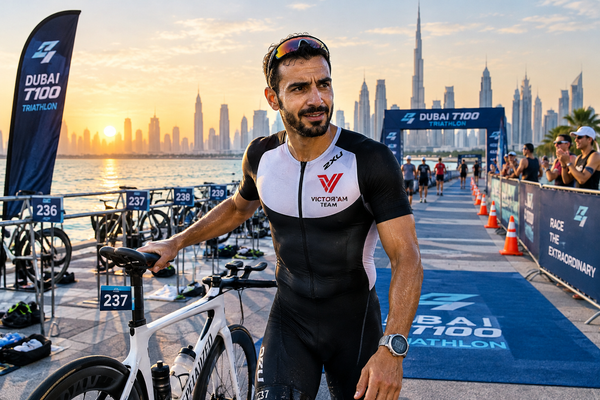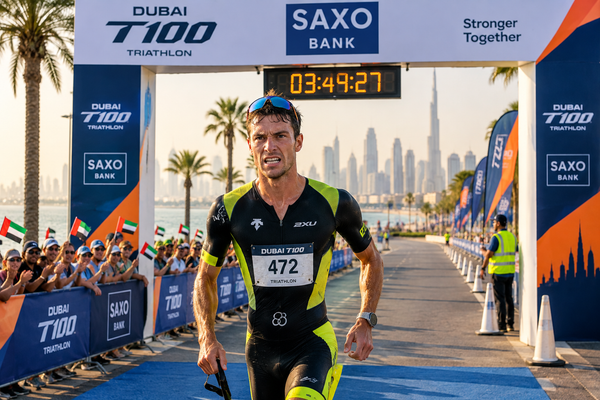
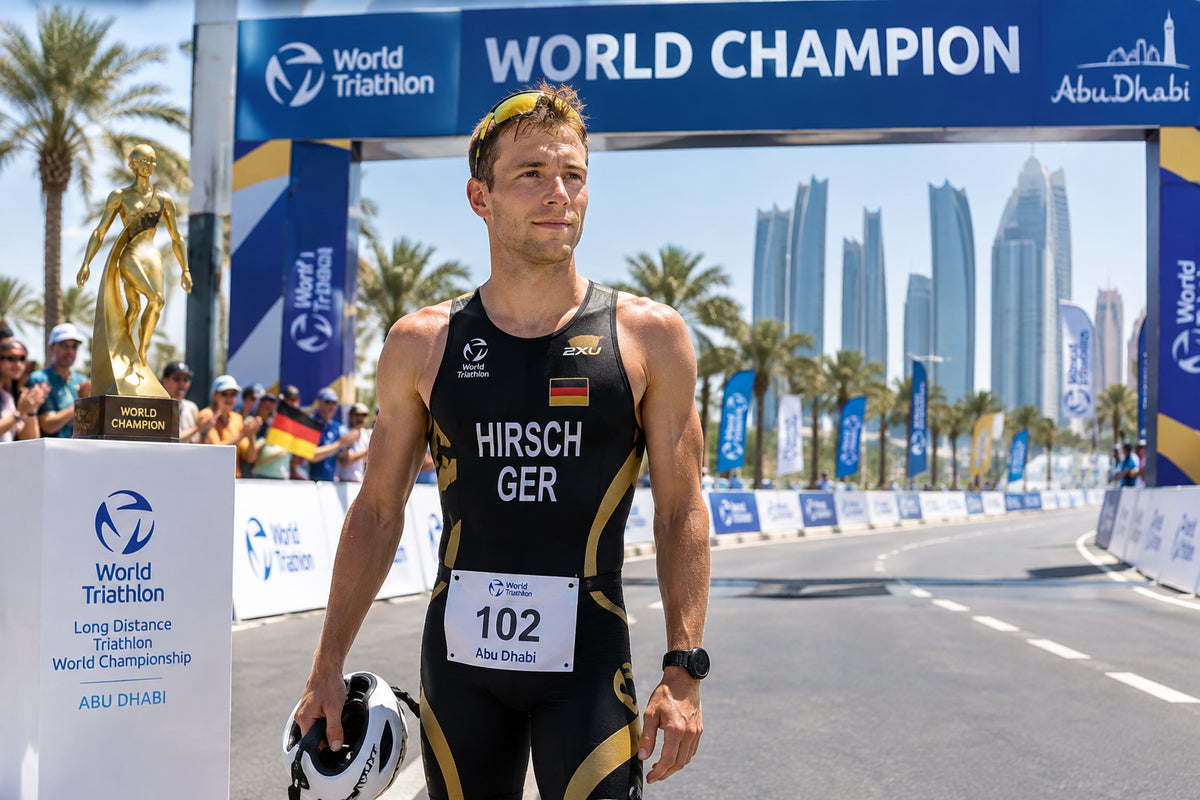
Six laps. Searing UAE heat. A 30km run with nobody in sight. That was Wilhelm Hirsch’s Sunday morning in Abu Dhabi. Germany’s newest Long Distance world champion began the race at the front alongside Spain’s defending champion, Antonio Benito. He finished more than five minutes ahead of the field, running alone.
The 2026 World Triathlon Long Distance Championships took place on 22 November 2026. Athletes raced a 3km swim, 120km bike, and 30km run. For Hirsch, the victory was his first world title at the distance—and a lesson in controlled racing, smart pacing, and adapting when the race changes.
Below, we look at the three stages of his race: the open-water swim, the bike, and the run. We’ll also explore what his approach can teach you about endurance racing. Race details come from Doug Gray’s report for World Triathlon and Hirsch’s post-race comments.
1. The Heat and the Plan: Hirsch Controls the Race from the Start
Taking the Lead in the Water
Hirsch didn’t wait to see how the race would unfold. He and Benito were quickly into their work, opening a gap on the first 1500m lap of the swim.
By the end of the 3km swim, the gap was significant:
- Well over two minutes on Louis Woodgate (GRE), Lukas Kocar (CZE), and Mikel Arrastate (ESP)
- Six minutes on Will Draper (GBR) and Bendix Madsen (DEN)
Why does an early gap matter? In a 3km swim, it’s more than a head start. It can mean riding without a group to follow, while the chasers have to spend extra energy trying to close the distance. Across a long-distance triathlon, small early advantages can grow.
Sharing the Pace on the Bike
On the 120km ride, Hirsch and Benito worked well together, taking turns at the front.
Swapping turns means two riders alternate who leads. The rider at the front takes on the harder effort, while the other gets a little recovery behind. Then they switch. Done well, pace-sharing can help both athletes move faster than they could alone.
Hirsch explained their plan after the race: I talked with Antonio before the race and we knew we wanted to work a gap to have a smooth run, but unfortunately I couldn't battle it out with him.
The goal was a smooth run, and their work on the bike helped create the cushion for it. Two rivals shared an objective, built a breakaway from the chasers, and left the final contest for later.
Managing the Heat
World Triathlon described the conditions as searing heat. If you’ve raced through a Mexican summer or another hot, humid climate, you know how heat can change the effort. Surges cost more, and recovering from mistakes can take longer.
Hirsch’s race shows why hot-weather pacing should be calculated, not reckless. He built a gap the field couldn’t close without emptying the tank too early.
Key takeaway: Controlled early aggression can beat panic pacing, especially in the heat.
2. Attrition on the Course: Injuries Reshape the Race
Madsen’s Early Exit
Not everyone made it deep into the day. Bendix Madsen (DEN) pulled out early on the bike with a foot injury he picked up during race week.
It’s a useful reminder for every athlete: the final week before a big race is for sharpening and resting, not taking unnecessary risks. A small niggle can become a race-ending problem when you add heat and distance.
Benito’s Injury and Hirsch’s Solo Run
The biggest change came early on the first run lap. Antonio Benito, the Spanish defending champion, pulled up injured, ending his race.
His exit left Hirsch free to settle into his rhythm and tackle the run alone. Hirsch had gone from racing a partner to racing the clock, which calls for a different mindset. With no one to chase or defend against, the focus becomes holding a consistent effort.
Kubo’s Dismount Tumble
Ondrej Kubo finished fourth despite a dramatic tumble at the dismount. The dismount is the moment a rider gets off the bike before transition. Tired legs and quick movements can make it a tricky point in the race.
Kubo got back up and still finished fourth, showing real resilience. For age-groupers, his race is a good reminder to practice dismounts when you’re tired, not only when you’re fresh.
3. The Solo Six-Lap Run: Controlled Power in the Final Stretch
How Hirsch Ran the Final 30km
With Benito out, Hirsch ran alone for most of the 30km. World Triathlon reported that he did it in style, looking controlled as he dug in across six gruelling laps. He crossed the finish line more than five minutes ahead of Draper.
Controlled doesn’t mean easy. Hirsch made that clear after the race:
The gap was quite comfortable but it was tough, especially over the last two laps. It's fast racing but it's tough racing, and I'm happy with the title.
A big lead removes some tactical pressure, but it doesn’t remove the work. The final laps still demand focus, fueling, and mental discipline.
The Fatigue Factor
Hirsch also shared that his season had been demanding: After Hawaii I've felt pretty tired. Now I'm back and heading to Australia and Qatar, so there are some races left, but for now I'm happy to be world champion.
That’s a helpful reality check. Even world champions deal with accumulated fatigue, and recovery and race selection matter alongside fitness. Hirsch still has Australia and Qatar on his schedule.
How to Pace a Solo Run: Lessons for Age-Groupers
You might not have a five-minute lead, but you’ll probably have stretches when nobody is near you. A few simple principles can help:
- Set your effort, not your position. Hold a target effort instead of reacting to the people around you.
- Break the run into chunks. Hirsch had six laps as checkpoints. You can use landmarks, aid stations, or laps to do the same.
- Save something for the end. Hirsch said the last two laps were the toughest. Plan to work hardest when it matters most.
- Don’t chase the clock too early. When you’re running without a rival, it can be tempting to push. Resist that urge.
4. The Podium Battle and the Next Generation
Will Draper: Closing the Gap
Will Draper had the toughest start, six minutes down after the swim. He then cut a minute off the leaders on the bike and closed in on third-placed Woodgate. Once he moved into silver, the podium never looked in doubt.
Draper couldn’t close the gap to Hirsch, but taking silver after such a deficit showed patience. He didn’t panic when he was behind; he let the race come to him.
Wojciech Kopyciński: Poland’s Young Star
Wojciech Kopyciński was five minutes back in fifth by the end of the bike. He moved up on the run, finishing three minutes behind Draper to take bronze. World Triathlon described him as Poland’s young star, and Kopyciński was delighted with the result.
Taking bronze after being fifth off the bike is a reminder that long-distance races are rarely settled before the run.
Louis Woodgate: A Young Athlete Under Pressure
Louis Woodgate (GRE) led the chasers out of T2 after holding third through the bike, though he couldn’t keep the gap below two minutes. He finished sixth. Losing places on the run is never fun, but it’s a common part of learning how to race the distance.
The Top Six at a Glance
| Place | Athlete |
|---|---|
| 1 | Wilhelm Hirsch (GER) |
| 2 | Will Draper (GBR) |
| 3 | Wojciech Kopyciński (POL) |
| 4 | Ondrej Kubo |
| 5 | Toon Marien (BEL) |
| 6 | Louis Woodgate (GRE) |
Key Takeaways
- Hirsch won through controlled pacing, not just raw speed.
- Working with a rival helped build the gap. Sharing the pace with Benito on the bike gave Hirsch the cushion he needed.
- Adaptability mattered. Injuries to Madsen and Benito, along with Kubo’s fall, reshaped the race. Hirsch adjusted without losing focus.
- The podium showed the depth of the field. Draper’s comeback and Kopyciński’s bronze made this more than a one-athlete story.
What You Can Take to Your Next Race
- Make a plan and a backup plan. Think about what you’ll do if a rival, your body, or the weather changes the day.
- Start controlled in the heat. Build your effort, but protect your energy for the later stages.
- Practice transitions when tired. Dismounts and T2 can be where fatigue shows.
- Respect race week. Rest and prevention are better than taking last-minute risks.
Preparing for a hot-weather race? Our race-day travel gear and race season essentials collections cover the basics. If you’re new to the sport, explore our triathlon essentials.
Hirsch’s next stops are Australia and Qatar, so keep an eye on his season. And if you’re curious about the Spanish side of the story, Benito is the defending champion. We’d love to hear how you follow the sport, whether in English, Spanish, or both. Share your own race-strategy stories with us.
#LongDistanceTriathlon #WorldChampionHirsch
Discover unique triathlon-themed merchandise, including stylish t-shirts, stickers, phone cases, and home decor - perfect for endurance sports enthusiasts and athletes. Shop now
Frequently Asked Questions
Who won the men’s 2026 World Triathlon Long Distance Championships in Abu Dhabi?
Germany’s Wilhelm Hirsch won his first long-distance world title in Abu Dhabi on 22 November 2026.
What were the race distances at the Abu Dhabi Long Distance Championships?
The race consisted of a 3km swim, a 120km bike ride and a 30km run.
Who finished second and third behind Wilhelm Hirsch?
Great Britain’s Will Draper finished second, and Poland’s Wojciech Kopyciński took third.
How did Antonio Benito’s race end?
Spain’s defending champion Antonio Benito Lopez withdrew after suffering an injury early in the run.
By what margin did Wilhelm Hirsch win?
Hirsch crossed the finish line more than five minutes ahead of runner-up Will Draper.
Where can I find results and live timing for World Triathlon events?
World Triathlon provides event results and real-time race timing through its Events and Live Timing pages at triathlon.org.
 Dec 5, 2026IRONMAN 70.3 Oman
 Dec 11, 2026IRONMAN 70.3 Bahrain
 Dec 11, 2026Qatar T100
 Jan 29, 2027Challenge Israman
 Jan 30, 2027Challenge Sir Bani Yas
 Jan 31, 2027IRONMAN 70.3 Nelson Mandela Bay