When Your Triathlon Gets Canceled: 3 Smart Ways to Salvage Your Season
You've been training for months — early morning swims, long weekend rides, back-to-back brick sessions. You've mapped the course in your head a hundred times. Then one email, one notification, one gut-punch announcement, and it's gone.
If you've been in triathlon long enough, you know this feeling. Race cancellations happen more than most athletes want to admit: extreme heat, wildfires, hurricanes, public health crises. You don't get a vote on whether the race goes forward. What you do get to decide is what happens next.
Coach Alison Freeman has lived this scenario more than once — and coached athletes through it even more. Her take isn't preachy or prescriptive. "I hate the word 'should,'" she says, "and grown-ups get to make their own decisions." What follows are three real options, each with honest tradeoffs, so you can make an informed choice when (not if) a canceled race lands in your inbox.
Option 1: Do the Race Anyway — But Run Three Reality Checks First
The instinct to race anyway is completely understandable. You've put in the work, you've earned the finish line, and the idea of packing that all away feels like a waste. But this option carries serious risk — more than most athletes in that emotional moment are willing to acknowledge.
Freeman tells the story candidly: "I was signed up for a long-distance triathlon in 2015, and with race-day temperatures expected to be well over 100 degrees, I told my husband, 'No matter what they decide, I am doing the full race anyway.' He responded with a look that made it clear he thought I'd completely lost my mind."
She now acknowledges he had a point.
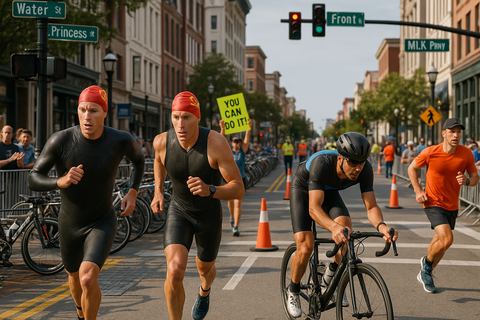
The infrastructure you take for granted is actually doing a lot of heavy lifting. Official race courses run because of safety personnel stationed throughout, well-stocked aid stations with trained volunteers, medical support on standby, coned bike lanes, and controlled intersections. Strip all of that away — especially on a day bad enough to trigger a cancellation — and you're looking at exponentially higher risk.
Before deciding to go self-supported, work through these three reality checks honestly:
- Safety of the course itself. If you're not local, don't assume. Swim conditions can shift unpredictably without course management. Bike course safety changes dramatically without traffic control. This isn't the day to make assumptions.
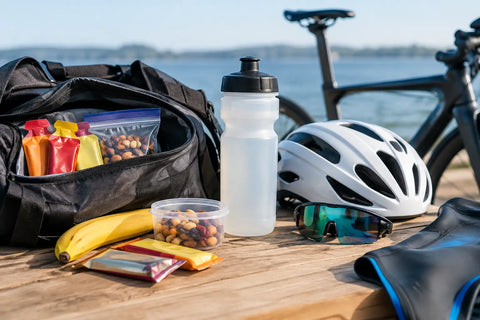
- Your ability to self-support the full distance. Can you carry — or resupply — enough fuel and hydration for your needs? On extreme-heat days, your electrolyte and hydration demands spike significantly. Most athletes underestimate this.
- Your emergency plan. What happens if you crash on the bike or have a medical issue on the run? Emergency response teams may already be stretched managing the same crisis that canceled your race in the first place.
The numbers tell the story clearly: even with full race infrastructure in place, roughly one in three starters ended up in the medical tent, and 22% didn't finish. As Freeman noted, "I did finish, but I could not have done so without the aid stations and volunteers."
When this option might make sense: you know the course intimately, conditions are genuinely mild, the distance is a sprint or Olympic, and you have a personal support team ready to shadow you. Even then, proceed with eyes wide open.
Option 2: Find an Alternate Race — But Watch Your Timing
Redirecting your fitness into a different official event is often the cleanest pivot available. You still get the race-day experience — the community, the support structure, the finish line — and your months of training find a proper landing spot.
Freeman did exactly this when a legendary 120-mile cycling event across three Colorado mountain passes was canceled days before the start due to wildfires. "I jumped into an Olympic-distance triathlon that same weekend," she says. Different distance, different sport — same fitness, same momentum.
The timing of your alternate registration matters more than most athletes expect.
- Same weekend or within 1–2 weeks: This is the sweet spot. Your fitness is peaked, your motivation is still running hot, and you haven't had time to fully decompress. The distance doesn't need to match your original race — it just needs to be within your current fitness range and logistically feasible.
- A few weeks out: Pause before clicking register. The initial fire that follows a cancellation announcement often fades faster than expected — and what's left can be fatigue rather than continued motivation.
- Months later: One of Freeman's athletes had her 70.3-distance race canceled in 2024 due to a hurricane and rolled her entry to a race several months later. "She ultimately found she didn't have the motivation to prolong her season through another round of half-distance training." The season extension that feels appealing in the moment can feel like a slog once the adrenaline fades.
Before registering for a substitute event, ask yourself honestly: Do I want to race, or do I feel obligated to use my fitness? Those are different motivations — and they tend to produce different outcomes.
Pro tip: If your substitute race falls weeks or months after your original, adjust your goals accordingly. Tapering for a race that didn't happen, then trying to optimize unexpected bonus training weeks, can sometimes yield a fitness boost — but just as often creates an awkward ending to an otherwise well-planned season.
Option 3: Create Your Own DIY Triathlon
When no official alternate race fits the window, or when you'd rather control the experience entirely, building your own event is more viable — and more satisfying — than you might think.
The case study that proves this comes from one of the most drawn-out cancellation sagas in recent memory. A long-distance triathlon race in Texas was first canceled in March 2020 (five weeks out, when COVID-19 made the call obvious), then again in fall 2020, then again in April 2021. Three cancellations. By the third one, Freeman and her athletes had had enough of waiting for official options.
"We created our own substitute event," she says. "DIY triathlons can sometimes be an even better option than official races, because you get to pick the date and the location and line everything up in the way that works best for you."
Build It Around What's Practical, Not Perfect
Don't chase exact replication of your original race distance. Planning routes with race-like GPS precision is harder than it sounds, and a few miles or minutes of variance won't change the challenge or the experience. Aim to be directionally appropriate — close enough that you get the stimulus and the satisfaction.
For the swim, strongly consider a pool over open water. Pools are safer without lifeguards and course management, easier to access, better for transition logistics, and often connect more cleanly to your bike route than a lake or ocean venue would.
For the bike and run, stick to familiar roads and paths you know to be safe. Map routes that pass markets or spots where your support crew can safely hand off fuel — these become your makeshift aid stations.
Rally Your Support Team
This is the element that transforms a solo workout into a race-day experience. Recruit family, friends, or teammates to set up coolers along the course, hand off nutrition, provide encouragement through the hard miles, and — critically — be there for the finish.
You'll be surprised how much a small crew of people cheering you through mile 18 of your run changes the psychological texture of the day. It's not an official race, but it's not just a training day either.
What the DIY Experience Actually Feels Like
Freeman is direct about this: "DIY events can feel a lot more like race day than you might expect. There's still the anticipation and dread of the long, arduous day and the usual weather concerns. You'll get encouragement from friends and teammates and push yourself to keep going even when you don't want to. And you'll have that incredible sense of relief when you cross the finish line."
The next morning, your legs will be wrecked, you'll eat everything in sight, and you'll have stories to tell. That's race day — official course or not.
The Decision Framework: Choosing Your Path
Still unsure which option fits your situation? Run through these questions:
| Question | What it tells you |
|---|---|
| Is my preferred option genuinely safe, or am I letting emotions override judgment? | Self-supported racing in unsafe conditions is rarely worth it |
| Do I want to race, or do I feel obligated to race? | Obligation-driven decisions often end in abandoned training cycles |
| Is my energy high or depleted right now? | Depleted athletes often overcommit to substitute races they later regret |
| Does extending my season serve my long-term training goals? | Not every season needs a late pivot — rest is sometimes the right call |
The quick-decision version:
- Alternate race available same weekend? → Option 2
- No races available + motivation is strong? → Option 3
- Extreme weather or safety concerns caused the cancellation? → Options 2 or 3 (not Option 1)
- Feeling tired and deflated more than fired up? → Consider rest and recovery before committing to anything
You Have More Options Than You Think
A canceled race is a gut punch. That's real. But it's a pivot point, not an ending.
The athletes who navigate cancellations best share a common trait: they make decisions based on honest self-assessment rather than sunk costs. Months of training are worth protecting — which is exactly why loading a canceled course on your watch in dangerous conditions isn't the way to honor them.
Three paths exist. One requires very careful safety evaluation and is rarely the right call. One channels your fitness into a different official event — most effective when the timing is tight. And one hands you full creative control over the experience — more authentic than it sounds, and sometimes the most memorable race you'll ever do.
As Freeman puts it: "Figure out what alternative option might fill your cup — and if it even needs to be filled at all. Then gather yourself, refocus, and turn those lemons into lemonade."
Your fitness isn't wasted. Your season isn't over. You just have a different race to plan.
Has your race ever been canceled? Share how you pivoted in the comments — what worked, what didn't, and whether the substitute ended up being better than the original. And if you're building out your race season, check out our triathlon suits, electrolyte supplements, and swimming goggles so you're ready to adapt when plans change.
Coach Alison Freeman is a USA Triathlon-certified coach with experience competing in and coaching athletes through everything from sprint-distance triathlons to long-distance events. This article originally appeared in Triathlete magazine.
Frequently Asked Questions
What should I do if my race is canceled?
You have several options: you can attempt to do the race on your own as a self-supported event, find another race to participate in, or create your own event at home. It's important to weigh the safety and logistics of each option before deciding.
Is it safe to do the race course on my own?
Before attempting to do the race course on your own, conduct an honest evaluation of the safety of the swim, bike, and run courses. Ensure you can support yourself with enough hydration and nutrition and consider the availability of emergency assistance.
How can I find a replacement race if mine is canceled?
Look for another race that is taking place on the same weekend or shortly thereafter. It doesn't need to be the same distance or discipline, just feasible based on your current fitness level and logistical arrangements.
What are some tips for organizing a DIY triathlon?
When planning a DIY triathlon, focus on selecting safe and familiar routes, potentially incorporating a pool swim for safety, and recruiting friends or family to help you with support and encouragement during the event.
What if I'm feeling exhausted after my race is canceled?
It's normal to feel fatigued after a race cancellation. Take some time to reflect and recharge before deciding whether to sign up for another event or create your own. Listen to your body and give yourself a break if needed.
Source: Triathlete Magazine — My Race Was Canceled: Can I Do It On My Own Anyway?