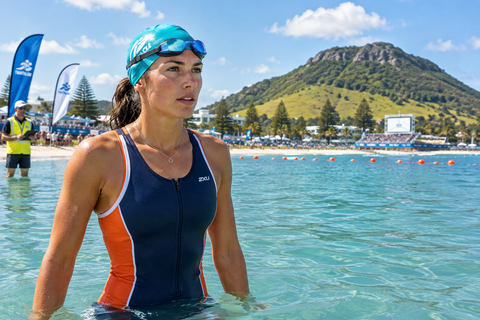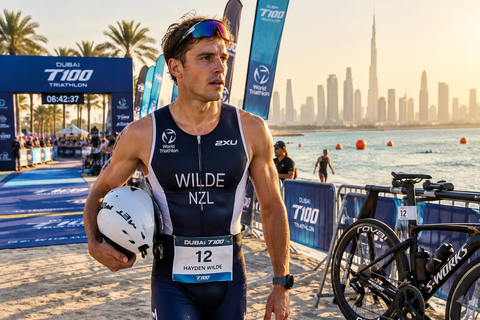

Two athletes crossed the finish line in Iquique, Chile, with the same official time. But the inaugural World Triathlon Cup Iquique could have only one first-ever champion. On Sunday, 8 November 2026, Colombia’s Maria Carolina Velasquez Soto outkicked Taylor Knibb of the USA in the final metres to claim the World Cup crown.
The race was shaped by much more than its sprint finish. Pacific swell made the swim start a challenge, 13 women shared the work on the bike, and a five-athlete run group narrowed to a duel for gold. Whether you’re preparing for your first sprint triathlon or following elite triathlon, there are useful lessons in this race.
This race report draws on World Triathlon's official race report. We’ll look at each discipline, then share ideas you can use at your own races.
A New Stop, a New Champion: Setting the Stage
An inaugural race creates a special place in race history: the first winner’s name stays in the record books. In Iquique, that name was Velasquez.
She arrived in strong form. About two months earlier, Velasquez won the sprint title at the South American Games. She also raced in San Pedro de la Paz the previous weekend, finishing sixth. Her Iquique victory was a major step up in just one week.
The race followed the sprint distance format: a 750m swim, a 20km bike and a 5km run. It’s the same format many beginners choose for their first triathlon, so it’s easy to connect with.
One notable absence made the women’s triathlon field harder to predict. Hungary’s Márta Kropkó placed second at both the Beijing and Tongyeong World Cups this season. She also led the swim in San Pedro a week earlier. But after an illness kept her unwell all week, she did not start in Iquique.
The takeaway: with a leading contender absent and a new venue on the Pacific coast, the race was wide open.
Reading the Pacific: The Swim
A heavy swell made the beach start a challenge of its own. The athletes had to push through breaking waves to reach open water on the single-lap 750m course. The course was simple, but the conditions made the swim tough.
The waves shaped the swim exit as well. Spain’s Ana Carballo Gómez and Italy’s Carlotta Missaglia read the sea well. They caught a wave on the way back and surfed toward the beach, gaining valuable metres. They recorded the two fastest swims of the day.
Imagine a skier following the fall line down a slope. The best route isn’t always the one that demands the most effort. It’s the one that works with the terrain.
Here’s how the swim unfolded behind the leaders:
- Close behind: Katie Rodda (GBR), Liis Kapten (EST) and Knibb were only a few seconds back.
- The next group: Velasquez, Annie Fuller (USA) and Manami Hayashi (JPN) were also within seconds. Velasquez and Fuller made the front group; Hayashi did not.
- A costly transition: Mexico’s Ana Maria Valentina Torres Gomez exited next. Her 56-second T1 (the swim-to-bike transition) left her further behind.
The swim gaps were small, but a slow transition was enough to leave Torres Gomez out of the front pack. If you’re preparing for your first sprint triathlon, this is a good reminder that practising T1 can pay off.
The takeaway: in rough water, reading the sea can matter as much as raw speed.
The Thirteen-Woman Bike Pack: The Bike
Four athletes tried to break away early: Carballo, Knibb, Missaglia and Kapten. Their move lasted less than one bike lap. Before the first lap ended, 13 women had joined up at the front and stayed together for the rest of the 20km:
Carballo, Missaglia, Rodda, Kapten, Knibb, Rosa Elena Martinez Melchior (VEN), Clara Carlquist (DEN), Marta Pintanel Raymundo (ESP), Velasquez, Fuller, Naomi Ruff (USA), Tjasa Vrtacic (SLO) and Aviv Levi (ISR).
The group shared the work, and every rider finished within 16 seconds of the fastest bike split: 28:43, set by Vrtacic and Levi.
A chase group fell about a minute behind. It included Hayashi, Eva Daniels (LUX), Annabel Morton (GBR), Diana Dunajska (SVK), Daryna Moskalenko (UKR), Sinem Francisca Tous Servera (TUR), Emma O'Brien (IRL) and home favourite Barbara Riveros (CHI). The gap left the podium battle to the 13 athletes up front.
A large, cooperative pack works much like a cycling peloton. Sharing the pace helps riders stay together, but it also makes it harder for anyone to build an advantage on the bike. That leaves the run to decide the race.
The takeaway: when the bike doesn’t split the field, the run can decide the result. Save some energy for it.
Five Become Three: The Run and the Sprint Finish
The run began with a few useful details:
- Quickest through T2 (the bike-to-run transition): Pintanel and Carballo.
- Knibb’s T2: 33 seconds, leaving her roughly eight seconds behind Velasquez at the start of the two-lap 5km run.
Knibb closed the gap quickly. The front group soon became five: Pintanel, Velasquez, Knibb, Carballo and Missaglia. Only three medals were available.
- 1 km to go: Pintanel was the first to be dropped, with Missaglia also falling away.
- 500m to go: Pintanel couldn’t follow the final push from Velasquez and Knibb.
- The final metres: Velasquez and Knibb sprinted for the line. Velasquez made the decisive move to take gold.
Knibb ran 16:03, the fastest run of the day, but that speed wasn’t enough to secure the win. A small deficit out of T2 and the sprint finish in the closing metres made the difference.
The rest of the podium and the top five were close, too. Pintanel held off Missaglia by two seconds for bronze, while Fuller finished fifth one second later. Just nine seconds separated the top five.
The takeaway: in a sprint triathlon, a few seconds in transition can affect the result. Knibb’s silver shows why T2 is part of the race, not a break from it.
What the Results Signal: Season Context
Iquique also offered several stories to follow across the Triathlon World Cup series:
- Taylor Knibb took silver less than a month after winning the long-distance world title in Kona. Winning a world title over a long distance, then challenging for sprint gold within weeks, shows impressive range.
- Annie Fuller finished fifth in only her second World Cup start, improving on her tenth-place finish at her debut the previous weekend.
- Marta Pintanel followed a podium in San Pedro de la Paz with bronze in Iquique, delivering two strong results in seven days.
- Barbara Riveros was the top Chilean in 17th on home soil. Daniela Moya Chamorro (CHI) finished 29th.
- Latin American athletes made their mark: Velasquez won, Martinez Melchior (VEN) placed seventh, and Elizabeth Bravo (ECU) ran her way up to 22nd. Torres Gomez (MEX) was in the mix in the swim, a positive sign of the region’s depth.
The field was strong throughout. Carballo, who led out of the water, finished sixth. Martinez Melchior, Ruff, Rodda and Vrtacic completed the top ten. Daniels led the chase group home in 14th with a 16:52 run. Carina Reicht (AUT) and Bravo had the strongest runs from the third group, climbing to 21st and 22nd.
The takeaway: the first Iquique World Cup brought a strong international field to South America, with close racing across the results.
Lessons You Can Use at Your Next Race
You don’t need to be an elite athlete to learn from Iquique:
- Practise open-water starts and surf entries. If you race in the ocean, practise running in, diving under waves and watching the swell before you swim. Train with a coach or a buddy, and never swim alone. Confidence in choppy water can make a real difference.
- Rehearse your transitions. Set up a mock T1 and T2 in your driveway or a local park, then time your practice. Free speed is the best kind.
- Ride smart in a group. If your race allows drafting, take a turn at the front and save energy for the run. If it doesn’t, follow the rules and pace yourself by effort.
- Save something for the final kilometre. The medals in Iquique were decided in the last 1,000 metres.
- Follow the race live. Use TriathlonLive to watch splits and timing in real time at upcoming events.
Getting ready for your first race? Explore our gifts for triathletes for useful essentials. If you’re heading to an event abroad, check out our race-day travel gear. Swimmers building open-water confidence can browse swim gear gifts. For more triathlon apparel and inspiration, visit our triathlon lifestyle apparel.
Final Thoughts: A Big Day for a New Venue
Velasquez became the first World Triathlon Cup Iquique champion through three key strengths:
- Sea-smart swimming: reading the swell mattered as much as raw speed.
- Pack riding: 13 women stayed together, sharing the work and keeping the front group intact.
- A closing sprint: a few metres at the end separated gold from silver.
Small margins decided the top five, with only nine seconds covering the group. That’s the appeal of sprint-distance racing: every detail matters. Iquique’s debut also gives South America a stronger place on the international calendar, and Velasquez’s victory is a major moment for Colombia.
Picture the finish: two athletes, the same official time, one champion. At your next start line, remember that races can turn on small things you can practise: a better start, a quicker transition or a stronger final push.
Ready to get after it? Read the full Iquique report and results from World Triathlon, and tell us in the comments about your most memorable swim start or transition. Join our newsletter for more race recaps and beginner-friendly training tips. ¡Vamos!
#Triathlon #IquiqueWorldCup
Source: https://triathlon.org/news/velasquez-outkicks-knibb-to-claim-first-ever-iquique-world-cup-crown
Discover unique triathlon-themed merchandise, including stylish t-shirts, stickers, phone cases, and home decor - perfect for endurance sports enthusiasts and athletes. Shop now
Who won the women’s 2026 World Triathlon Cup Iquique?
Maria Carolina Velasquez Soto of Colombia won the inaugural women’s World Triathlon Cup Iquique after a close sprint finish against Taylor Knibb of the United States.
Who finished on the podium in Iquique?
Maria Carolina Velasquez Soto took gold, Taylor Knibb finished second, and Marta Pintanel Raymundo of Spain placed third.
When and where was the 2026 World Triathlon Cup Iquique held?
The race took place on 8 November 2026 in Iquique, Chile, on the Pacific coast.
What were the distances in the women’s Iquique race?
The race featured a 750-metre swim, a 20-kilometre bike leg, and a two-lap, 5-kilometre run.
How close was the finish between Velasquez and Knibb?
Velasquez and Knibb were credited with the same time, with Velasquez making the decisive move in the final metres to claim the win.
Who recorded the fastest run in the race?
Taylor Knibb recorded the fastest run, completing the 5-kilometre leg in 16:03.
How did the Pacific Ocean affect the swim?
Heavy swell and breaking waves made the beach-start swim challenging. Ana Carballo Gómez and Carlotta Missaglia used a wave to surf toward the beach and move to the front of the field.
How many seconds separated the top five finishers?
Just nine seconds separated the top five athletes. Marta Pintanel finished third, two seconds ahead of Carlotta Missaglia, while Annie Fuller placed fifth one second behind Missaglia.