Mental Toughness Wins Kona: How Vincent Luis Stayed Strong When Every Other Champion Cracked
In a race that left some champions walking the marathon course and others surrendering hard-earned leads in the final kilometers, one man refused to crack. Vincent Luis — French, multiple short-course world champion, and a first-timer in Kona's fiery terrain — claimed the most prestigious long-distance triathlon title on his debut. It was simultaneously his farewell to professional racing. A debut, a win, a retirement — all wrapped into one scorching afternoon in Hawaii.
Why Nobody Saw This Coming
To appreciate Luis's victory, you need to understand the field he faced. Seasoned climbers, endurance machines, and heat warriors all lined up alongside a short-course specialist stepping into his first long-distance world championship. In any other context, that résumé might have made him an inspirational underdog story — nothing more.
The difference wasn't fitness. It was something harder to quantify: mental strength.
Windy conditions eliminated any chance of record-breaking performances, making raw speed less decisive from the gun. The notorious Hawaiian heat transformed the marathon into a brutal survival test where mental resilience became the decisive currency. And in that currency, Luis was unexpectedly wealthy.
Section 1: The Perfect Career Ending — Debut, Victory, Retirement
A Unique Career Path
It is rare for an athlete to debut at the pinnacle of their sport and retire on the same day. Most competitors spend years simply trying to reach that height. Luis chose a different arc: build an outstanding short-course career, then close it with one unforgettable chapter.
This path gave him a psychological edge that race analysts often overlook. Defending champions arrive in Kona with something to protect — a title, a ranking, a reputation. Luis showed up with nothing to lose and everything to gain. That absence of defensive pressure is a powerful force, especially when every athlete on the course searches for a reason to ease up.
Luis had no internal battles to fight. He was completely, irreversibly all in.
His short-course background — built on high-intensity efforts, tactical racing, and iron discipline — prepared him differently than the typical long-course approach. The mental fortitude forged through years of short-course world championship racing equipped him to push through pain without flinching.
Making the Jump from Short-Course to Long-Course
Common wisdom holds that short-course speed does not guarantee long-distance success. The disciplines demand fundamentally different attributes. Sprint and Olympic-distance racing rewards explosive power and tactical positioning; full long-distance racing tests pacing discipline, nutrition management, and heat tolerance across seven, eight, or even nine hours.
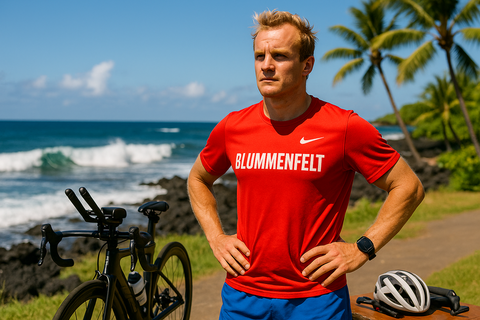
Kristian Blummenfelt — a decorated short-course champion and former long-distance world champion — finished 8th in this very race, underscoring that the transition is anything but automatic. What separated Luis from Blummenfelt on this day was not raw talent. It was his response to a race where sustained aggression became nearly impossible for most competitors. Luis adapted. Blummenfelt struggled.
Section 2: The Race — How It Unfolded, and Where It Was Won
The Swim: An Unusual Equality
Elite long-distance races typically open with a swim that creates meaningful early separation. Kona 2026 defied that pattern. Twenty-five athletes exited the water within 30 seconds of each other — an unusually large and cohesive lead pack. Belgian Marten Van Riel led with a time of 48:17, closely followed by Menno Koolhaas. Patrick Lange, Kristian Blummenfelt, Sam Laidlow, Florian Angert, Pierre Le Corre, and Vincent Luis all emerged together.
Notably absent from this pack were Gustav Iden, who lost 1:52 in the swim, and Magnus Ditlev, who dropped back by 2:01. Under different circumstances those gaps could have been pivotal. Race day had other plans.
The large lead group nullified traditional swim-to-bike tactics and placed every athlete at an equal psychological starting point for the bike leg. Execution — not positioning — would decide the race.
The Bike: Aggression, Cramps, and a Stunning Comeback
The bike leg produced dramatic narratives that both created and destroyed podium chances. Jonas Schomburg made the first bold move. After Koolhaas led the early stretch, Schomburg launched a solo attack and built a lead of over a minute and a half. It was daring — and costly. Midway through the leg, cramps struck and his lead dissolved.
Meanwhile, Magnus Ditlev — who started 2:01 behind the lead pack — mounted an impressive comeback. Around the 110-kilometer mark the Dane surged decisively to the front. By T2, Ditlev held a 1:30 advantage over Sam Laidlow, who had led the chase group throughout the second half of the bike. Here is how the field looked entering the marathon:
| Position at T2 | Athlete | Gap to Ditlev |
|---|---|---|
| 1st | Magnus Ditlev | — |
| 2nd | Sam Laidlow | +1:30 |
| 3rd | Matthew Marquardt | +2:23 |
| 4th | Gregory Barnaby | +3:34 |
| 5th+ | Blummenfelt / Luis | +6:00+ |
On paper, Luis appeared out of contention — six minutes down with a formidable race leader still looking strong. Kona 2026, however, was anything but a paper race.
The Marathon: When Mental Toughness Became Everything
The marathon delivered the full fury of the day — and the stage where Luis rewrote the script entirely. Laidlow was the first to falter. Starting the run in second place, he was walking within a few kilometers and ultimately retired due to injury. Ditlev appeared in control — until he was not. At the halfway point of the marathon he still held a 4:30 lead over Blummenfelt and Luis, who had steadily worked their way up from the back of the lead group, with Iden tracking closely behind.
Then came the collapse. Ditlev succumbed to the searing heat, walking repeatedly and staggering along the course. His lead evaporated with every passing minute. Luis dropped the struggling Blummenfelt and locked on to the fading leader. He passed Ditlev — a bittersweet moment for both men — and then faced one final threat.
Iden was closing fast. Just a minute behind Luis with only 5 km remaining, he was the fastest runner on the course. For a brief, tense stretch it looked as though the race might slip away. Then Iden began paying for his aggressive surge — slowing at precisely the cruellest possible moment.
Luis was described as "essentially the only man today who never cracked." He reacted decisively, widened his lead with every stride, and crossed the finish line in 7:47:27.
Iden finished second in 7:49:03, just 1:36 behind. Marquardt, who executed a patient race from start to finish, took third in 7:49:59.
Section 3: Why Luis Won — The Tactical and Mental Blueprint
The Pattern Nobody Could Miss
Look at what happened to the athletes who led the bike leg:
- Ditlev (race leader at T2): collapsed, finished outside the top 10.
- Schomburg (built a 1:30 solo lead): hit by cramps, finished 7th.
- Koolhaas (led early in the bike leg): faded to 10th.
- Van Riel (fastest swimmer, 7th at T2): deficit ballooned through the run.
Now observe the athletes who paced conservatively:
- Luis (6+ minutes back at T2): finished 1st.
- Marquardt (2:23 back at T2): finished 3rd.
- Barnaby (3:34 back at T2): finished 4th.
The data tells a clear story: athletes who pursued aggressive early positioning buckled under the heat, while those with disciplined pacing flourished by trusting the process.
The "Nothing to Lose" Advantage
Luis's victory also rests on a psychological element worth examining closely. Athletes who enter a race with a title to defend, a ranking to protect, or a reputation to uphold often make different decisions under pressure. They push when restraint is wiser, expend effort unnecessarily, or face internal conflicts that erode performance at critical moments.
Luis arrived at Kona for his first and last time. There was no next race to protect, no legacy to hedge. There was only the freedom to go entirely all in, armed with the discipline refined through a career full of short-course victories. That blend of freedom from expectation and supreme self-control is extraordinarily rare. We may never see it expressed in quite this way again.
Pacing Discipline as a Trainable Skill
Here is a practical takeaway from Luis's triumph: in brutal conditions, being behind at T2 can be a strategic asset. When you are six minutes down, the temptation to chase another athlete's pace weakens. You are forced to manage your own effort rather than burning out in pursuit of someone else's rhythm.
Ditlev, Schomburg, and Koolhaas were ahead — and that position pressured them to respond to every threat, guard their advantage, and sustain efforts the heat would not allow. Luis faced none of those dilemmas. Conservative early pacing in extreme conditions is not timid racing. It is strategic racing, and Luis executed it flawlessly.
Section 4: The Full Top 10 — A Race of Contrasts
| Place | Athlete | Time | Story |
|---|---|---|---|
| 1st | Vincent Luis | 7:47:27 | Never cracked; patient execution throughout |
| 2nd | Gustav Iden | 7:49:03 | Strong charge; faded in final 5 km |
| 3rd | Matthew Marquardt | 7:49:59 | Steady progression; consistent effort |
| 4th | Gregory Barnaby | 7:51:02 | Conservative bike; solid run |
| 5th | Pierre Le Corre | 7:53:29 | Reliable performance; no major issues |
| 6th | Sam Long | 7:55:21 | Consistent performance |
| 7th | Jonas Schomburg | 7:56:42 | Aggressive bike; struggled on the run |
| 8th | Kristian Blummenfelt | 7:58:07 | Overtaken by Luis mid-marathon |
| 9th | Youri Keulen | 7:58:26 | Consistent top-10 finish |
| 10th | Menno Koolhaas | 7:58:55 | Led initially; faded late |
The gap between 1st and 10th was just over 11 minutes — remarkably tight for an event of this length — illustrating how brutal the conditions were for every competitor. Within those 11 minutes, the divide between wise pacing and costly overreach is impossible to miss.
Section 5: What This Means — For the Sport, and for You
Kona's Reputation for Chaos, Confirmed
Long-distance triathlon's premier event has a long history of upending favourites and rewarding the unexpected. Windy conditions eliminated records before the race even began, and the heat turned the marathon into a war of endurance. The biggest names — Blummenfelt, Ditlev — could not dominate a race that demanded a different skill set entirely.
Kona does not reward the best athlete on paper. It rewards the athlete who is best prepared for that specific day.
That insight resonates with age-groupers tackling their first long-distance event every bit as much as it applies to world champions. Conditions can rewrite everything. Flexibility, patience, and heat management are race skills — not optional extras.
Short-Course Excellence Can Transfer — With the Right Preparation
Luis's victory challenges the belief that short-course speed simply does not translate to long-course success. It can — but as Blummenfelt's 8th-place finish demonstrates, translation never happens by default. The key lies in thorough preparation for the specific demands of long-course racing and in honestly resetting pacing expectations. Luis showed exactly what that looks like when executed with intelligence and humility.
Leaving at the Top: A Rare and Powerful Choice
There is something profoundly admirable about choosing to leave a sport at the peak rather than chasing a gradual decline. Luis's decision to retire after this victory, rather than returning to defend a title, lends his career a sense of completeness that is genuinely rare in professional sport. For fans, it is a reminder to appreciate greatness while it unfolds. For athletes reading this: what does your ideal career arc look like — and are you actively working toward it?
What Age-Groupers Can Take Home from Kona 2026
Whether you are training for your first sprint triathlon or preparing for your inaugural long-distance race, Luis's performance delivers immediately applicable lessons:
- Pace conservatively in the heat. Every athlete who held onto bike-leg aggression paid dearly on the marathon course.
- Trust your run. Patient riding can yield extraordinary dividends in the final stretch if your run training is solid.
- Develop mental toughness like fitness. Luis stayed composed while chaos erupted around him — a quality built through consistent training, racing exposure, and deliberately facing discomfort.
- Heat management is a race skill. Hydration strategies, cooling techniques, and knowing when to ease off in rising temperatures can separate a strong finish from a broken one.
- Being behind does not mean being out. Luis was over six minutes back at T2 and won by 1:36. Kona 2026 proves patience is not passive — it is strategic.
Frequently Asked Questions
Who won the long-distance triathlon World Championship in Kona in 2026?
Vincent Luis won the long-distance triathlon World Championship in Kona in 2026, marking it as both his debut at the event and his retirement from professional racing.
What were the main challenges faced by the athletes during the race?
The race was affected by windy conditions, which hindered record times, and several athletes struggled with the heat, leading to dramatic shifts in position during the marathon segment.
Which athletes were notable among the top finishers in the race?
In addition to Vincent Luis, notable finishers included Gustav Iden in second place and Matthew Marquardt in third. Other top finishers included Gregory Barnaby, Pierre Le Corre, and Kristian Blummenfelt.
What was unique about Vincent Luis's race strategy?
Vincent Luis maintained a steady pace throughout the race without succumbing to the pressure or heat that affected many of his competitors, ultimately allowing him to capitalise on their struggles and secure his victory.
Where can I find more information on upcoming events in triathlon?
You can find more information on upcoming triathlon events by visiting the race report and news sections of Triathlon Today at tri-today.com.