
The Energy Lab Lesson: What Magnus Ditlev's Kona Collapse Teaches Every Endurance Athlete About Pacing and Limits
By TriLaunchpad — Inspired by reporting from Jonathan Turner, TRI247 News Director
With less than 30 minutes left in the race and his greatest dream within reach, Magnus Ditlev's journey crumbled in mere minutes. What unfolded in the Energy Lab is a story every endurance athlete needs to understand — not just as spectacle, but as instruction.
The elite Danish triathlete had spent hours building what seemed like an unassailable lead during the long-distance triathlon World Championship in Kona, Hawaii. He appeared composed, strategic, and undoubtedly in control. But as he approached the Energy Lab, everything changed — not gradually, but in an instant.
"The lights suddenly went out," Ditlev shared on Instagram, a sentiment familiar to every endurance athlete, whether a rookie or a seasoned age-grouper. We've all experienced that moment when our bodies refuse to cooperate with our minds, even if it wasn't on such a grand stage or while watching a 4:33 lead slip away.
This is Ditlev's story, but it's also a reflection on what happens within each of us when we push the boundaries of ultra-endurance racing — and what we can take away from this painful near-miss.
A Champion in Control
Building a Dominant Position
Ditlev didn't start in front in Kona. After the 2.4-mile swim, he found himself just over two minutes behind the leader — a significant gap but not unmanageable in long-distance triathlon. During the 112-mile bike ride, he executed a strategic and patient approach, methodically closing the gap until he took the lead.
Small moments demonstrated his composure: when a water bottle fell from his bike, he took the time to hand it off to a race moto instead of leaving it behind. Such details reveal character under pressure. By Transition 2, Ditlev had built a clear lead over Sam Laidlow and Matthew Marquardt, with Vincent Luis and Kristian Blummenfelt trailing over six minutes behind.
Strategic Race Management
As he began the marathon, Ditlev wisely didn't let his lead make him reckless. He took the time to hydrate and cool down at the aid stations, managing the notorious Hawaiian heat. When Luis and Blummenfelt were 4 minutes and 33 seconds back, victory seemed within reach.
"On race day I executed my pacing, cooling and nutrition plan to the best of my ability and thought I stayed within my limits on the bike and run."
That phrase — thought I stayed within my limits — is crucial. He wasn't careless or dismissive of the plan; he was performing as optimally as one can over 140.6 miles in the Hawaiian sun.
The Illusion of Security
This makes what happened next all the more heartbreaking. As competitors pushed hard from behind, Ditlev maintained his lead deep into the marathon. It seemed like the preparation was paying off and the race was his to lose. But the difference between appearing in control and nearing collapse turned out to be alarmingly small.
"The Lights Suddenly Went Out"
The Moment Everything Changed
The Energy Lab is notorious in the triathlon world. Located on the Kona marathon course, it's an exposed, grueling stretch with intense heat and little shade — a mental and physical gauntlet that has caused even the strongest athletes to falter. Ditlev was returning from this section — around miles 18 to 19 of the marathon — when his body issued an undeniable ultimatum.
The transition was anything but gradual; it was almost immediate. He went from looking assured to struggling with his pace in what felt like no time at all. After momentarily recovering at an aid station, he picked up his stride — and then it all came crashing down.
The Physiology of Bonking
What Ditlev encountered is known among endurance athletes as bonking — a sudden and intense glycogen depletion that forces the body to shut down. When glycogen stores are critically low, fatigue becomes overwhelming, affecting both physical movement and mental clarity. You may feel okay, then manageable, then just fine — and suddenly, you don't.
Several factors likely contributed to Ditlev reaching that breaking point:
- 8+ hours of racing in Hawaii's extreme conditions
- Cumulative heat stress peaking in the exposed Energy Lab
- High sustained effort on the bike and initial run while holding a lead
- Individual metabolic variation — everyone metabolizes fuel differently, and no training can simulate race-day physiology perfectly
Even with precise fueling and preparation, something went awry beyond his control.
The Race Slipping Away
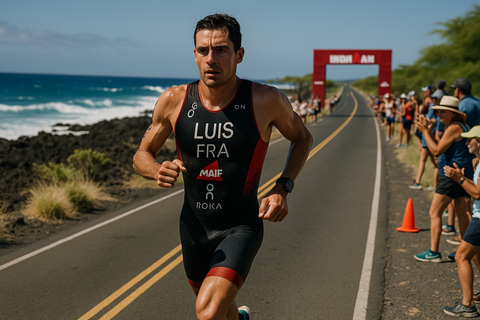
As Ditlev struggled, Luis kept closing in. By the 20-mile mark, Ditlev's once-solid lead of 4:33 had flipped — Luis was ahead by 1:49. The Frenchman, who had publicly stated this would be his final professional race, overtook Ditlev, who was now reduced to walking. The statistics present a cold reality; the emotional experience was far more human.
The Decision — Possible vs. Responsible
Why Stopping Was the Right Call
Ditlev's response in this critical moment reveals important traits about him as both an athlete and a person.
"I did everything I could to keep going but in the end, it was neither possible nor responsible to keep pushing."
This differentiation between possible and responsible is vital in ultra-endurance racing. In a world where a DNF carries a heavy psychological load, the urge to dismiss warning signs can easily override sound judgment. Ignoring such signals has led athletes to serious harm. Ditlev chose wisely — and that choice signals the maturity that will safeguard a long career.
What This Means for Amateur Athletes
If you're prepping for a long-distance triathlon or a 70.3-distance race, consider Ditlev's moment in the Energy Lab. Bonking is not a personal failure. It's a physiological occurrence that can ambush even the most prepared athletes. Know the warning signs:
- Sudden, unexplained loss of pace
- Difficulty concentrating or processing
- Heavy legs that resist effort
- Lightheadedness or disorientation
- An overwhelming desire to stop
If you notice these signals, slowing down or stopping is the smart choice — not an indication of weakness.
Two Years of Struggle, One Day of Leadership
The Road to Kona
To grasp the full weight of Ditlev's experience, it's essential to understand the journey that led him there.
"It's been a tough two years for me dealing with sickness and disappointing results. Over the past few months I felt that things were starting to turn around and I managed to prepare better and more meticulously for a race than I ever have."
This wasn't just an attempt at the world title — this was about coming back. A Danish athlete, after two tough years of illness and setbacks, arrived in Hawaii with the best preparation of his life. This story was ripe for triumph. And, in the most agonizing way, it came so close to being exactly that.
The Limits of Perfect Preparation
The uncomfortable truth Ditlev's story reveals is that preparation is vital, but it doesn't guarantee success. You can have the perfect pacing plan, a disciplined nutrition strategy, and months of training — yet still hit a wall that can't be foreseen. Individual physiology varies too much, and no training can completely simulate race conditions.
Kona is the ultimate test of this. As Taylor Knibb reflected on her own Kona experiences: "The island will always win." This is not a reason to abandon thoughtful preparation — it's quite the opposite. Ditlev's careful planning almost got him to victory. Prepare like he did, but also accept that race day will demand aspects that can't be completely practiced.
Grace, Hunger, and What Comes Next
Gracious in the Hardest Moment
What followed his collapse spoke volumes about Ditlev. He congratulated Vincent Luis — the eventual champion — and acknowledged the significance of Luis's win as the Frenchman's final professional race. Ditlev recognized this unique narrative without resorting to excuses or self-pity. No blame. Just honest reflection and respect for his competitors.
The Hunger Remains
"Leading this race for so long into the marathon is the craziest experience I've ever had and definitely leaves me hungry for next year!"
This isn't the language of a defeated athlete. This is someone who has discovered they belong at the forefront of this race and intends to leverage that knowledge moving forward. Leading in Kona deep into the marathon — even without clinching the win — is a lesson in itself. Ditlev now knows exactly where his limits lie and under what conditions they unfold. That understanding is invaluable, and it hasn't crushed his spirit.
What This Signals for His Future
Athletes who react to heartbreak with determination — who analyze failure with clarity rather than resentment — tend to return as stronger competitors. History has shown this repeatedly. Ditlev's ability to lead races, combined with his newfound understanding of his own limits, sets a promising stage for his future Kona endeavors. Watch for him in 2027.
What Every Endurance Athlete Can Take from Kona
Whether you are preparing for your first long-distance triathlon, aiming for a podium finish at a local 70.3-distance race, or simply seeking to complete your first half marathon without hitting a wall, Magnus Ditlev's experiences in Hawaii provide valuable lessons for everyone.
- Bonking is about physiology, not personal failure. It can affect even the most well-prepared athletes. Recognizing this helps eliminate shame and provides practical insight.
- Thorough preparation stacks the odds in your favor. Ditlev's discipline brought him near victory. Preparation is crucial, but it can't promise outcomes.
- Understand the line between discomfort and danger. Long-distance racing will challenge you. The challenge lies in recognizing normal effort from critical warning signals.
- Focus on pacing, cooling, and nutrition. Ditlev's strategy encompassed these three key areas. Give them dedicated attention in your race plan, especially for events in hot conditions.
- Wisdom and stubbornness are distinct. Choosing to stop when continuing becomes "neither possible nor responsible" is a matter of intelligence. Your health and career are more significant than any single race finish.
Final Thought
Ditlev reached Kona with a story to tell after two hard years. He built a commanding lead, managed the race, and followed through with his plan. Then, in the relentless Energy Lab heat — just 30 minutes from achieving his goal — the lights went out. He faced it with integrity, grace, and an immediate desire to try again.
This reflects perhaps the most crucial lesson: the athletes who shape long careers aren't always those who dodge heartbreak. They are the ones who absorb it, learn from it, and return with renewed wisdom and passion. Magnus Ditlev will be back in Kona. And when he returns, he'll do so as someone who knows exactly what it feels like to lead that race.
That is a formidable contender.
Interested in the gear, nutrition, and mindset essential for long-distance triathlon racing? Check out our race season essentials or browse the complete triathlon training collection for athletes chasing their next finish line. If you're just beginning, our first triathlon guide provides everything you need to approach the start line with confidence.
Cover photo: Magnus Ditlev during the 2026 Frankfurt race. Photo credit: Getty Images.
Frequently Asked Questions
What happened to Magnus Ditlev during the 2026 long-distance triathlon World Championship?
Magnus Ditlev was leading the men's long-distance triathlon World Championship but experienced a sudden deterioration less than 30 minutes before finishing. Despite managing hydration and cooling effectively, he began struggling and stopped running, which allowed eventual champion Vincent Luis to catch up and surpass him.
How did Magnus Ditlev prepare for the Hawaii race?
Ditlev's preparation involved overcoming a challenging two years marked by illness and disappointing results. He felt that he had prepared better than ever for the race, focusing meticulously on his training and strategy.
What did Magnus Ditlev say about his experience during the race?
Ditlev expressed that leading the race for so long was an incredible experience that left him eager for future races. Despite the disappointment, he congratulated the finalists and stated that he still feels motivated to compete again next year.
Who were the top finishers in the 2026 long-distance triathlon World Championship?
Vincent Luis won the race, followed by Gustav Iden in second place and Matthew Marquardt in third. Magnus Ditlev, who was leading the race earlier, finished after experiencing difficulties.
What strategies did Ditlev use during the race?
Ditlev utilized a pacing, cooling, and nutrition plan throughout the race. He focused on hydration and took time at aid stations to maintain his performance, but ultimately faced unexpected challenges that led to his decline.
Source: tri247.com — Magnus Ditlev Kona 2026 Reaction
Discover unique triathlon-themed merchandise, including stylish t-shirts, stickers, phone cases, and home decor — perfect for endurance sports enthusiasts and athletes. Shop now