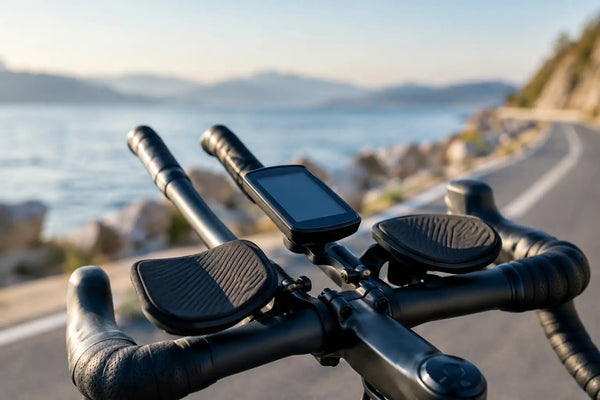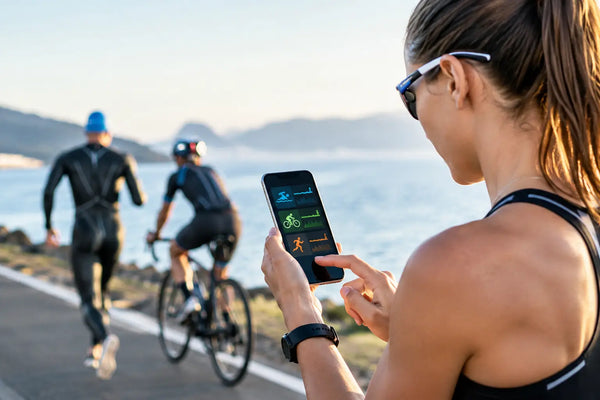

You know the moment: you’re leaving the water and trying to switch your watch from swim to bike. Or you’re 40 minutes into a run when the battery icon starts flashing. Maybe your GPS track even shows you running straight through a building.
Before you read: The source material for this article was a short product announcement. The transcript contained only an access error, so there was no usable text to review. This is a first look based on announced specifications, not a hands-on review. Details we couldn’t confirm are marked in brackets.
These tech hiccups may not ruin a race, but they can distract from the effort you’ve worked so hard to put in. That’s why Decathlon’s new triathlon-specific watch, the Race 500, is worth a closer look. Its headline features are dual-frequency GPS and a claimed 20 hours of battery life with GPS on.
Many amateur triathletes don’t need, or can’t justify, spending several hundred euros on a premium device. This first look covers what the Race 500 promises, what those features mean in everyday terms, where it may involve trade-offs, and who might find it useful.
What’s New: The Race 500 at a Glance
Decathlon positions the Race 500 as a dedicated triathlon watch, rather than a general fitness tracker. That matters because triathlon involves more than swimming, cycling, and running: you also need to move between those activities. A watch designed around the full swim-bike-run sequence may make race day simpler than a running watch with a multisport mode added on.
Here’s what we can take from the announcement:
- Brand: Decathlon
- Category: Multisport / triathlon watch
- Headline features: Dual-frequency GPS, 20-hour battery life with GPS
- Listed price: €139.99 [Verify before publishing]
- Release date: [Verify before publishing]
- Successor to an existing model, or a new line? [Verify before publishing]
Dual-Frequency GPS, Explained Simply
Many sports watches have traditionally used one satellite signal, often called L1. Dual-frequency GPS watches can also use a second signal, commonly called L5.
Imagine trying to find a friend in a crowded stadium. One person tells you roughly where they’re sitting, but you end up a few rows away. A second reference point can help you narrow down their exact seat. In a similar way, two signals let a watch cross-check your position and correct some errors.
This can be especially helpful in places where GPS signals have a harder time:
- Urban canyons: Signals bounce off tall buildings and may confuse the watch. That’s how a GPS track can make it look like you ran through a building.
- Tree cover: Forest trails and shaded bike paths can weaken the signal.
- Near water: Reflections from the surface can add noise to your position.
Why It Matters for Triathletes
Each part of a triathlon puts GPS tracking to a different test. On the bike, speed and distance help you understand your splits and pacing. On the run, inaccurate pace readings can make it harder to stick to your plan. Open-water swimming is especially challenging because a watch can usually get a clearer GPS signal only when your arm is out of the water.
One important caveat: dual-frequency hardware doesn’t guarantee a perfect GPS track. Results also depend on the chipset, antenna design, and software. [Research needed: independent accuracy tests comparing the Race 500 with single-frequency watches. Until those tests are available, treat accuracy as a promising feature, not a proven result.]
Triathlon Mode and Multisport Workflow
A triathlon watch has to work well during transitions. Ideally, you press a button at the water’s edge and move through the swim, T1, bike, T2, and run without fumbling with menus.
Before you buy, check:
- Does the watch record T1 and T2 automatically, or do you press a button each time?
- Which swim profiles does it include: pool, open water, or both?
- Is the watch rated for swimming? [Confirm water-resistance rating.]
- Can you record a brick workout (a bike session followed immediately by a run) without ending and restarting the activity?
[Research needed: Confirm the full list of sport profiles and how transitions work. These details will help show whether the Race 500 is ready for race day.]
New to the sport? Our triathlon gear picks cover other essentials to consider alongside a watch.
Battery Life: 20 Hours With GPS
The claimed 20 hours with GPS is an attention-grabbing figure. Many amateurs finish a sprint or Olympic-distance race in a couple of hours, while a 70.3-distance race often takes roughly five to eight hours. Long-distance races can take well over ten hours for many age-group athletes. On paper, 20 hours would cover these race durations, with time left for a pre-race warm-up.
But battery claims depend on how a watch is used. Real-world performance can vary with:
- GPS sampling mode: the most accurate settings usually use more battery
- Screen brightness and whether the display stays on
- Heart-rate sensor use and connected features such as notifications
- Water and cold temperatures, which can affect performance
Our advice: Don’t plan a long-distance race around the headline figure alone. Charge the watch fully, use conservative settings, and test it on a long ride before race day. [Research needed: Confirm the conditions used to measure the 20-hour figure and compare it with watches at a similar price.]
Limitations and Honest Trade-Offs
Budget sports GPS watches often make compromises, and that’s not necessarily a problem if you know what matters to you. Compared with premium triathlon watches, more affordable models may skip or simplify:
- Offline maps and navigation
- Music storage for phone-free runs
- Advanced recovery and physiological metrics
- Premium materials, such as sapphire glass or titanium cases
- A polished app ecosystem with detailed training analytics
[Research needed: Confirm which of these features the Race 500 includes.]
Who might want to look elsewhere: Athletes who need detailed physiological data, route navigation for unfamiliar training areas, or deep integration with third-party training platforms.
Who it may suit: Newer triathletes, budget-conscious age-groupers, and anyone looking for GPS and swim-bike-run tracking without paying for features they may not use.
Price and Value in Spain
The listed price provided for the Decathlon Race 500 is €139.99, but confirm the Spanish retail price and availability before publishing. At this price, the key question is how its features compare with other budget GPS watches, not just whether it costs less than premium models.
Before publishing, confirm:
- Retail price in euros: €139.99 [Verify]
- Where to buy: Decathlon stores and online [Verify availability]
- Launch promotions: [Verify]
- Two or three competitor prices for a side-by-side comparison
| Feature | Race 500 | Competitor A | Competitor B |
|---|---|---|---|
| GPS | Dual-frequency | [ ] | [ ] |
| Battery (GPS) | 20 h (claimed) | [ ] | [ ] |
| Triathlon mode | Yes | [ ] | [ ] |
| Water resistance | [ ] | [ ] | [ ] |
| Price (€) | 139.99 [Verify] | [ ] | [ ] |
Readers in Spain can browse our gear picks for triathletes. If you’re in Mexico, where Decathlon also operates, check whether the Race 500 is available locally before ordering. Launch timing and prices may differ by country. You can also explore our triathlon gear picks.
A Quick Example: A Training Week With the Race 500
Here’s how a typical training week could put the watch’s tracking and battery to the test:
- Tuesday, pool swim: Check whether pool mode records lengths and pace accurately.
- Thursday, bike intervals: See how consistent the GPS speed readings are under tree cover.
- Saturday, long ride plus brick run: Test triathlon mode by switching from bike to run, and see how the battery holds up over a longer session.
A week like this can help you decide whether the watch fits your routine. If you’re building out your training setup, our training gear picks may give you a few more ideas.
Key Takeaways
- The Race 500 is aimed at amateur triathletes who want multisport tracking without premium pricing.
- Dual-frequency GPS and a claimed 20-hour battery life are its headline features.
- It may involve trade-offs, so compare its confirmed features with your own priorities.
- Important details, including price, water resistance, transition handling, and real-world GPS accuracy, still need confirmation.
What to Do Next
- Match the specifications to your needs. If you mainly want reliable tracking for sprint and Olympic-distance races, an affordable watch may be enough.
- Compare prices with other watches in your budget.
- Test it before race day. Try a pool or open-water swim and a long ride before relying on the watch in competition.
Affordable, purpose-built gear can make structured multisport training more accessible. That’s good news for newcomers in Spain, Mexico, and beyond. Planning your race season? Browse our race season essentials and race-day travel gear.
What watch are you racing with right now? Tell us in the comments, and subscribe for a hands-on follow-up once we’ve put the Race 500 through real training sessions.
Source: https://en.triatlonnoticias.com/noticias-material/decathlon-race-500-reloj-gps-triatlon/
Discover unique triathlon-themed merchandise, including stylish t-shirts, stickers, phone cases, and home decor - perfect for endurance sports enthusiasts and athletes. Shop now
What does “Forbidden by GTranslate WAF: 12001” mean?
It indicates that a request handled through GTranslate was blocked by a web application firewall (WAF). The message alone does not identify the specific rule or cause of the block.
Why might the GTranslate WAF block a request?
A WAF may block requests it considers suspicious or potentially harmful. Automated traffic, unusual request patterns, security rules, or a configuration issue may contribute to a block.
How can I troubleshoot error 12001?
Try loading the page again, checking whether the issue occurs in another browser or network, and disabling VPN or proxy services temporarily. If the error continues, contact the website administrator or GTranslate support and include the affected URL and any reference details shown on the error page.
Can a website administrator resolve a GTranslate WAF block?
Yes. The administrator can review relevant WAF and server logs, check GTranslate settings, and determine whether a security rule is blocking legitimate traffic. Any rule changes should be made carefully to preserve the site's security.
Does error 12001 mean my device has been infected?
Not necessarily. The message indicates that a request was blocked; by itself, it does not confirm malware or a security problem on your device.
 Feb 6, 2027IRONMAN Lanzarote
 Apr 18, 2027IRONMAN 70.3 Valencia
 Apr 18, 2027Wallisellen Triathlon
 May 9, 2027Challenge Salou-Costa Daurada
 May 15, 2027MTRI Alicante 2027
 May 16, 2027IRONMAN Aix-en-Provence