
What You Didn't See on the Broadcast: Behind-the-Scenes Photos from the 2026 Long-Distance Triathlon World Championship in Kona
While millions tuned into the live feed, Triathlete staff photographer Brad Kaminski was capturing the raw moments that truly told the story of race day.
The broadcast highlights the winners breaking the tape, leaders racing neck-and-neck, and the ocean waves swirling at the start. However, it misses the powerful moments: the second a champion transitions from poised to desperate, a legendary athlete helping out in a volunteer shirt, or two rivals sharing a genuine smile in transition before embarking on the grueling 140.6-mile journey.
That's where a photographer like Brad Kaminski shines. At the 2026 Long-Distance Triathlon World Championship in Kona, he documented one of the most unpredictable days in the history of this race — featuring a first-time participant clinching the men's title, a defending women's champion collapsing near the finish, and a triathlon legend rolling up his sleeves to help others in need.
Here's a look at the moments you missed.
The Pre-Race Intensity — The Calm Before the Storm
Athletes Lock In Before the Start
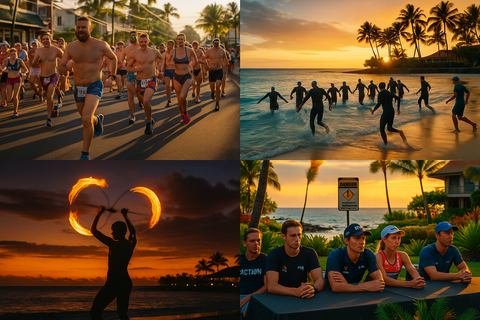
Long before the starting cannon echoes over Kailua-Kona Bay, every athlete is already racing in their minds. Kaminski's pre-race photos reveal the immense psychological spectrum present among elite competitors, something broadcast commentary often overlooks.
Defending women's champion Solveig Løvseth (NOR) appears serene in her pre-race portrait. No gadgets, no elaborate warm-ups, just a composed demeanor. This calm was intentional. During a pre-race press conference, Løvseth spoke about her adaptable philosophy that led to her 2025 title:
“I think I just need to see what happens. You can't over-plan; you must adapt as the race unfolds.”
This insightful remark would later take on an ironic twist.
In contrast, Sam Long (USA) approached the water's edge exuding energy and flexing theatrically, a performance he backed up by finishing sixth overall in 7:55:21. Meanwhile, Lucy Charles-Barclay (GBR) stood ready with the focused expression of someone who knew exactly what awaited her in the water.
Key Takeaway: Elite triathlon begins in the athlete's mind. Still images portray psychological states in ways broadcast commentary simply can't capture.
The Swim Start — 21 Men Within 18 Seconds
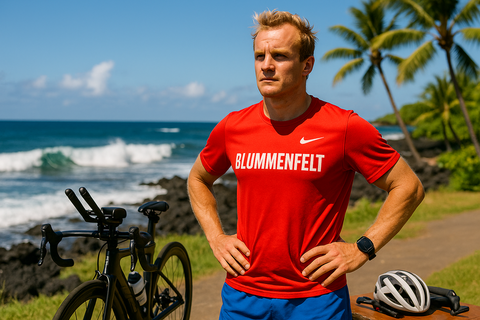
If you watched the broadcast swim coverage, you saw leaders and landmarks. What you missed is the extraordinary closeness of the elite men at the front. Twenty-one professional men exited the swim within just 18 seconds of each other. That's impressive on paper, but Kaminski's photos show the tight-knit pack during the early bike miles — former champions like Patrick Lange (DEU) and Kristian Blummenfelt (NOR) shoulder to shoulder with eager Kona rookies.
The women's swim told a different story. Lucy Charles-Barclay demonstrated why she's regarded as the best open-water swimmer, exiting in 51:29 with a 90-second lead. Meanwhile, Vincent Luis (FRA), the eventual race winner, transitioned smoothly through T1, showing no signs of anxiety as a Kona newcomer.
The image of Taylor Knibb and Julie Derron walking towards their bikes, smiling, contrasts beautifully with the intensity that would soon envelop them. At that moment, they appeared as training partners instead of rivals.
The Bike Leg — A Race of Strategy, Risk, and Resilience
Crowded Miles and the Duel of Experience vs. Newcomers
The bike course out of Kona leads into the lava fields along the Queen Ka'ahumanu Highway — a crucial starting point where races can split apart. In 2026, this division happened early. With so many men exiting the swim together, the opening bike miles became a tactical chess match at over 30 mph. Rookies set a fast pace, challenging seasoned athletes to either engage early or stick to their game plan.
The scorching conditions added pressure. Temperatures soared into the 80s (°F) with humidity at 82% — a heat that punishes mistakes. Kaminski captured Lara Hernandez-Tome (ESP) actively cooling herself mid-ride, an image that speaks volumes without needing words.
The Game-Changing Moment — Knibb at Mile 70
A pivotal moment in the women's race occurred at mile 70. Taylor Knibb (USA) overtook Lucy Charles-Barclay decisively, a move that altered the race dynamics and led to a three-minute lead by T2. Kaminski was right there. The broadcast may have shown snippets, but the still image highlights the widening gap — evidence of how one moment can change everything.
The Unfiltered Struggles of the Bike Leg
Marten Van Riel (BEL), who set the early pace, found himself struggling on the bike. Kaminski caught him amidst the lava fields, an image that confirmed reports of his distress. He finished 36th overall (8:42:18), a tough outcome for such a talented athlete. Kristian Blummenfelt (NOR) executed a well-paced ride that kept him podium-bound but later revealed that a lack of hydration during the run cost him, ultimately finishing in eighth place.
Patrick Lange's Bittersweet Farewell
The three-time former champion came to Kona for one last race before retirement, carrying the experience of past victories. But the bike leg unraveled him. He withdrew mid-race — a DNF marking his last competitive appearance in Kona. That moment could have been the end of his story: a great athlete fading quietly from the scene.
Instead, Kaminski's lens captured Lange later on the course, wearing a volunteer shirt as he handed out water to fellow athletes still pushing through the lava fields. That image speaks volumes about Lange's character and reflects the spirit of the triathlon community far better than post-race interviews ever could. He came to race. When he couldn't, he chose to serve.
The unseen stories — the DNF that turns into volunteerism, the smile in T1 before the struggle begins — are often the most genuine the race tells.
The Run — Drama, Desperation, and the Echoes of 2025
Men's Race: Luis Closes the Deal
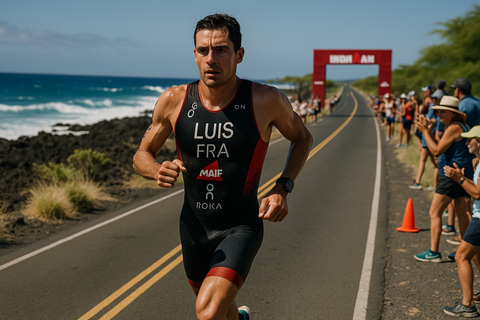
As the men hit the run course, Vincent Luis (FRA) was strategically navigating through the field. Kaminski captured him in pursuit of Gregory Barnaby (ITA), who would ultimately finish fourth in 7:51:02. Luis's demeanor conveys focus and determination, illustrating his calculated approach.
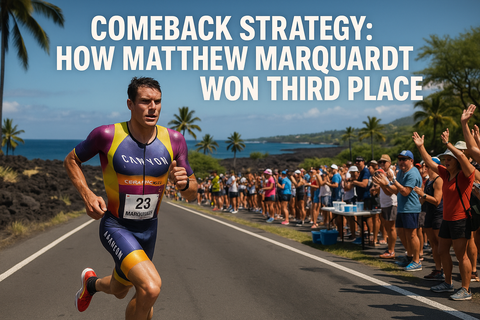
Matthew Marquardt (USA) surged ahead, exiting the water in fourth place, recording the second-fastest bike split of the day (4:11:28), and maintaining his position during the run. He finished third in 7:49:59. Jonas Schomburg (GER) finished seventh (7:56:42), while Pierre le Corre (FRA) consistently pushed through, ending up fifth in 7:53:29. In this mix, Luis, racing at Kona for the first time, skillfully balanced aggression and patience, ultimately winning in 7:42:27.
Women's Race: The Drama That Resounded from 2025
If the men's race was defined by strategy, the women's race unfolded with raw emotion. Taylor Knibb built a solid three-minute lead off the bike. But then, Solveig Løvseth surged ahead on the marathon, looking poised to be crowned champion once again. Then, tragedy struck.
Løvseth collapsed in the final miles, nearly in the same spot where Knibb herself had faltered the year before. Kona has a way of repeating its challenges. Regrouping, Knibb reclaimed her lead and held on to win in 8:36:29.
As for Løvseth, after a moment on the pavement to recover, she stood up and joyfully walked to the finish, high-fiving supporters all the way. Finishing eighth, it was a moment that transcended defeat — a powerful statement. Kaminski captured that journey, a memory more significant than any number. Julie Derron (CHE) secured a hard-earned third place, showcasing the unique stories and perseverance of three very different athletes.
The Finish Line — Triumph, Struggles, and the Journey Beyond
When Luis Crossed the Tape
Vincent Luis's post-finish celebration radiates pure shock. It's not the polished response of an athlete expecting to win, but the genuine disbelief of a man who left everything on the course and found victory in his first attempt. He was greeted by his partner, Georgia Taylor-Brown, an Olympic medalist herself. This moment captured by Kaminski feels intimate, even amidst the celebration.
When Marquardt Fell
Matthew Marquardt collapsed after securing third place. This image, while not unusual at Kona, powerfully conveys the toll of a 7:49:59 effort. Third place represents not comfort, but the culmination of one's all, poured out on the pavement under the Hawaiian sun.
What the Finish Line Truly Represents
The broadcast gives us finish-line footage — energetic crowds, commentary, and timing screens. Yet it often overlooks the texture: the volunteers rushing in to assist, the emotional expressions of loved ones, and moments when an athlete's legs give out, or their hands rise in triumph. Magnus Ditlev (DNK) moving through an aid station with cheers of encouragement. Julie Derron celebrating her hard-earned podium finish. Taylor Knibb, breaking the finish tape, radiating the weight of what she has just accomplished after a grueling race.
The Bigger Picture: Why Behind-the-Scenes Coverage Matters
Long-distance triathlon is one of the most visually captivating sports. Yet much of its drama escapes typical broadcast coverage, which follows leaders and highlights timed segments. Photography invites us to slow down. One image of Patrick Lange in a volunteer shirt resonates deeper than any highlight package. The shared smile between Knibb and Derron in T1 adds nuance to their competitive narrative, one that numbers and statistics can't capture.
Kona 2026 delivered everything we expect: unexpected winners, painful collapses, and legends stepping aside with grace as newcomers rose to the challenge. Brad Kaminski was there, at every moment the broadcast missed, telling the truths of the day.
Five key reminders from this race, illustrated by these images:
- Patience often triumphs over aggression in Kona (think: Luis, Knibb).
- The race doesn't finish at the line — it continues at aid stations, collapse zones, and volunteer areas.
- Great photography reveals the psychology behind the performance.
- Kona holds a collective memory — lessons repeat year after year, sometimes even on the same stretch.
- Community supports individual success by forming the backbone of every athlete's achievement.
Keep Exploring
Whether you're a longtime follower of Kona or just discovering what long-distance triathlon truly requires, this race offers something for everyone. For gear to support your own triathlon journey — whether you're gearing up for your first sprint or preparing for your third 70.3-distance race — explore our curated collections designed specifically for dedicated athletes:
- 🏊 Ready to race? Check out our First Triathlon Kit for everything you'll need from day one, including gafas de natación antivaho con protección UV to help you see clearly in open water.
- 🎁 Shopping for a triathlete friend? Browse our Gifts for Triathletes or, for her, our Triathlon Gifts for Her collection.
- 🏁 Preparing for your big event? Our Race Season Essentials will support you from training to the taper, including Tabletas de Hidratación y Electrolitos GU Energy para Triatlón.
Frequently Asked Questions
Who won the men's and women's races at the 2026 long-distance triathlon World Championship in Kona?
France's Vincent Luis won the men's race with a time of 7:42:27, while American Taylor Knibb emerged victorious in the women's race, finishing in 8:36:29.
What strategy did Solveig Løvseth use during the race?
Solveig Løvseth adopted a no-plan approach similar to the strategy that helped her win in 2025, stating the need to adapt to how the race unfolds.
Did any notable athletes withdraw from the race?
Yes, Patrick Lange withdrew from the race after a strong swim performance and was later seen volunteering at an aid station.
What were the weather conditions like during the race?
The race took place in steamy conditions with temperatures reaching the 80s (F) and humidity at 82%.
What happened to the leading athletes during the run?
Taylor Knibb briefly lost the lead to Solveig Løvseth during the run but managed to reclaim it in a dramatic finish, while Løvseth collapsed in the final miles but still finished eighth overall.
Who were some of the other prominent competitors in the race?
Other notable competitors included Magnus Ditlev, Kristian Blummenfelt, and Matthew Marquardt, with Marquardt finishing third overall.
Source: triathlete.com — 2026 World Championship Exclusive Photos