
From Penalty Box to Podium: Matthew Marquardt's Gutsy Third-Place Performance at Kona 2026
When Matthew Marquardt crossed the finish line at the 2026 long-distance triathlon World Championship in Kona, he didn't jog through the tape with his arms raised — he collapsed onto the carpet. That moment encapsulates everything about his relentless spirit, even after serving a 2-minute penalty during the bike leg that would have derailed most athletes' mental focus.
Marquardt's third-place finish wasn't just a result — it was the culmination of a comeback story built on an unexpected nutritional discovery, fierce discipline, and the mental toughness of someone who is simultaneously training to become a head and neck cancer surgeon. Here is how he pulled it off.
The Penalty That Could Have Stalled His Race
Leading, Then Stopping — Mid-Bike
Marquardt entered the swim with the lead group, a strong start that quickly turned into front-running action on the bike. Just as he was making his mark, an official issued a 2-minute penalty, forcing him out of the race clock and into the penalty tent. He wasn't thrilled about the decision — he made that clear in his post-race debrief. But what makes his response extraordinary is that he refused to let the setback distract him.
In long-distance triathlon, a 2-minute penalty is significant. At Kona, where split-second timing matters, two minutes can mean several finishing positions. Many athletes might panic and rush to make up time, derailing their pacing strategy and ruining their run.
Using the Penalty Tent as a Reset Button
Marquardt flipped the narrative. Instead of letting frustration take over, he used those two minutes as an opportunity to mentally regroup. When he re-entered the race, he was composed, focused, and still riding his own race. The results prove the strategy worked: Marquardt posted the second-fastest bike split of the day, just 5 seconds behind Gregory Barnaby (ITA). Serving a 2-minute penalty and still nearly leading the bike leg by time is not luck — that is elite mental control.
“I just wanted to do my own race today: swim my own race, bike my own race, and run my own race.”
This mindset — focusing on his own plan rather than reacting to the chaos around him — turned a potential disaster into a podium finish.
The 2026 Breakthrough: How Marquardt Solved His Cramping Problem
A 2025 Season Defined by Pain
To truly appreciate Marquardt's performance in 2026, we need to look at his 2025 season. Since turning pro in 2023, he showed promise with an 11th-place finish at the 2023 long-distance world championship in Nice and a 15th at Kona in 2024. Yet 2025 became defined by one critical issue: cramping in every single race.
Cramping can be a nightmare in long-distance triathlons. It often turns a solid run into a desperate shuffle and wipes out hours of hard work in seconds. Common causes include electrolyte imbalances, dehydration, aggressive pacing, or insufficient glycogen stores — and the root cause varies between athletes. Marquardt finished 8th at the 2025 long-distance world championship in Nice, a solid placement that still didn't reflect the potential he knew he had.
The Counterintuitive Fix That Changed Everything
Early in the 2026 season, Marquardt made a surprising discovery: he had been eating too many carbohydrates the day before competition. This runs contrary to standard carb-loading advice, but emerging sports science confirms that nutrition is deeply individual. What works for one athlete can backfire for another.
For Marquardt, reducing his pre-race carbohydrate intake appeared to completely resolve his cramping. The proof lies in his 2026 season results:
- 🏆 Long-Distance South Africa — 1st place
- 🥈 Long-Distance Lake Placid — 2nd place
- 🥈 Long-Distance Sweden — 2nd place
- 4️⃣ Middle-Distance Pennsylvania — 4th place
- 🥉 Long-Distance World Championship Kona — 3rd place
Five significant races, zero cramping. That is not luck — it is a genuine breakthrough. His 2026 season is a textbook example of how solving one underlying issue unlocks consistent performance across an entire calendar.
Key lesson for age-groupers: If you are regularly dealing with cramps and standard solutions are not working, it may be time to rethink your assumptions — even the ones you have always trusted. Experimenting with electrolyte supplementation during training can help identify what works best for your individual physiology.
The Run: Patience, Persistence, and Watching Leaders Fade
Fourth Place at the Halfway Mark
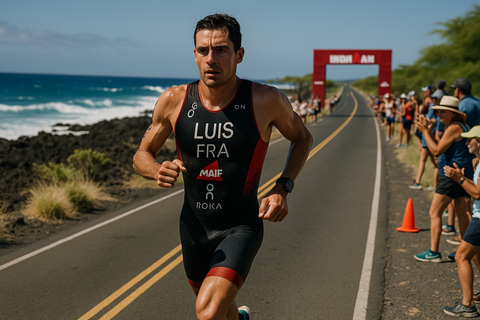
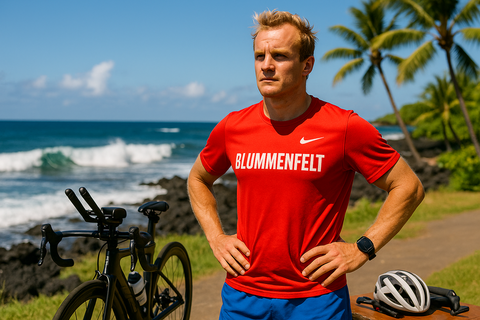
When Marquardt hit the infamous Energy Lab — the midway point of the Kona marathon — he was sitting in fourth place, running alongside Gregory Barnaby (ITA). Ahead of them, Magnus Ditlev (DNK) led the charge while Kristian Blummenfelt (NOR) held third. At that moment, a podium finish looked like someone else's story. Marquardt kept running his race.
The Final Five Miles: Long-Distance Triathlon's Oldest Truth
With about five miles remaining, the race dynamics shifted — not because Marquardt surged, but because the leaders ahead of him began to falter. Magnus Ditlev started experiencing difficulties. Kristian Blummenfelt slowed from his earlier pace. Here is the crucial insight: in long-distance triathlon, the winner is rarely the fastest athlete — it is the one who maintains pace the best. Steady execution, backed by proper fueling with energy gels designed for long efforts, becomes a decisive weapon as others unravel.
Marquardt moved into second place behind Vincent Luis. Then Gustav Iden unleashed a powerful late charge to claim second. Marquardt held his ground, crossed in third, and collapsed on the finish carpet — not from weakness, but from having held absolutely nothing back.
Surgeon by Day, Podium Finisher on Race Day
Completing Surgical Training at Ohio State
Marquardt is not a full-time triathlete. He is completing his fellowship training as a head and neck oncology surgeon at Ohio State's James Cancer Hospital — one of the most demanding paths in medicine. Fellowships in surgical oncology demand long operating room hours, intense study, and the emotional weight of caring for cancer patients. The fact that Marquardt competes at the top level of long-distance triathlon while carrying this workload is extraordinary by any measure.
The Two-Career Mindset
Both medicine and elite sport share the same core qualities, and Marquardt embodies them in parallel:
- Delayed gratification — training for years toward a race, studying for years toward a career.
- High tolerance for discomfort — physical during racing, emotional during surgical training.
- Systematic problem-solving — diagnosing his cramping like a clinical issue, then testing and validating a solution.
His ability to stay composed under pressure — during a penalty, in championship heat, watching leaders fade — demonstrates the mental resilience forged across multiple high-stakes environments. His achievements challenge the idea that elite athletic performance requires single-minded dedication. It is possible to excel across different fields, but it demands exceptional self-awareness and systems.
The Trajectory That Points to Something Bigger
| Year | Race | Result |
|---|---|---|
| 2023 | Nice (Long-Distance WC) | 11th |
| 2024 | Kona (Long-Distance WC) | 15th |
| 2025 | Nice (Long-Distance WC) | 8th |
| 2026 | Kona (Long-Distance WC) | 3rd |
This is not a straight line — it is a trajectory with a defining breakthrough. The dip to 15th in 2024 and the cramping season of 2025 could have defined a stalled career. Instead, they became the catalyst for his podium success. Finishing third at the long-distance world championship in Kona means he stood among the sport's very best: Gustav Iden, Vincent Luis, Kristian Blummenfelt, and Magnus Ditlev. The next question is obvious: can he win it?
That answer depends on whether his surgical career allows for the training volume required, and whether the athletes ahead of him improve at the same rate he continues to develop.
What Every Triathlete Can Learn From This Race
1. Mid-race adversity does not have to mean disaster. A penalty, a flat tire, or a fueling mistake — how you respond in the moment matters more than the setback itself. Marquardt's penalty-tent reset is a masterclass in refocusing instead of reacting.
2. Your cramping problem may have an unexpected source. If you have tried the standard fixes — electrolytes, hydration, pacing — and still suffer cramps, it is time to question assumptions. Marquardt did exactly that with his pre-race carbohydrate intake.
3. “Do your own race” is not just a phrase — it is a strategy. Marquardt never chased Ditlev or panicked about Blummenfelt's pace. He executed his plan and let the race come to him in the final miles.
4. Seasonal consistency matters as much as peak-day performance. Five top-four finishes in 2026 happened because he identified a problem, implemented a fix, and executed the same strategy all year long.
Ready to Train Smarter?
Whether you are aiming for your first sprint tri or dreaming of competing on a world-championship course, starting with the right gear and the right mindset is essential. Explore our race season essentials or browse triathlon lifestyle apparel built for athletes who train through every season. If Marquardt's story has inspired you to tackle your first long-distance event, our gifts for triathletes collection is a great place to start.
What is the biggest in-race setback you have ever faced? Whether it was a flat tire at mile 40 or a stomach issue on the run, a setback does not erase your determination. Like Marquardt's experience, the race continues until you cross that line.
Catch Matthew Marquardt's full race debrief video for an in-depth look at every segment — including how he processed his penalty and what a long, hard day in Kona truly looks like from the inside.
Frequently Asked Questions
What was Matthew Marquardt's overall result in the 2026 long-distance triathlon World Championship?
Matthew Marquardt finished in third place at the 2026 long-distance triathlon World Championship in Kona.
How did Marquardt perform despite receiving a penalty during the race?
Marquardt served a 2-minute penalty but still achieved the second-fastest bike split, just 5 seconds behind Gregory Barnaby, and ran a consistent marathon to secure third place.
What notable struggles did Marquardt face earlier in his career?
Earlier in his career, particularly in 2025, Marquardt experienced frequent cramping during races, which he later identified as linked to excessive carbohydrate intake the day before racing.
What was Marquardt's performance leading up to the 2026 long-distance World Championship?
Leading up to the championship, Marquardt won the long-distance South Africa event, placed fourth at the middle-distance Pennsylvania race, and took second at the long-distance Lake Placid and Sweden events.
What was Matthew Marquardt studying in addition to his triathlon career?
In addition to his triathlon career, Matthew Marquardt is completing his fellowship training to become a head and neck oncology surgeon at the James Cancer Hospital at Ohio State.
What did Marquardt say about his approach to the race?
Marquardt emphasized the importance of focusing on his own race strategy, stating, “I just wanted to do my own race today: swim my own race, bike my own race, and run my own race.”