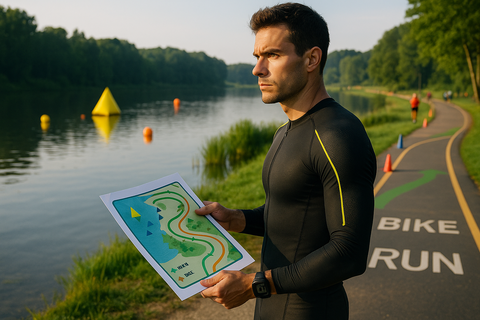
Imagine if every run, ride, and walk you've ever tracked was quietly building a hidden map of achievement—just waiting to be unlocked.
A new collecting craze is sweeping through the triathlon community, and it has nothing to do with medals, finisher T-shirts, or Strava KOMs. It's called Squadrats, and once you see your training history transformed into a colorful patchwork of collected squares, it's nearly impossible to look at your regular routes the same way again.
Squadrats is gaining serious momentum among endurance athletes worldwide—and triathletes, with their high training volumes and multi-discipline lifestyles, are finding themselves particularly hooked. As Triathlon Today editor Tim Moria puts it: "Every once in a while, a craze comes along that catches on as if it's always been there. Squadrats is one such craze."
In this guide, you'll learn exactly how Squadrats works, why the triathlon community is embracing it so enthusiastically, and how to use it strategically to make your training more varied, more fun, and more rewarding—without sacrificing a single quality workout.
What Exactly Are Squadrats? (The Basics)
Understanding the Core Concept
At its heart, Squadrats is beautifully simple: you collect digital tiles—squares measuring approximately 1.5 km × 1.5 km—by physically passing through them during real-world activities. Run through a neighborhood you've never visited? Those squares are yours. Cycle through a new part of town on your long ride? Collected. Walk to a coffee shop in a new city? Add it to your map.
Collection happens automatically. Once you've linked your Strava account to the Squadrats app, every activity you upload to Strava gets scanned, and any new tiles you passed through are instantly added to your growing collection. For existing Strava users, the friction is essentially zero.
The concept isn't entirely brand new—apps like Wandrer have let users "collect" streets and cities for years. But Squadrats has carved out its own identity, particularly among the biking, running, and walking crowd, with a clean interface, satisfying visual feedback, and a hierarchy of goals that keeps you chasing the next milestone.
The Squadrats Hierarchy: From Tiles to Übersquadrats
One of the cleverest design choices in Squadrats is its layered collection system. There's always something to chase, regardless of where you are in your journey:
- Squadratinho: A subdivision within a Squadrat (64 per Squadrat). Fast—great for instant gratification.
- Squadrat: The primary tile unit (~1.5 km × 1.5 km square). The core goal.
- Yard: A collection of multiple linked Squadrats. Medium-term commitment.
- Übersquadrat: A larger grouping of linked Squadrats. Long-term achievement.
The genius of this structure is that no matter how far along you are, there's always a meaningful next step. A beginner picking up the app for the first time gets immediate wins through Squadratinhos. A seasoned collector with thousands of tiles gets the long-horizon challenge of completing Yards and Übersquadrats across entire regions.
Getting Started: Faster Than Tying Your Shoes
One of the most satisfying moments in the Squadrats experience happens before you even lace up for your first intentional collection run. Squadrats allows you to retroactively link your historical Strava data, instantly populating your map with years of past activities.
As Tim Moria noted when he set up his own account, the import process "did need some time—several hours even—but then you immediately have all the tiles from your Strava activities published in recent years. And then the real collecting can begin."
Imagine opening the app to find your hometown already dotted with hundreds of collected squares, each one a ghost of runs and rides past. It's a genuinely powerful visual—and a surprisingly emotional one for athletes who've been logging miles on Strava for years.
Getting started checklist:
- ✅ Download Squadrats free from the Apple App Store or Google Play Store
- ✅ Create your account and link your Strava profile
- ✅ Allow the retroactive import to process (grab a coffee—it may take a few hours)
- ✅ Open your map and see your training history come alive
How Squadrats Actually Works (The Mechanics)
Your Map: A Living Record of Everywhere You've Trained
Once your data is loaded, the Squadrats map becomes one of the most compelling views of your athletic life you've ever seen. The tiles you've collected glow on the map; the uncollected ones sit blank, practically begging to be filled in.
Predictably, most athletes will see a dense cluster of collected tiles centered on their home base—your usual running loops, your go-to bike routes, your regular commute. Then, as the map extends outward, the density thins. The gaps become visible. And that's where the magic happens.
Those blank squares stop looking like empty map space and start looking like opportunity. A neighborhood three streets over that you've never explored. A trail system on the edge of town you keep meaning to visit. A coastal road you pass on the way to a friend's house but have never actually ridden.
Competition Without Race-Day Pressure
Squadrats also includes a ranking system where you can compare your tile count against other users in the app. This adds a layer of friendly competition that feels distinct from the intensity of race-day performance.
There's no chip timing here. No age-group podium. Just a community of people who share the quiet satisfaction of clicking "one more square" into place. For athletes who spend months building toward a single race result, that low-stakes competitive element can be genuinely refreshing.
Why Triathletes Are Obsessed (The Psychology)
Gamification Meets Endurance Training
Triathletes are, by nature, a data-driven, goal-oriented group. Power meters, pace analysis, heart rate zones, training stress scores—the community has always embraced quantification. Squadrats slots neatly into that culture while offering something the numbers don't always provide: a sense of exploration and discovery.
The collection psychology is real. Humans are wired to find satisfaction in completing sets—it's the same impulse behind loyalty programs, stamp cards, and yes, Pokémon. Squadrats channels that impulse into something that gets you out the door on a drizzly Tuesday when motivation is low and the couch is calling.
Crucially, collecting squares doesn't compete with your training goals—it enhances them. You're not choosing between a quality workout and a Squadrats session. You're simply directing your existing training miles toward slightly different geography. The effort stays the same; the reward multiplies.
Breaking Route Monotony (A Real Training Problem)
Ask any experienced triathlete what their biggest psychological challenge in training is, and monotony frequently comes up. Running the same 8 km loop three times a week for months on end works physiologically—but mentally, it can grind you down.
Squadrats provides a built-in, self-renewing antidote to route fatigue. Once you've collected the tiles on your regular routes, you naturally start looking for new ones. That 10 km easy run gets rerouted two streets north to grab a fresh row of Squadratinhos. Your Sunday long ride ventures into a neighborhood you've passed a hundred times but never explored. The training stimulus remains appropriate; the route becomes an adventure.
As Moria notes: "Occasionally planning your training routes cleverly can yield some extra tiles; something that encourages you to step off the beaten track and explore areas where you haven't trained before."
The Multi-Discipline Advantage
Here's where triathletes have a structural edge over almost every other category of Squadrats collector: all three disciplines count.
Running miles, cycling kilometers, open water swims that start with a bike ride to the lake—every tracked activity feeds the collection. A triathlete logging a standard training week generates tile opportunities across running, cycling, and potentially walking-based recovery sessions. That's a fundamentally different collection pace than a single-sport athlete.
The math works in triathlon's favor: more disciplines, more routes, more tiles, faster progression toward Yards and Übersquadrats.
Travel and Racing: A Whole New Map
For athletes who race frequently or travel internationally, Squadrats adds an entirely new dimension to time away from home. "Going on holiday to a new location and then going for a bike ride or run logically yields a whole series of new Squadrats," notes Moria.
Think about what that means in practice:
- Arrive two days early for a race in a new city → explore the course area on foot and collect dozens of fresh tiles
- Training camp in a new region → every session generates tiles that would otherwise require a special trip to collect
- Family vacation → a 45-minute morning run becomes both guilt-free training time and a productive tile-collecting mission
For triathletes who already travel to races across Latin America, Europe, or North America, Squadrats transforms every destination into a new chapter of the same ongoing collection story.
Strategic Tips for Maximizing Your Collection
Optimize Your Training Routes Without Compromising Quality
The golden rule of Squadrats integration: let it enhance your training, not hijack it. The goal is never to sacrifice workout quality for tile count. Here's how to thread that needle:
During easy and recovery sessions: These are your prime Squadrats opportunities. An easy aerobic run at conversational pace is the perfect time to venture into new territory. The terrain is more interesting, the pace stays controlled, and you're banking tiles with zero cost to your training plan.
On long rides: Build small geographic detours into the early or middle sections of your long bike rides, when you're fresh. A five-minute diversion to cover a new row of tiles adds minimal time and gives you a mini-objective to break up the mental monotony of a four-hour ride.
During brick workouts: If your brick session ends with a short run, use a slightly varied route to pick up adjacent tiles near your usual loop. The added navigation challenge can actually help sharpen focus during the run-off-the-bike cognitive adjustment.
Plan Your Gap-Filling Sessions
Once you've studied your Squadrats map, you'll start to see patterns in your uncollected tiles. Look for:
- Clusters of adjacent blank tiles that a single loop could efficiently sweep through
- Isolated tiles just off your regular routes that require only a small detour
- Corridors of uncollected tiles that could become the backbone of a new regular training route
Treat these map gaps like a puzzle to solve—one that conveniently requires you to go outside and move your body.
Make Race Travel Count
Before your next race, open your Squadrats map for the destination city. Identify the blank squares around the race venue, the transition area, and any neighborhood you'll be staying in. Then plan:
- A shakeout run that sweeps through as many uncollected tiles as possible
- A pre-race bike spin that covers new territory along or near the course
- A post-race recovery walk that ticks off tiles you couldn't reach during training
You'll return home from every race not just with a finisher medal but with a satisfying new cluster of collected squares.
Set Seasonal Collection Goals
Squadrats works best when you give it structure. Rather than passively accumulating tiles, set intentional targets that align with your training calendar:
- Off-season / base phase: Focus on local exploration—aim to complete your immediate neighborhood and surrounding areas completely before expanding outward.
- Build phase: Use Squadrats to add variety to your increasing training volume. New routes = new tiles = fresher legs mentally.
- Race season: Leverage travel to new destinations for bulk collection, and use the ranking system to track your progress against the community.
- End-of-season: Review your map and identify the most accessible remaining gaps to target during your final weeks before the off-season begins again.
The Broader Picture: Why Gamification Works for Endurance Athletes
Squadrats isn't an isolated phenomenon. It's part of a broader evolution in how endurance athletes find and sustain motivation outside of race-specific goals. Apps like Wandrer pioneered the concept of collecting geographic achievements; Squadrats refined it for the biking and running community with larger, more achievable tiles and a cleaner user experience.
What makes this category of app particularly powerful for triathletes is the decoupling of achievement from race results. Race seasons are finite. Weather cancels events. Injuries sideline athletes. Life interrupts training blocks. But Squadrats never shuts down. There's always a new tile to collect, always a blank square within reach, always a small win available on any given Tuesday.
For athletes who've built their identity around competition and performance metrics, that kind of low-stakes, always-available achievement fills an important psychological gap. It keeps training purposeful and engaging even when the next race is months away—or when the training plan calls for something as unglamorous as a 45-minute easy jog.
The triathlon community in particular—whether you're an age-grouper in Mexico City logging pre-dawn runs before work, a beginner in São Paulo building toward your first sprint distance, or a seasoned competitor in Madrid with decades of Strava data waiting to be imported—brings exactly the right combination of training volume, geographic curiosity, and data enthusiasm to thrive in Squadrats.
Quick-Reference: Squadrats FAQ
Is Squadrats free?
Yes. Download it at no cost from the Apple App Store or Google Play Store.
Do I need Strava to use Squadrats?
Yes. Squadrats functions as a Strava companion app and requires a linked Strava account to record your activities.
Can I import my old Strava activities?
Absolutely—and this is one of the most satisfying parts of getting started. Link your Strava retroactively and let the app process your history. Depending on how many activities you have, this can take several hours, but the result is an instantly populated map of years of training.
What activities count toward tile collection?
Squadrats is designed for biking, running, and walking activities. All three disciplines count, which gives triathletes a natural edge in accumulation speed.
Does collecting squares interfere with my training?
Only if you let it. Used strategically—primarily during easy sessions and travel—Squadrats enhances training variety without compromising workout quality.
Can I compete with other users?
Yes. The app includes rankings where you can see how your Squadrat count compares to other collectors in the community.
Get Off the Beaten Track
Squadrats won't make you faster. It won't shave minutes off your next 70.3-distance race or improve your open water sighting. But it will make the daily grind of endurance training more engaging, more exploratory, and more rewarding—especially on the days when motivation needs a nudge.
Here's your action plan:
This week:
- Download Squadrats from your app store
- Link your Strava account and let the retroactive import run
- Open your map and study the gaps around your home training area
This month:
- Plan 2–3 sessions specifically designed to fill visible gaps on your map
- Explore one new neighborhood or trail during an easy session
- Check the rankings and see where you stand in the community
This season:
- Set a personal collection goal—completing your home region, reaching a specific tile count, or unlocking your first Yard
- Use every race trip and travel opportunity to collect new territory
- Share your map with your training group and see who's been exploring the most interesting corners of their city
The blank squares are out there. Lace up, sync your Strava, and go collect them.
Looking to gear up for your next training adventure? Browse our triathlon training gear or explore our selection of running shoes for training to keep your kit race-ready wherever your Squadrats map takes you.
What is Squadrats?
Squadrats is a new craze among endurance athletes where participants collect 'tiles' or squares of approximately 1.5 kilometers by 1.5 kilometers that they have passed through while biking, running, or walking. These tiles are tracked using the Squadrats app, which syncs with Strava activities.
How can I collect Squadrats?
To collect Squadrats, you need to download the Squadrats app and link it to your Strava account. As you log activities such as biking or running, the app automatically tracks the tiles you pass through and adds them to your collection.
Can I retroactively collect Squadrats from past activities?
Yes, you can link your Strava account to the Squadrats app retroactively, allowing you to collect tiles from your past activities. However, it may take some time for the app to process this information.
What are Squadratinhos and how do they relate to Squadrats?
A 'Squadrat' is a square tile of about 1.5 kilometers, which can be further divided into smaller sections called 'Squadratinhos'. Collecting Squadratinhos allows you to accumulate tiles more quickly as they represent subdivisions of the larger Squadrats.
Is the Squadrats app free to download?
Yes, the Squadrats app is available for free and can be downloaded from the Apple Store and Google Play Store.