Beyond the Pain Barrier: Sam Laidlow's Record-Breaking Triumph at Challenge Roth 2026
The fastest long-distance triathlon ever recorded wasn't a flawless endeavor. It was a testament to strategy, endurance, and sheer willpower.
As Sam Laidlow approached the final six kilometers of Challenge Roth 2026, his watch displayed a pace nearing five minutes per kilometer. His heart rate was dropping, and he had briefly walked. His mind, as he described, had essentially shut down.
"That's it. Your brain's off, and it's all a blur. You've gone past the threshold where it hurts and you're thinking about the pain. It's more that I simply can't remember the last 6k." — Sam Laidlow
From an outsider's perspective, 7:21:04 appears to be a meticulously crafted performance — a 46:57 swim, a 3:54:58 bike split, a 2:36:53 marathon, and a world record shattered by eight seconds. From Laidlow's vantage point, it was a tactical risk, a technological endeavor, and a survival tale that nearly unraveled at the end.
This tension — between the clean numbers on a results page and the chaos behind them — is precisely what makes this performance worth examining. Whether you're a seasoned triathlete, a gear enthusiast, or someone curious about pushing beyond known limits, Laidlow's record at Challenge Roth 2026 offers a rare, unfiltered glimpse into the mechanics of elite performance.
The Return to Roth: Strategic Choices Behind the Record
Aiming for a Better Performance
After winning Challenge Roth in 2025 with a time of 7:29:35 — already among the fastest long-distance performances — Laidlow could have targeted numerous lucrative races. Yet, he returned.
"I think there's probably two main reasons," he says. "The first being that I just felt like I could perform so much better than I did last year."
His 2025 victory, he explains, was built on a compromised training block and a fortunate alignment of circumstances. With a full, healthy preparation, he believed he could shave five to ten minutes off his time. This kind of self-assessment — identifying a gap between current performance and actual potential — is a hallmark of elite athletes who don't just win races but continually raise the bar.
Roth's Unique Culture: An Intangible Draw
The second reason for Laidlow's return had nothing to do with numbers.
"Roth always reminds me why I do this sport," he reflects. "It's so unique as an event, not just in our sport, but in any sport, I think. And it really aligns with my own values of family and work ethic and discipline and kindness from the community there."
This matters more than it might seem. Laidlow contrasts this mindset with his 2023 long-distance world championship victory in Nice, which he describes as coming from a "young and immature" place — a performance he associated almost entirely with proving himself. Roth represents something different: a race that fits his identity, not just his ambitions.
Tactical Calculations: Making the Record Inevitable
When Kristian Blummenfelt — holder of the previous fastest iron-distance time — entered the race, and three-time Roth champion Magnus Ditlev followed, Laidlow recognized that a very fast time would become the price of winning, not a separate goal.
The tactical problem was straightforward: Blummenfelt is one of the most formidable runners in long-distance triathlon. Blummenfelt's 2:29:33 marathon at Roth proves that point. Waiting for the run leg would mean a foot race Laidlow might not win.
"My goal was really to beat him. And that demands maybe different kinds of strategies." — Sam Laidlow
The solution? Attack early and build a lead on the bike that the marathon couldn't erase. The record, if it came, would be a byproduct of winning — not the target itself.
The Canyon Group Chat: Coordinating Tactics in an Individual Sport
The WhatsApp Strategy That Wasn't (Really)
In the days before the race, word leaked that three Canyon-sponsored athletes — Laidlow, Rico Bogen, and Jonas Schomburg — had formed a WhatsApp group to coordinate tactics. The triathlon world buzzed with speculation about team racing creeping into an individual sport.
The reality, as Laidlow tells it, was considerably more chaotic.
"It was an actual WhatsApp group," he confirms, laughing slightly. But it was created by Canyon's athlete manager — not the riders themselves — and felt like an awkward attempt to formalize something that needed no formalization.
"Mostly, all three of us weren't replying to the messages, to be fair." — Sam Laidlow
They already understood the race. No memo required.
Coordinated Aggression Without a Playbook
All three Canyon athletes share a profile: elite swimmers and cyclists capable of building significant leads before the marathon. All three had a shared interest in making the race painful for Blummenfelt from the first kilometer.
"We all wanted a win, but equally, we could just make sure the pressure was always on," Laidlow explains.
The plan worked perfectly, though not for the reason Laidlow expected. He thought he'd spotted Blummenfelt during the swim and deliberately conserved energy — no point creating a gap if the fastest runner in the field was already right there. He was wrong.
The Intel at T1 That Changed Everything
Laidlow's girlfriend was waiting at the transition. Her message was brief and decisive: Blummenfelt was already three minutes back.
"That was a really positive surprise," Laidlow says. "I just wanted to apply the pressure from the start to make sure that it was literally just us three."
From that moment, the race was on. Bogen exited the water first in 46:56, Laidlow one second behind, Schomburg two seconds back. When Bogen crested a hill during the early bike while Laidlow was already pushing hard watts and still came over the top, Laidlow had all the confirmation he needed: the iron-distance rookie was ready to race.
Mastering the Rolling Course: Why Roth Isn't Actually Flat
Debunking the "Fast Course" Myth
There's a common assumption among triathletes who've never raced at Roth: the times must mean the course is flat. Laidlow pushes back on that immediately.
"People kind of see the times, and they think Roth is flat, but it isn't," he explains. "It's really very rolling."
This distinction matters enormously for pacing strategy. On a flat course, even power output is close to optimal power output. On rolling terrain, the calculus is entirely different.
Pre-Race Testing: Two and a Half Weeks of Preparation
Laidlow arrived in Roth nearly two and a half weeks before race day — something race director Felix Walchshöfer told him almost no one does. He came early to test with Swiss Side (his wheel partner) and to build a pacing strategy specific to the course's terrain.
"The goal at the end of the day is to ride fast. So it's about a combo of pushing the power in the right places." — Sam Laidlow
On rolling roads, that means applying power where speed is lower (the climbs) and backing off when gravity and momentum are doing the work (the descents). Simple in theory. Physiologically brutal in practice.
The Stochastic Power Profile and Its Cost
Laidlow's normal heart rate on the bike sits around 145–150 beats per minute. During the first hour at Roth, it was closer to 160 — sometimes above that on the steeper hills. That's a significant cardiovascular tax.
But here's the counterintuitive part: that aggressive first hour also included planned moments of deliberate restraint. The WhatsApp group strategy — for all its lack of active participation — had aligned on this point.
"We planned that we'd take the first hour very hard, but there were two moments where we'd really rest also," Laidlow notes. "There was no one trying to push the pace on the bits where we were resting. That was really useful, because if you push that first hour and your heart rate's high and you can't take nutrition, then it bites you back later."
Elite racing, at its most refined, includes knowing exactly when not to push.
The Two-Man Time Trial and the Blood Flow Problem
Riding with Bogen: Inefficiency by Design
Once Schomburg fell off the front pace, the race became a two-man time trial between Laidlow and Bogen. Two athletes, aligned interests, both driving hard to build a lead over Blummenfelt and the rest of the field.
The problem: Laidlow doesn't actually believe riding with another athlete on rolling terrain is more efficient.
The issue is what he calls the "concertina effect." Even when sitting legally at 20 meters, the gap can compress at the bottom of a hill as speed drops — suddenly, 20 meters becomes 15. To avoid drafting, the trailing rider has to back off on the climb. Then, as the lead rider crests and accelerates downhill, the gap expands again, forcing the rider behind to push hard over the top.
"In the end, you're then pushing watts exactly where you shouldn't be." — Sam Laidlow
His preference is a solo time trial: fully focused, pacing to his own rhythm. At Roth, that wasn't possible.
The Left Leg Complication
Layered on top of the tactical awkwardness was a recurring physical issue: reduced blood flow to Laidlow's left leg. The solution required a kind of improvised interval structure — five minutes at normal power, then ease off to allow blood flow to return, then let Bogen pass.
"What I ended up doing was five minutes at the power that I would normally sustain, and then I would slow down and let Rico come past and do my best to get the blood flow back into my leg," he shares.
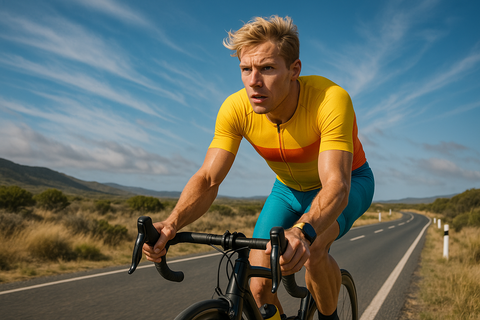
The result was a bike leg that felt wrong from start to finish. "Every picture I've seen, I'm literally grimacing," he admits. Yet he still rode 3:54:58 — more than eight minutes faster than his 2025 Roth time, despite power numbers that were, by his own assessment, well below what he'd produced before.
That gap between perceived suffering and actual output is worth sitting with. It suggests that aerodynamic optimization and tactical execution can compensate for significant physiological limitations.
The Equipment Revolution: Canyon Speedmax and Position Over Power
The Adjustability Advantage
Triathlon equipment discourse often focuses on what's fastest. Laidlow's framing of the new Canyon Speedmax is more useful: it's a tool that makes it easier to find the optimal position for him.
"What Canyon's main goal with this bike was to make a bike that was very adjustable," he explains.
Previous setups required different spacers, cockpits, and base bars to test position changes — mechanical work that makes systematic testing cumbersome. The new Speedmax simplifies that process, allowing more efficient iteration.
"At the end of the day, most of the drag is coming from our body. So the body's position is the most important." — Sam Laidlow
The bike doesn't make you faster. The bike makes it easier to find the position that makes you faster.
Testing Season vs. Racing Season
Laidlow spent the early part of 2026 testing the new Speedmax while continuing to race on his previous setup. He won twice — at 70.3-distance events in Valencia and Lanzarote — on the old bike. Challenge Roth was the first race where he would compete with the aerodynamic gains from all that testing.
This disciplined separation of development and competition phases reflects a methodical approach that runs throughout Laidlow's preparation. No shortcuts. No untested variables on race day.
The Marathon Collapse: "The Real Battle and the Race Started"
The Strong Start That Promised Everything
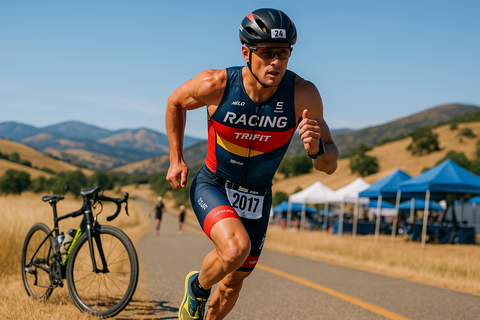
Laidlow entered T2 alongside Bogen with a 12-minute lead over Blummenfelt. The tactical plan had executed perfectly. He didn't know exactly what marathon time he was capable of — maybe a 2:34 or 2:35 if everything went well — but he knew he was in better shape than the previous year's 2:37:19.
He set off at 150 beats per minute: the upper limit of what he knew he could sustain.
"I set off on the upper limit of what I knew I was capable of," he remembers.
For the first 30 kilometers, it worked. He moved away from Bogen. He stayed disciplined. He didn't let the 12-minute cushion lull him into overconfidence — a lesson learned from a near-disaster at Kona, where he was on world record pace at kilometer 10 and walking four kilometers later.
The Nutritional Deficit Moment
Around the 30-kilometer mark, the warning signs appeared. His heart rate began drifting downward — not through deliberate recovery, but through depletion. His legs started to betray the pace his mind wanted to hold.
"I think I'd just simply run out of carbs," he confesses. "And that was when the real battle and the race started."
By 34 kilometers, he had completely blown up. Spectators were screaming that the world record was still within reach. His watch showed something close to five minutes per kilometer. In his head, the record was already gone.
His only remaining goal was simpler: reach the finish line.
The Dark Place — Brain Shutdown at 36K
What happened in those final six kilometers is difficult to reconstruct because Laidlow can barely remember them.
Frequently Asked Questions
What record did Sam Laidlow set at Challenge Roth 2026?
Sam Laidlow set the Iron-distance world record at Challenge Roth 2026 with a finishing time of 7:21:04, breaking the previous record by eight seconds.
What were Sam Laidlow's splits during the race?
During the race, Sam Laidlow recorded a swim time of 46:57, a bike split of 3:54:58, and a run time of 2:36:53.
What were Laidlow's tactics during the race?
Laidlow focused on aggressive pacing and tactical decisions to create pressure on his competitors, particularly Kristian Blummenfelt, throughout the race to secure his victory.
How did Laidlow prepare for the race?
Laidlow arrived in Roth early for course testing and worked extensively on his pacing strategy with a focus on the specific rolling terrain of the course, which was crucial for his performance.
What challenges did Laidlow face during the race?
Laidlow experienced difficulties during the final stretches of the marathon, including a significant drop in energy and needing to manage a nutritional deficit while pushing through physical and mental hurdles.
Why did Laidlow choose to race at Challenge Roth again?
Laidlow returned to Challenge Roth because he believed he could perform better than his previous year and appreciated the unique atmosphere and community support the event provided.
Source: triathlete.com — Sam Laidlow World Record Interview 2026