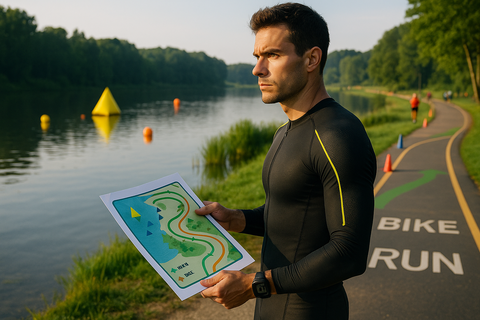
On paper, it's just six four-minute efforts. But done right, it will bring you to your knees—and make you a dramatically better racer.
The Deceptively Simple Workout That Separates Elite Triathletes from the Rest
There's a workout sitting on training plans across the world that doesn't look like much. Six intervals, four minutes each, four minutes rest. No fancy structure, no clever acronym, no app-generated complexity. Just you, your bike, and twenty-four of the most mentally grueling minutes you'll ever spend on two wheels.
When it shows up on your calendar, you'll probably think: I've got this.
You don't.
The 6x4 VO2 max interval session is the workout that elite coaches swear by, experienced athletes dread, and beginners underestimate—every single time. And understanding why it works is the key to unlocking a new dimension of performance, whether you're chasing a podium at your local sprint triathlon or dreaming of long-distance glory.
When Triathletes Proved They Could Compete at the Highest Levels
Let's set the scene. A decade ago, it was easy to dismiss triathlon cycling as "good enough for the run-off." Cyclists were cyclists. Triathletes were triathletes.
That narrative is officially dead.
Cam Wurf was racing on both the long-distance triathlon circuit and for the INEOS Grenadiers—one of the most dominant WorldTour cycling teams on the planet—simultaneously. Paula Findlay has repeatedly beaten WorldTour riders to claim the Canadian national time trial title. Taylor Knibb competed in the individual time trial at the Paris Olympics. Georgia Taylor Brown and Laura Philipp have trained in WorldTour camps. Kristian Blummenfelt once came close to making a full career switch to professional cycling.
The cycling fitness required at the top of triathlon is no longer a secondary skill. It is elite-level cycling.
This convergence has a direct implication for how serious triathletes need to train. If the athletes competing against you are riding at WorldTour-adjacent standards, cookie-cutter HIIT sessions from a generic fitness app aren't going to cut it. You need workouts forged in the same fire.
Why the "Dreadful Classic" Beats Modern HIIT—And It's Not What You Think
Here's where most training advice stops at physiology. We're going further.
Coach Jesse Moore—who brings over 20 years of coaching experience, a background as a domestic pro racer, a stint on the professional 70.3 circuit, and athletes like Dauphiné winner Andrew Talansky and former U.S. junior road race champion Cole Davis on his résumé—coaches this workout to everyone from age-groupers to pros. And he's thought deeply about why it works when so many newer alternatives fall short.
"The workout that all of my athletes dread the most, including myself, but also get the most out of, is the traditional 6 x 4 min VO2 w/ 4 min recovery." — Coach Jesse Moore, Moore Performance Coaching
Physiologically, the session makes sense: four minutes is long enough to fully tax your aerobic system, drive your heart rate to its ceiling, and force every energy system to work at maximum capacity simultaneously. Repeated six times with limited rest, the cumulative stress drives genuine VO2 max adaptation.
But modern training culture has produced plenty of clever workarounds—micro-intervals, 30/15 patterns, over-unders, Tabata variations. Many of them deliver comparable physiological stimulus. So why does Moore still prescribe this blunt instrument from the previous century?
Because the shortcuts miss the point.
"There have been lots of creative and effective HIIT ways to short-cut the physiological benefits of this old school suffer fest, but what they all miss is the mental toughness that comes out of not having the break from the psychological and panic-inducing pressure of having to hold that power, HR, and effort for four straight minutes with limited rest." — Coach Jesse Moore
The brief relief embedded in micro-interval formats—those tiny two-second pauses between 30-second blasts—provides more than a physiological breather. They provide a psychological one. And in racing, there are no psychological breathers.
The Real Differentiator: A Pure Psychological Battleground
This is where the 6x4 VO2 becomes something genuinely special—and genuinely brutal.
Moore doesn't just track power files after this session. He evaluates the emotional reaction of his athletes. What they say, what they negotiate with themselves, how they process the suffering. And what he hears is illuminating.
"There's a lot of cursing attached to my name on these days. Athlete comments revolve around a lot of self-talk, negotiations with oneself about the size of the pizza they get to have if they just do one more, or selling their firstborn child if they could skip the last two." — Coach Jesse Moore
If that sounds extreme, it's supposed to. The psychological journey of this workout maps almost perfectly onto the mental experience of a hard race. Here's what Moore identifies:
The Mental Stages of the 6x4 VO2
-
Pre-Workout Dread
The anxiety doesn't begin at the start line of the first interval. It begins the moment you see the workout on your calendar—sometimes days in advance. Self-doubt accumulates quietly. -
Warm-Up Phantom Issues
Suddenly your knee feels a little off. Your legs are unusually heavy today. Your stomach isn't quite right. The mind becomes extraordinarily creative at generating reasons to bail before the real work begins. -
During-Effort Mental Management
This is the core of the battle. The challenge isn't just holding the power—it's holding the power while managing panic. Four minutes is long enough that you can see the suffering stretching out ahead of you. Short micro-intervals don't create this pressure. The 6x4 does. -
Post-Effort Processing
The negotiations, the cursing, the existential bargaining. All of it is data. It tells Moore that his athletes are operating under genuine psychological stress—which means they're building genuine psychological resilience.
"It's a pure psychological battleground. From the moment of dread when it shows up on the workout calendar, the self-doubt, phantom niggles or poor feelings during the warm-up, to the focus required to take them one at a time and not become overwhelmed by the totality of the task in front of you. It's all pure gold come race day." — Coach Jesse Moore
The Race-Day Translation
Here's the connection that makes this more than just masochism with a training plan: the moments that decide races are almost always mental.
When a faster rider accelerates and you have to decide in a fraction of a second whether to respond—that decision isn't purely physiological. Your legs might have the watts. But does your mind say yes?
"Racing is hard, and managing one's head before, during, and after is critical. You can only learn how to do that under real pressure, and this workout provides that opportunity to practice outside of a racing context. To have calloused your mind against the stone this workout provides is often the difference maker between who says yes and who says no to that internal question when the moment of selection comes." — Coach Jesse Moore
Mental toughness, in other words, isn't a personality trait you're born with. It's a skill you train. And the 6x4 VO2 is one of the best training tools available for developing it.
The Full Protocol: How to Execute This Workout (And Actually Survive It)
Ready to try it? Here's exactly how to approach the session—including the details that determine whether you walk away with a genuine adaptation or just a bad day.
Step 1: Warm-Up (20–30 Minutes)
Don't skip or rush this. A proper warm-up serves both physiological and psychological purposes—it prepares your body and gives you time to transition mentally into the work ahead.
Warm-Up Structure:
- 20–30 minutes of easy riding
- 4 x 1 minute progressive efforts, building from 40% to 80% effort
- 4 x 15-second sprints with 1–2 minutes easy between each
These short efforts "wake up" the high-intensity pathways without depleting them. Think of it as previewing the stress to come without paying the full cost yet.
Fueling note: This session is short but extraordinarily demanding on your energy systems. High-octane power requires high-octane fuel. If you use gels, taking one in the final portion of your warm-up is a smart strategy.
Step 2: Choose Your Location
Find a stretch of road—flat or on a hill—where you will not be interrupted. Traffic lights, stop signs, pedestrians, and turn signals aren't just inconvenient; they undermine the psychological continuity that makes this workout so effective. Unbroken focus is part of the stimulus.
Step 3: The Main Set — 6 x 4 Minutes VO2
The Complete Workout:
| Segment | Duration | Intensity |
|---|---|---|
| Warm-Up | 20–30 min | Easy + progressive efforts |
| Interval 1 | 4 min | RPE 9–10 / VO2 max power |
| Recovery | 4 min | As easy as needed |
| Intervals 2–6 | 4 min each | RPE 9–10 / VO2 max power |
| Recoveries 2–5 | 4 min each | As easy as needed |
| Cool-Down | 20–30 min | Easy |
Measuring Effort:
- Power meter: Use power zones as your primary metric, combined with RPE. VO2 max efforts typically land around 120–150% of your Functional Threshold Power (FTP).
- No power meter: RPE 9–10 is your guide. It should feel like you genuinely cannot sustain this for the entire four minutes—and yet somehow you do.
- Heart rate: Not useful here. Your heart rate won't respond fast enough to serve as real-time feedback for a four-minute effort.
Step 4: The Critical Pacing Warning
This is where most athletes make their fatal mistake.
Do not start hard and hang on. Do not treat the first interval as a warm-up for your ego and blast off at maximum intensity, then spend intervals 2–6 in a deteriorating fade.
A word of caution: don't start too hard. Rather, start at a 9 RPE and build into maximal. A good way to approach the first effort is to perform it completely seated.
Starting seated forces control. It slows your acceleration, keeps you from sprinting off the line, and sets you up to build across the four minutes rather than collapse through them. The goal is to sustain maximum effort across all six repetitions—not to achieve one heroic first interval and limp through the rest.
Step 5: Recovery Between Efforts
Recovery is flexible—make it as easy as you need it to be. Options include:
- A brief unclip of 5–15 seconds followed by soft pedaling
- Easy spinning on flat ground
- On a hill: a relaxed roll back down while keeping the legs moving
The one non-negotiable: keep your legs moving. Stopping completely lets them tighten up, which makes the next interval harder to start and increases injury risk.
Step 6: Cool-Down (20–30 Minutes)
A thorough cool-down isn't optional after this session. Twenty to thirty minutes of easy riding calms the nervous system, begins the metabolic clearing process, and helps you transition from "existential crisis mode" back to functional human.
How You'll Know You Did It Right
This isn't a session where you check your power numbers, see a green zone, and feel satisfied. The feedback is visceral.
If you aren't melting from the inside and having an existential crisis, you didn't do it right.
Coach Moore's athletes confirm this experience with remarkable consistency. Forum user as9934 described completing a similar session—6x8 minute over-unders with 3–4 minutes rest—and the outcome was unambiguous: "Died somewhere around number 4. Had to dial the power WAY down for the last two. Was swearing and shouting so loud at the end, I woke my girlfriend up."
Lurker4 took a slightly different variation—4x6 minutes at 108% FTP with 6 minutes active recovery at 70%—after running 22 kilometers earlier in the day, sustained by what they described as a pre-workout consisting of "six Oreos." The humor is real. The suffering was realer.
That's the community of people doing this workout. Welcome.
Common Questions Before You Start
Can I do this workout without a power meter?
Absolutely. Use RPE 9–10 as your guide. Heart rate won't give you useful real-time feedback, so don't rely on it as your primary metric.
What if I can't hold power for all six efforts?
This is common—especially early in a training block. The solution isn't to start harder; it's to start more conservatively. Begin seated, build within the four minutes, and prioritize consistent quality across all six repetitions over one impressive first interval.
How often should I do this workout?
This session is intense enough that most athletes benefit from incorporating it every 7–10 days during a structured high-intensity block, with adequate easy days on either side. It is not a workout you can repeat daily—nor should you want to.
Is this appropriate for beginners?
This session works best for athletes who have built a solid aerobic base. If you're in your first season of triathlon, prioritize building that foundation before introducing VO2 max work at this intensity. For athletes with a year or more of consistent training, it's appropriately scalable—adjust target power to your current fitness, not your aspirational fitness.
The Bottom Line: Train the Body, Forge the Mind
The convergence of triathlon and professional cycling has raised the bar for what "elite" means in this sport. But it's also revealed something equally important: the athletes who consistently perform under pressure aren't just physically superior. They've trained their minds as rigorously as their legs.
The 6x4 VO2 interval session is deceptively simple. It looks innocent on paper. It is not innocent. Done correctly, it will push you to your physiological ceiling and to your psychological edge—and it will do it repeatedly, across six efforts, with only enough rest to make you think the next one might be manageable before proving you wrong.
That is exactly the point.
Modern HIIT variations can deliver comparable aerobic adaptation. What they can't replicate is the sustained, unbroken psychological pressure of holding maximum effort for four straight minutes—the kind of pressure that actually shows up in races. The mental callousing you build in this workout is the skill that keeps you pedaling when your brain is screaming to stop.
Here's your challenge for this week: pull up your training plan, find your next opportunity for a hard bike session, and replace it with this one. Prepare your route. Fuel properly with quality energy supplements. Respect the pacing. And when you're somewhere around the fifth interval, bargaining with yourself about pizza or contemplating more dramatic sacrifices to get out of the sixth—remember that's not failure. That's the workout working.
Share your experience (and your creative negotiations with yourself) in the comments. We want to know what you promised yourself to get through that last interval.
And if you survived, you might just be ready to explore the rest of your race season essentials with a slightly more calloused mind than you had before.
What is the "6 x 4 minutes VO2" workout?
The "6 x 4 minutes VO2" workout is a cycling routine consisting of six intervals where you maintain a high intensity effort for four minutes, followed by a four-minute recovery. It's designed to improve physical and mental toughness, pushing cyclists to their limits.
Why is this workout so psychologically challenging?
This workout is psychologically challenging because it requires athletes to sustain a very high effort level under pressure for extended periods. The mental focus required to push through discomfort and self-doubt during the workout builds resilience that is crucial on race day.
How should I prepare for the "6 x 4 minutes VO2" workout?
Prepare for this workout by starting with a comprehensive warm-up of 20 to 30 minutes, including progressive intensity efforts to get your body ready for the high intensity. Ensure you're well-fueled, possibly consuming a quick energy source like a gel before the intervals.
What metrics should I use during this workout?
During the workout, use Rate of Perceived Exertion (RPE) as your guide, aiming for a level of 9-10, which means very hard effort. If you train with power, use power readings to gauge effort, rather than heart rate, as it may not respond quickly enough during intense efforts.
Is this workout suitable for all levels of cyclists?
While this workout can provide significant benefits, it is not recommended for beginners or those unaccustomed to high-intensity intervals. It's more suitable for seasoned cyclists and triathletes looking to build both physical and mental resilience.