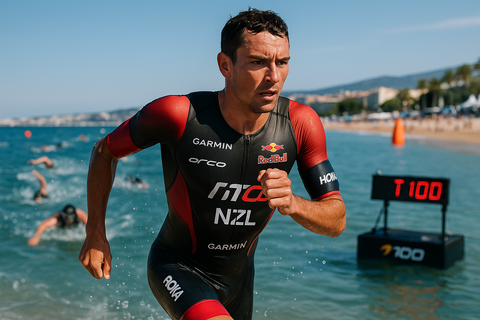
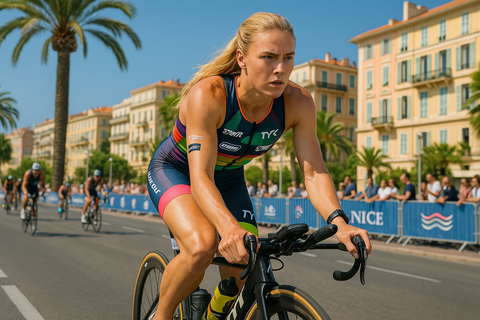
Two champions. Two completely opposite strategies. One unforgettable race weekend on the Costa Daurada.
Challenge Salou 2026 Race Results: Will Draper's Dominant Victory & Elisabetta Curridori's Title Defense
The Men's Race: Will Draper's Relentless Assault
A Crowded Start Sets the Stage
The men's race began as a packed, shoulder-to-shoulder affair. A dense lead pack emerged from the swim, with athletes like Enzo Bourbon, Malachi Cashmore, and defending champion Thomas Davis all arriving together into T1. There was no early separation, no tactical advantage for any single athlete — just a compressed field and the bike course waiting ahead.
The Bike Leg: Where the Race Was Decided
Harry Palmer and Jack Hutchens immediately set a blistering pace on the bike, pushing speeds upwards of 60 km/h to force an early selection. The strategy was clear: go hard early, break the field, and control the race from the front.
It almost worked. But it didn't account for Will Draper.
While the leaders were battling for position, Draper launched a relentless assault. Closing the gap with what seemed like effortless power, he didn't just join the leaders — he bypassed them entirely.
| Checkpoint | Draper's Gap Over Nearest Rival |
|---|---|
| Bike halfway | +0:42 |
| T2 (Transition 2) | +2:25 |
| Early run | +3:25 (estimated) |
| Finish line | +1:36 over 2nd place |
In roughly 45 minutes of racing, Draper turned a 42-second lead into a 2 minute 25 second cushion. That's not just speed — that's surgical execution of a power-based strategy, applied at precisely the right moment.
The lesson here is counterintuitive: Draper didn't attack when the pace was highest. He attacked when the frontrunners — Palmer and Hutchens — were most fatigued from setting the pace. Timing, not just power, made the difference.
The Run: "An Extra Gear" Left
Coming into T2 with a 2:25 lead, the question wasn't whether Draper would win. It was by how much.
As he exited transition, Draper reportedly shouted to the crowds that he still had "an extra gear" left. He wasn't joking. In the opening kilometers of the run, he added another full minute to his lead, effectively neutralizing any remaining threat from the chase group.
This kind of psychological confidence isn't arrogance — it's the natural result of executing your race plan perfectly. When you've saved something for the run, you know it. And when your competitors sense that certainty, the mental battle is already over.
The Podium Battle: Hutchens vs. Berland
Behind Draper, a fierce secondary race unfolded for the remaining podium spots. Jack Hutchens had been one of the pace-setters on the bike and was now paying the metabolic price — but he refused to crack.
Frenchman Arthur Berland was the man on the move, surging through the field and passing Hutchens at the halfway mark of the run. It looked like Berland would hold on for second. But in a dramatic final-kilometer sprint, Hutchens dug deep and reclaimed the spot he'd worked so hard for.
Men's Final Podium — Challenge Salou 2026:
- 🥇 Will Draper (GBR) — 3:36:11
- 🥈 Jack Hutchens (GBR) — 3:37:47 *(+1:36)*
- 🥉 Arthur Berland (FRA) — 3:38:23 *(+2:12)*
A British 1-2 in Salou — and not a single second wasted between second and third. That's the quality of field Challenge Family races consistently attract.
The Women's Race: Elisabetta Curridori's Masterclass in Patience
The Swim: Local Hero Takes Center Stage
If the men's race was about raw power, the women's race was an entirely different kind of story — one built on patience, composure, and the quiet confidence of a defending champion who knew exactly what she was doing.
It didn't start that way for Elisabetta Curridori.
Supported by a roaring home crowd, Spanish athlete Marta Sanchez set the water on fire. She emerged from the swim with a commanding 42-second lead over Jasmine Holmes. Further back, a group featuring Juliette Lucet, Brooke Gillies, and Milan Agnew followed. And Curridori? She was trailing by over 90 seconds — a significant deficit on a course this fast.
For most athletes, that gap would trigger panic. For Curridori, it was simply the opening chapter.
The Bike Leg: The Tactical Tug-of-War
Sanchez carried her momentum onto the bike, initially extending her lead as the kilometers ticked by. The home crowd favorite looked like she might just pull off the upset of the year. At one point, the gap stretched back out to 1 minute 30 seconds.
Behind Sanchez, the dynamics were shifting rapidly. Curridori surged through the field to reach second place, then found herself absorbed into a high-octane chasing group with Milan Agnew and Juliette Lucet. Rather than attacking solo, she did something smarter: she settled in, conserved energy, and waited.
Then, at the halfway point of the bike leg, everything changed.
The tides turned at the halfway mark of the bike leg. Sanchez began to fade, her lead shrinking to a mere 20 seconds within a few kilometers.
What looked like a commanding lead had evaporated almost entirely by T2. Sanchez — who had likely gone out too hard, fueled in part by the energy of the home crowd — was caught, and a four-woman lead group entered the run together: Curridori, Agnew, Lucet, and Sanchez.
The race was now decided on foot.
The Run: Curridori's Victory Lap
As the half marathon began, Juliette Lucet made a bold early move, briefly snatching the lead. It was an aggressive play — but it was also a desperate one. Curridori's response was immediate and decisive: she reclaimed the top spot almost instantly, with only Milan Agnew possessing the strength to stay within striking distance.
What followed was a masterclass in controlled dominance.
What followed was a steady, relentless demonstration of pace. By the midpoint of the run, Curridori had built a 40-second cushion. By the third lap, that gap had grown to a full minute. For the Italian star, the final kilometers weren't just a race; they were a victory lap.
| Run Checkpoint | Curridori's Lead |
|---|---|
| Early run | Neck and neck (4-woman group) |
| Midpoint | +0:40 |
| Third lap | +1:00 |
| Finish | +0:40 over Agnew |
The gap closed slightly at the end — a sign of Agnew's incredible resilience — but Curridori's title was never truly in doubt after she established her rhythm.
The Podium: Drama in the Final Meters
Curridori crossed the line in 4:04:02, successfully defending her title. Milan Agnew followed in a hard-earned second place at 4:04:42 — just 40 seconds back, a testament to her own exceptional run.
And then, in the closing meters, Marta Sanchez — who had faded so dramatically mid-race — found one last surge. She overtook Juliette Lucet to claim the bronze medal in 4:08:23. A narrative arc of early dominance, mid-race struggle, and final-kilometer resurgence, all in one race. Quite a day for the Spanish athlete on home soil.
Women's Final Podium — Challenge Salou 2026:
- 🥇 Elisabetta Curridori (ITA) — 4:04:02
- 🥈 Milan Agnew (AUS) — 4:04:42 *(+0:40)*
- 🥉 Marta Sanchez (ESP) — 4:08:23 *(+4:21)*
Contrasting Strategies: Power vs. Patience
Draper's Aggressive Dominance
Draper's strategy was built on a simple premise: build an insurmountable lead on the bike, then manage the run. He waited for the pace-setters to exhaust themselves, struck at the optimal moment, and never looked back. The psychological effect of shouting "I've got an extra gear" as he entered T2 wasn't incidental — it was part of the race.
Risk: High. If Draper had cramped or blown up with a 2:25 lead, he would have handed the race back to the field with nowhere to hide.
Reward: Total control. When it works, aggressive bike racing turns a hard race into a time trial.
Curridori's Surgical Precision
Curridori's strategy was the mirror image. She accepted a 90-second deficit without panicking, positioned herself strategically within the chase group, conserved energy through drafting dynamics, and moved decisively only when the moment called for it — at the bike halfway point when Sanchez began to fade.
Risk: Lower. She was never in a position where she needed to gamble everything on one move.
Reward: Clinical efficiency. She arrived at T2 with fresher legs than anyone who had attacked early, and she used every last joule of that energy on the run.
The Broader Tactical Lesson
Both strategies worked because they were matched to each athlete's actual strengths. Draper's power suited aggression; Curridori's experience suited patience. The mistake most age-group racers make is copying a strategy that doesn't fit their physiology.
Know your strength. Execute it when conditions favor it. That's the entire playbook.
What Age-Group Racers Can Take from Challenge Salou
🚴 The Bike Leg Decides Races
Both Draper and Curridori gained their decisive advantages on the bike — not the run. The run was about managing what they'd built, not creating it. If you're spending 90% of your training time running and only dabbling on the bike, you're leaving positions on the table.
Invest serious time in bike-specific power development and pacing discipline. It's where races are won and lost at every level.
⏱️ Don't Panic at Early Deficits
Curridori trailed by over 90 seconds after the swim. She won by 40 seconds at the finish. That's a 130-second swing — achieved not by panicking, but by trusting her process.
If you exit the swim behind where you hoped, breathe. The bike leg is the great equalizer. Focus on your pacing, not the gap.
🧠 Know Whether You're a Front-Runner or a Closer
Draper is a front-runner — he builds leads and defends them. Curridori is a closer — she positions, conserves, and pounces. Neither style is superior. But training the wrong style for your natural racing profile is a common and costly mistake.
Ask yourself honestly: do you perform better when you control the pace from the front, or when you chase and overtake in the final third? Then train and race accordingly.
💪 Confidence Comes from Preparation, Not Position
When Draper shouted that he had an extra gear, it wasn't bravado. It was the result of knowing exactly how he'd paced his bike leg and what he had left in the tank. That kind of confidence is built in training, not conjured up on race day.
The more precisely you train to your race plan, the more confident you'll feel when it matters most.
Final Results at a Glance
Men's Race
| Place | Athlete | Country | Time | Gap |
|---|---|---|---|---|
| 1st | Will Draper | GBR | 3:36:11 | — |
| 2nd | Jack Hutchens | GBR | 3:37:47 | +1:36 |
| 3rd | Arthur Berland | FRA | 3:38:23 | +2:12 |
Women's Race
| Place | Athlete | Country | Time | Gap |
|---|---|---|---|---|
| 1st | Elisabetta Curridori | ITA | 4:04:02 | — |
| 2nd | Milan Agnew | AUS | 4:04:42 | +0:40 |
| 3rd | Marta Sanchez | ESP | 4:08:23 | +4:21 |
The Takeaway: Two Champions, One Lesson
Challenge Salou 2026 gave us two victories that couldn't look more different on the surface — and yet they share a common thread. Both Will Draper and Elisabetta Curridori won because they understood themselves as athletes, built a strategy around that understanding, and executed it with discipline when the pressure was highest.
Draper reminded us that when a rider has genuine power and the timing to use it, the bike leg can make a race entirely. Curridori reminded us that a title defense isn't about ego — it's about reading the race with cold clarity and moving only when the moment is right.
Whether you're eyeing a Challenge Family race, planning your first triathlon season, or simply trying to understand what separates the winners from the rest, this weekend on the Costa Daurada offered as clear a lesson as you'll find.
The best triathletes don't just swim, bike, and run. They think.
Gearing up for your next race? Check out our premium triathlon suit and racing running shoes to make sure you're ready to execute your own race-day strategy. Don't forget electrolyte supplements for optimal hydration during your training and racing.
Who won the 2026 Challenge Salou race?
Will Draper won the men's race with a time of 3:36:11, while Elisabetta Curridori won the women's race, defending her title with a time of 4:04:02.
What were the key highlights of Will Draper's performance?
Will Draper showcased remarkable power during the race, advancing from a 42-second lead halfway through the bike leg to a 2:25 advantage by T2. He extended his lead further during the run.
How did Elisabetta Curridori secure her victory?
Elisabetta Curridori initially trailed following the swim but strategically advanced through the bike leg and reclaimed the lead during the run, finishing strong with a comfortable margin.
What challenges did the athletes face during the race?
The race featured a fast and tactical course that demanded both speed and strategic decision-making. Athletes contended with changing dynamics, especially during the bike and run phases.
What platforms can I follow for more triathlon news?
You can follow Triathlon Today for comprehensive race reports, news updates, and gear reviews on their website.