Pool swim vs open water: what to know
The first time many triathletes leave the pool and swim in a lake or the ocean, the shock is not fitness. It is control. The line on the bottom is gone, your pace feels harder to judge, and even a short swim can feel mentally louder than a long pool session. That is why understanding pool swim vs open water matters early, not just a few weeks before race day.
If you are training for your first triathlon, this comparison is not about deciding that one is better. It is about knowing what each environment builds, what each one exposes, and how to use both to become race-ready with more confidence and fewer surprises.
Pool swim vs open water: the biggest difference
A pool is controlled. Open water is variable. That single contrast affects almost everything else.
In the pool, you know the distance, the temperature is usually stable, the walls break up your effort, and the visual reference is simple. You can track splits, count strokes, and repeat intervals with precision. For beginners, this makes the pool the fastest place to improve technique and basic swim fitness.
Open water asks for a different skill set. You deal with current, chop, glare, waves, crowds, changing temperatures, and sometimes poor visibility. There are no lane ropes and no wall every 25 or 50 meters to reset your breathing. You need to sight, stay calm, hold direction, and keep moving when conditions are not ideal.
This is why strong pool swimmers are not always strong open-water swimmers right away. Fitness transfers, but comfort does not always transfer at the same speed.
What the pool does best
For structured training, the pool still wins.
If your goal is measurable progress, pool sessions give you clean feedback. You can build aerobic capacity, improve body position, work on catch mechanics, and learn pacing without extra variables. When you are new to triathlon, that matters. Beginners often need consistency more than complexity, and the pool gives you exactly that.
The pool is also safer for learning. You can stop at the wall, adjust goggles, reset your breathing, and focus on one technical change at a time. If you panic easily in the water or come from a running or cycling background, this environment helps you develop the basic confidence that open water demands later.
There is another practical point. Most athletes can access a pool far more often than a safe open-water venue. That means your weekly training is usually built there, even if your race is not.
Still, pool training has limits for triathletes. Turns and push-offs create mini-recoveries that do not exist in a race. You also do not learn how to navigate, manage contact, or stay relaxed when you cannot see the bottom.
What open water does best
Open water is where triathlon-specific swim readiness gets tested.
You learn how your stroke holds up without lane lines. You learn whether your breathing stays controlled when the water moves. You learn how often to sight without wrecking your body position. Most important, you learn how to stay composed when your environment feels less predictable.
That mental side is a big deal. For many first-time triathletes, the swim is not the hardest discipline physically. It is the most stressful. Open-water practice reduces that stress because it makes race-day sensations familiar. Cold water, crowded starts, buoy turns, and the feeling of being bumped by other swimmers are easier to manage when they are not new.
Open water also teaches efficiency in a more honest way. Without walls, you sustain effort continuously. If your pacing is too aggressive, you feel it. If your line is off, you swim extra distance. If your stroke falls apart under stress, the water tells you quickly.
The trade-off is that open water is a poor place for highly controlled interval work. It is better for simulation, adaptation, and confidence under realistic conditions.
Why beginners often misread their swim ability
A common mistake is assuming pool speed equals race readiness. Another is assuming fear in open water means poor fitness. Both can be wrong.
You might be fit enough to swim the distance but still struggle in open water because your breathing spikes when visibility drops. Or you might be slower in the pool but perform better outside because you pace calmly, sight well, and stay relaxed in a pack.
Triathlon rewards applied skill, not just raw swim metrics. That means your training should answer two questions: Can you swim the distance efficiently, and can you do it under race-like stress?
If the answer to the first question is no, spend more time in the pool. If the answer to the second is no, you need more open-water exposure.
How to train for both without overcomplicating it
For most beginner and early-stage triathletes, the smartest setup is simple: use the pool for the majority of your swim volume and use open water regularly enough that race conditions stop feeling foreign.
In practical terms, that usually means two or three pool sessions per week and one open-water session when possible, especially in the final 6 to 10 weeks before an event. If open water is not available weekly, even occasional sessions can help if you treat them with purpose.
Use pool time to build form and fitness. Focus on pacing, steady aerobic work, and drills that improve alignment and breathing control. Use open water to practice starts, sighting, continuous swimming, buoy turns, and calm execution.
This split works because each environment solves a different problem. The pool improves your engine and mechanics. Open water improves your adaptability and race confidence.
Skills that matter more in open water than in the pool
Some athletes train hard in the pool but never specifically practice the skills that save energy outside. Sighting is the obvious one. If you lift your head too high or too often, your hips drop and your rhythm breaks. That costs time and raises effort.
Drafting matters too. Swimming behind or slightly beside another athlete can reduce effort, but only if you are comfortable being close to other swimmers. Then there is start management. A triathlon swim rarely begins in the calm, controlled way a lane session does. You need a plan for where to line up, how hard to go in the first minutes, and how to settle your breathing quickly.
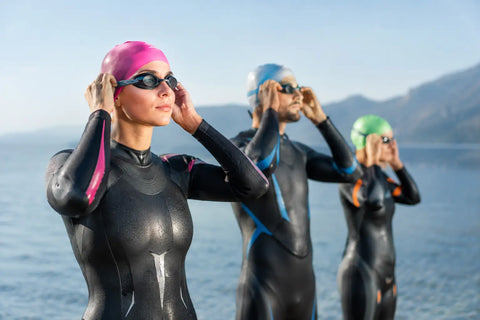
Even small details change. Bilateral breathing can be more useful when waves or sun make one side less comfortable. Wetsuit swimming changes body position and feel in the water. Pool swimmers who never test that before race day often need an adjustment period.
Which one is harder?
For most triathletes, open water feels harder. That does not always mean it is physiologically harder. It often means it is less predictable.
A pool asks you to perform. Open water asks you to perform and adapt at the same time. If you are highly skilled and comfortable outdoors, open water can feel smooth and even enjoyable. If you are new, the same session can feel tense and inefficient.
This is good news because confidence is trainable. Many athletes who once feared open water become steady and capable there after a few months of specific practice. The key is not forcing huge sessions. It is building familiarity step by step.
The best choice for race prep
If your race includes an open-water swim, training only in the pool is not enough. It can get you fit, but it may not get you ready.
At the same time, replacing most pool work with open water is usually not the best move, especially for beginners. You lose some structure, consistency, and technical control. The better approach is to keep the pool as your foundation and layer in enough open-water practice to remove uncertainty.
Think of it this way: the pool builds capacity, open water validates it. When both are present in your plan, your swim becomes more complete.
For athletes moving from sprint to Olympic or longer distances, this balance becomes even more important. Longer swims increase the cost of poor navigation, poor pacing, and rising anxiety. The more distance you race, the more valuable specific open-water skill becomes.
If you want a confident answer to pool swim vs open water, here it is: train in the pool to improve, train in open water to compete well. One develops the system. The other prepares you to use it when the race gets messy.
A good triathlon build is not about choosing the perfect environment. It is about removing weak links before they show up on race morning. Start where you can train consistently, add race-specific exposure early enough, and give yourself enough repetitions that the water feels familiar instead of intimidating. That is how confidence becomes performance.