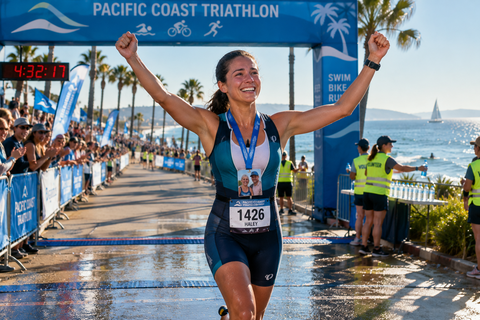

Run if you can, walk if you need to. Just don’t stop. That was Sanket Arsekar’s message after finishing a long-distance triathlon event in Goa. It’s a reminder for anyone who has seen a race on the calendar and thought, That’s not for me.
On Monday, 2 November 2026, Arsekar, a 38-year-old from Sanvordem, Goa, completed the Goa 70.3-distance triathlon for the third consecutive year. He ran the 21.1 km half-marathon leg of a relay team that finished in 6 hours and 3 minutes. That same day, he launched a 30-day fitness challenge for people across Goa.
Here’s a simple look at the race, how the relay worked, and what beginners can learn from three years of showing up. You’ll also find a practical way to start building an endurance habit, even if you work full time. Race details come from reporting by TNM with ANI inputs.
What a 70.3-Distance Race Involves
The “70.3” refers to the total distance in miles. A 1.9 km swim, 90 km bike ride, and 21.1 km run add up to roughly 113 km, or 70.3 miles. That’s half the distance of a full long-distance triathlon—and still a challenging day of swimming, cycling, and running.
| Leg | Distance | Arsekar’s relay teammate |
|---|---|---|
| Open-water swim | 1.9 km | Ram |
| Bike | 90 km | Navin |
| Run (half-marathon) | 21.1 km | Arsekar |
Open-water swimming takes place in natural water, such as the sea, a lake, or a river. Unlike a pool, it has no lane lines or wall to rest on, so it can feel daunting for first-timers.
This was the sixth edition of the Goa race. The report describes it as an event that attracts athletes from across India and abroad, and as one of the country’s most challenging endurance events.
Why a Relay Is a Great Way to Start
In a relay, each teammate takes on one discipline. Three people cover about 113 km together, so no one needs to be strong in all three sports.
If you’re a runner who feels unsure about swimming, or a cyclist who has never raced, a relay gives you a way to participate without mastering every discipline first. It can also make your first multisport event more social and less intimidating. Think of it as a welcoming first step into triathlon.
Three Years of Showing Up
The most striking part of Arsekar’s story isn’t his finish time. It’s that he came back.
“Three years ago I signed up to test myself. Today it is part of who I am.”
That’s what can happen when a goal becomes part of your identity. Training can shift from something you feel you have to do to something that feels like part of your life.
Arsekar also shares the principle behind that change:
“Fitness is not about one race. It is about showing up every single day.”
Beginners often focus on race day. But long-term progress comes from ordinary training days, too. A short workout you complete is more valuable than a perfect plan you drop after two weeks.
Poco a poco—little by little—is a mindset shared by athletes from Goa to Guadalajara. You don’t need to do everything at once to build endurance.
Fitness Beyond the Finish Line
Arsekar’s work extends beyond racing. According to the report, he has taken part in youth and community initiatives across Goa, including organising treks to local waterfalls to encourage fitness, outdoor activity, and an addiction-free lifestyle.
A workout doesn’t have to involve a bike, a wetsuit, or a start line. A group hike counts, too. It helps build both aerobic fitness and the habit of moving regularly—two things that support endurance sports.
#SuperFitNovember: A 30-Day Challenge
On the day he finished the race, Arsekar launched #SuperFitNovember, a 30-day open fitness challenge for people across Goa. The report describes the challenge this way:
- Daily exercise: Participants do simple exercises each day.
- Share your effort: They post a photo or video using #SuperFitNovember.
- The finale: The challenge ends with a 5 km and 10 km marathon on 29 November.
- Medals for consistency: Everyone who stays consistent receives a medal, not just the fastest finishers.
That last detail is especially encouraging for beginners. Rewarding consistency shows that simply showing up is worth celebrating.
The report says the challenge is aimed at people across Goa, but doesn’t explain whether people elsewhere can join or how registration works. If you’re in another place, you can still borrow the idea: choose 30 days, do something small each day, and share your progress with friends. Community fitness challenges like this can also bring athletes together in Mexico and across Latin America.
Can a Beginner Do This? Start With a 30-Minute Walk
Arsekar’s advice is simple and welcoming:
“If I can train alongside my work, anyone can start with a 30-minute walk.”
Here’s one way to turn that idea into a plan. This is general beginner guidance, not a personalised prescription. If you have health concerns, check with a doctor before starting.
- Week 1: Walk for 30 minutes most days. Focus on consistency, not speed.
- Weeks 2–4: Add short jogging intervals. Run when you can and walk when you need to.
- Month 2 and beyond: Continue gradual run-walk sessions. If you enjoy them, consider a local 5 km event or a community fitness challenge before signing up for longer distances.
Choose a pace that lets you speak in short sentences. If you feel unusually unwell or have pain that changes how you move, stop and seek appropriate medical advice. The goal is to finish feeling that you could do it again—not to prove yourself on day one.
Key Takeaways
- A 70.3-distance triathlon combines a 1.9 km swim, 90 km bike ride, and 21.1 km run.
- Relay teams let beginners try a multisport event by focusing on one discipline.
- Three years of participation shows how a goal can become a lasting habit.
- Community activities such as hikes and 30-day challenges can make fitness more welcoming.
- Starting with a 30-minute walk is a practical first step toward endurance training.
Arsekar’s story isn’t a promise that everyone should race a 70.3. It’s a reminder that endurance grows through small, repeatable efforts. Start with a walk, find a supportive community, and keep going at a pace that works for you.
Editorial Note
This article is based on a TNM report that includes ANI inputs. Quotes, race details, and challenge information are attributed to that reporting. The training suggestions are general information for beginners, not medical advice.
Run if you can, walk if you need to. Just don’t stop. Goa’s Sanket Arsekar completes his third 70.3 relay, inspires locals with 30-day challenge.https://t.co/8Er0V0J3FB
— Sunday Goa Times (@SundayGoa) November 2, 2026
#FitnessChallenge #SuperFitNovember
Source: https://thenewsmill.com/2026/11/sanket-arsekar-completes-ironman-70-3-goa-triathlon-for-third-year/
Discover unique triathlon-themed merchandise, including stylish t-shirts, stickers, phone cases, and home decor - perfect for endurance sports enthusiasts and athletes. Shop now
Who completed the 70.3-distance Goa triathlon for the third consecutive year?
Sanket Arsekar, a 38-year-old BJP party worker from Sanvordem, Goa, completed the event for the third consecutive year.
Which part of the 70.3-distance Goa relay did Sanket Arsekar complete?
Arsekar ran the 21.1-kilometre half-marathon leg of the relay. His teammates completed the 1.9-kilometre open-water swim and 90-kilometre cycling legs.
How long did Arsekar’s relay team take to finish?
The team finished the 70.3-distance Goa relay in a total time of 6 hours and 3 minutes.
What is the #SuperFitNovember challenge?
It is a 30-day open fitness challenge launched by Arsekar for people across Goa. Participants do simple daily exercises and share a photo or video using the hashtag #SuperFitNovember.
How will the #SuperFitNovember challenge conclude?
The challenge is scheduled to conclude with 5- and 10-kilometre marathons on November 29. Medals will be awarded to participants who maintain consistency.