How to Improve Triathlon Transitions
Nobody signs up for a triathlon thinking, "I can't wait for T1." But race results say a lot about the athletes who treat transitions like a real discipline. If you want to know how to improve triathlon transitions, start here: the goal is not to rush blindly. It is to move with control, make fewer decisions, and leave each transition area feeling settled instead of scrambled.
For beginners, transitions often feel chaotic because they combine stress, fatigue, gear changes, and race rules in a very small space. A few lost seconds are normal. Losing one or two minutes because you forgot your helmet strap or couldn't find your spot is preventable. That matters in every race format, but especially in sprint and Olympic distance events where transitions make up a bigger share of your total time.
Why transitions matter more than most beginners think
A stronger swim, bike, or run takes weeks and months to build. Better transitions can improve in a few focused sessions. That is why they are one of the fastest performance gains available to new triathletes.
There is also a confidence benefit. When your transition plan is clear, your heart rate stays lower, your attention stays where it should, and race day feels more manageable. For first-timers, that mental control can be as valuable as the time saved.
The trade-off is simple. If you chase every possible second, you may create mistakes. If you move too cautiously, you give away free time. The best transition strategy sits in the middle: fast enough to be competitive, calm enough to stay accurate.
How to improve triathlon transitions before race day
The biggest gains happen before you arrive at the venue. Most athletes do not have a transition problem on race morning. They have a preparation problem.
Start by reducing decisions. Lay out only what you truly need. In T1, that usually means helmet, sunglasses if you use them, bike shoes or running shoes if you are not clipping in barefoot, and your bike. In T2, keep it equally simple: running shoes, race belt if you did not wear it on the bike, cap or visor if needed, and maybe nutrition if your plan calls for it.
More gear is not always better. Socks can help prevent blisters, but they also cost time. Cycling shoes clipped to the bike can be faster, but only if you have practiced mounting and dismounting safely. For a first triathlon, choosing slightly slower but more reliable options is often the smarter call.
Build a transition setup you can repeat
Your setup should look the same every time you practice. Put your helmet upside down on the handlebars or on the towel with the straps open. Place sunglasses inside the helmet if that helps your sequence. Set shoes in the exact direction your body will move. Keep your towel small and use it more as a visual marker than a beach mat.
A repeatable setup matters because transitions happen under pressure. You will not rise to the occasion. You will fall back on what you rehearsed.
Walk the flow, not just the rack
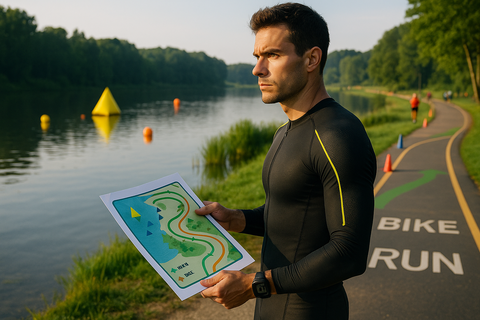
Many beginners memorise where their bike is and stop there. That helps, but it is only part of the job. You also need to know the full route: swim in, run to your rack, bike out, bike in, and run out. Know where the mount and dismount lines are. Know which side of the rack you will approach from.
If the venue allows it, walk the path more than once. Count landmarks. Look for a tree, banner, aisle number, or fence line near your spot. After the swim, everything can look different than it did during check-in.
T1: From swim to bike without the panic
T1 is often the more difficult transition because your heart rate is high, your balance can feel strange after the swim, and you need to handle more gear. The cleanest T1 starts before you even reach your bike.
As you exit the water, begin thinking ahead. If you wear a wetsuit, unzip it early when allowed and peel it to your waist while running. Keep your cap and goggles together in one hand or tucked into a sleeve so you do not drop them. Arrive at your rack already in transition mode.
Once there, follow the same order every time. Wetsuit off. Helmet on and fastened. Sunglasses on. Bike shoes or running shoes on. Grab bike. Run out. This order matters because touching your bike before your helmet is secured can lead to a penalty in many races.
A common mistake is trying to do too many things at once. Athletes hop on one foot, fight with a wetsuit, and look around for lost gear. Slow is not the answer, but clean movements are. Sit for a few seconds if you truly need to remove a stubborn wetsuit. That can still be faster than stumbling through 30 seconds of frustration.
Practice the first 60 seconds of T1
You do not need a full race simulation every week. Just rehearse the first minute. After a swim session or even at home, practice running in, removing your wetsuit, putting on your helmet, and moving out with your bike. Time it, then repeat.
This is where short, focused drills work better than vague intention. Ten minutes of transition practice can create more race-day improvement than another hour spent thinking about it.
T2: Faster because it should be simpler
T2 is usually shorter, and that is exactly why athletes get careless. They come off the bike, mentally relax, and lose easy seconds.
Your T2 starts before the rack. In the final minutes of the bike, shift to an easier gear, spin your legs up, and prepare to run. If you use elastic laces, make sure they are set correctly before race day. If you need nutrition for the run, decide in advance whether it goes in your hand, pocket, or race belt.
At the rack, the sequence should be automatic. Rack bike. Helmet off. Shoes on. Grab what you need. Run out. If your station is crowded, take the extra second to place the bike securely. A messy rack can cost more time than it saves.
The main goal in T2 is to leave quickly without forgetting something important. That might mean your cap in hot conditions, your gels for a longer race, or simply your race belt if your bib must be visible on the run. What you need depends on race distance, weather, and your comfort with running off the bike.
The best drills for improving triathlon transitions
If you want a practical answer to how to improve triathlon transitions, this is it: practice them as a skill, not as an afterthought.
One useful drill is the dry transition repeat. Set up your gear at home or at the track and go through T1 or T2 five to eight times. Keep the movements identical. Another is the brick with a transition focus, where the goal is not just bike-to-run fitness but clean setup, dismount, shoe change, and exit rhythm.
A third option is visual rehearsal. This sounds simple, but it works. Close your eyes and run through your entire transition sequence step by step. Picture your hands, your gear, the order, and the direction you move. When race morning gets noisy, familiarity helps.
For newer athletes, once a week is enough. Closer to race day, add one or two shorter sessions where transitions are the main purpose rather than an extra detail after training.
Common mistakes that slow you down
Most slow transitions come from the same issues. Too much gear. No fixed order. No practice. And no awareness of race rules.
Another mistake is copying advanced athletes without the skill to match. Flying mounts and barefoot running in cycling shoes look fast, and they can be. They can also turn into wasted time or a crash if you have not practiced them enough. Your best transition is the fastest version of what you can execute consistently.
Nervous energy also causes overpacking. You bring extra nutrition, extra layers, and backup items "just in case," then spend race morning sorting through clutter. A clean transition area usually belongs to an athlete with a clear plan.
Race-day habits that make transitions easier
Arrive early enough that you are not setting up under pressure. Check your rack position, tyre pressure, and exit routes. Then stop adjusting everything. Constant tinkering usually increases stress, not readiness.
Before the start, do one final scan of your setup and one mental walkthrough of both transitions. Keep it brief. You are not trying to memorise the whole race again. You are reminding your body of the sequence.
If you want extra support as you prepare for your first race or step up in distance, TriLaunchpad can help you organise training, readiness, and gear choices without the usual overload. That kind of structure makes transitions easier too, because confident athletes make cleaner decisions.
A good transition does not look dramatic. It looks boring, controlled, and efficient. That is the point. On race day, you do not need perfect. You need a plan simple enough to hold up when your heart rate spikes and your brain gets noisy. Build that plan now, rehearse it until it feels normal, and let free speed become part of your race.