How to Choose Your First Triathlon
Picking your first triathlon can feel harder than the training plan. One race looks beginner-friendly until you notice the open-water swim. Another has a flat bike course, but it is held in the hottest month of the year. If you are wondering how to choose a triathlon race without second-guessing every option, the goal is simple: find the event that matches your current fitness, your timeline, and the kind of race day experience you actually want.
A lot of new triathletes make the same mistake. They choose the race that sounds exciting, popular, or close to home, then try to force their training around it. That can work, but it often creates avoidable stress. A better approach is to choose a race that gives you the best chance to train consistently, arrive prepared, and enjoy the day instead of just surviving it.
How to choose a triathlon race based on your real starting point
The best race for you is not the most famous one. It is the one that fits where you are now.
Start with your strongest and weakest disciplines. If you are a confident swimmer but new to cycling, a race with a calm swim and a less technical bike route will probably feel better than one with hills, sharp turns, and wind. If swimming makes you nervous, the swim should drive the decision more than anything else. A shorter race with a pool swim or sheltered open water can change your whole first-race experience.
Be honest about your current training rhythm too. If you are working full time, managing family responsibilities, and fitting training into early mornings, a sprint triathlon may be the smart move even if an Olympic distance sounds more impressive. There is no shortcut around training load. Longer races ask for more volume, more recovery, and usually more logistics.
This is where confidence matters. You do not build confidence by picking the hardest option available. You build it by choosing an event you can prepare for well.
Distance matters, but not the way most beginners think
Most first-timers should look at sprint distance first. That is not because it is easy. It is because it is manageable. A sprint still demands fitness, pacing, and transitions, but the training is more realistic for busy adults and the learning curve is less punishing.
Olympic distance can also be a good first race if you already have a strong endurance base from running, cycling, or both. But that depends on your swim comfort and how many weeks you have to train properly. If your current fitness is inconsistent, moving up in distance too early can turn a motivating goal into a long day of damage control.
Half-distance and IRONMAN events are usually better as second or later milestones. They reward experience. Nutrition, pacing, and gear choices matter more, and small mistakes become bigger problems over longer hours.
A useful question is this: do you want your first race to be a confidence-building launch point, or a huge survival challenge? Both are valid, but they lead to very different race choices.
Course profile can make one sprint feel harder than another Olympic
Distance tells you part of the story. Course details tell you the rest.
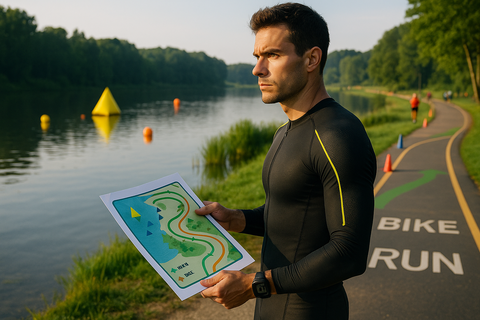
Look closely at the swim format. Pool swims remove some open-water stress, but they also create a different rhythm and can involve seeded starts. Open-water swims vary a lot. A calm lake is not the same as ocean surf. If you are still learning to stay relaxed in open water, that difference is massive.
The bike course deserves even more attention than many beginners give it. Elevation, road surface, technical turns, traffic management, and wind exposure all affect how demanding the race feels. A flat course may sound easier, but if it is hot and windy, the effort can still spike. A rolling course might be fine for a cyclist with decent handling skills, but intimidating for someone still getting comfortable clipping in and out.
Then comes the run. Shade, terrain, and temperature matter. A flat 5K in mild weather feels very different from a hilly run on exposed pavement at midday. Race websites often show elevation maps, but even simple clues like start time and local climate can help you judge what the day will really ask from you.
Timing is one of the biggest factors in how to choose a triathlon race
A race is only a good fit if your training calendar works for it.
Most beginners should give themselves enough runway to build gradually. That does not mean waiting forever. It means choosing a date that supports consistency instead of panic. If a race is eight weeks away and you are barely swimming, that is probably not the best first target. If it is five or six months away, you have time to build skills without rushing every session.
Weather season matters too, especially in Mexico and for athletes training through variable climates. Preparing for a hot race means more than being fit. You need time to adapt your pacing, hydration, and expectations. A race held during rainy season may also affect bike safety and training quality depending on where you live.
Travel adds another layer. A destination race can be memorable, but it also adds cost, packing stress, unfamiliar roads, and schedule disruption. For a first triathlon, local or regional events often make more sense. Fewer moving parts means more energy for the race itself.
Pick the race environment that matches your personality
Some athletes want a big-event atmosphere with crowds, expo energy, and a highly produced finish line. Others do better in smaller local races where the vibe is calmer and transitions feel less chaotic.
Neither is better. It depends on what helps you perform with confidence.
Large branded races can be motivating, but they can also feel overwhelming for first-timers. More athletes means more congestion in transition, more movement at the swim start, and more pre-race nerves. Smaller events may be simpler and less intimidating, though they sometimes offer fewer on-course amenities.
Think about what usually helps you on big days. If you thrive in high-energy environments, a major event might suit you. If you prefer control and lower stress, a community race may be the better starting point.
Budget and logistics are part of performance too
Your race choice should work financially, not just physically.
Entry fees are only one piece. Add travel, hotel, bike transport, nutrition, kit, and possible federation or one-day license costs. A race that looks affordable at first can become expensive quickly if it requires flights and extra gear.
There is also the equipment question. Some races are more beginner-friendly because they do not pressure you into upgrading everything. You do not need a superbike to start. But if a course is highly technical or the event has stricter gear expectations, your current setup may feel less suitable.
This is where smart planning beats impulse. If choosing a simpler, closer event leaves more budget for swim lessons, bike maintenance, or a proper wetsuit, that may improve your experience more than spending everything on a bigger race name.
Use your goal to choose the right race, not the other way around
Before you register, define what success looks like.
If your main goal is to finish your first triathlon, choose the race that gives you the highest probability of a steady, controlled day. If your goal is to test your fitness, you can tolerate a bit more challenge. If your goal is to progress toward half-distance or IRONMAN racing, your first event should still be a smart stepping stone, not a random badge.
This is one of the clearest ways to decide how to choose a triathlon race. The right event is the one that fits your next milestone.
A practical filter helps. Ask yourself: can I train for this consistently, am I comfortable with the swim setting, does the course suit my current ability, and do the travel and costs make sense? If the answer is no on two or more of those, keep looking.
For beginners, the best race often has a shorter distance, manageable logistics, a realistic build-up window, and a course that does not punish your weakest discipline. That may not be the most glamorous option, but it is often the one that moves you forward fastest.
If you want a cleaner way to compare options, tools like TriLaunchpad can help you narrow races by location, readiness, and progression stage so you spend less time guessing and more time preparing.
Choose the race that lets you show up ready, not just registered. That is how momentum starts in triathlon, and it is usually the difference between finishing one event and building a real journey in the sport. To support your training journey, consider investing in quality magnesium supplements for recovery and a reliable GPS watch to track your progress across all three disciplines.
Find the perfect race day essentials at TriLaunchpad — your triathlon journey starts here. Shop all collections →