
At the 2026 Age-Group World Championships in Pontevedra, former elite triathletes made up about 3% of the finishers and won 1 in 5 of the world titles. We checked every result. Here's what we found, both sides of the argument, and a simulator so you can decide where the line should be.
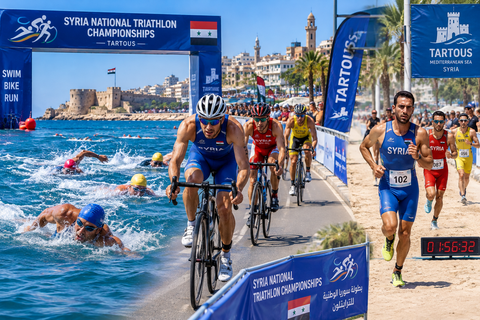
If you've never raced, here's the one thing to know first: almost everyone in triathlon is an age-grouper. You race against people your own age, in five-year brackets (40 to 44, 45 to 49 and so on), and that's true at your first local sprint and at the world championships. Qualify through your national federation and you can race for a world title in your bracket.
Some of the people in those brackets used to be professionals. A few of them still race elite events. We wanted to know how much that changes who wins.
What we checked2,997 finishes, every race history
We pulled the official results of the age-group Sprint (Sept 24) and Standard (Sept 26) races at the World Triathlon Championship Finals in Pontevedra, Spain: 2,997 finishes across 59 world titles. Then we matched every finisher to their World Triathlon athlete profile and read their full results history.
We counted someone as a former elite if they had raced at least three international elite events (continental cups or higher), or had raced at least once at a World Cup, World Championships, Olympics or major Games. National championships don't count, so a strong club racer who once entered their national "elite" race isn't on the list. That left 67 people.
The numbersThe closer to the top, the more former elites
| Share held by former elites | Count | Share | |
|---|---|---|---|
| All finishers | 84 of 2,997 | 2.8% | |
| Top 10 in their age group | 50 of 538 | 9.3% | |
| On the podium | 27 of 170 | 15.9% | |
| World champions | 12 of 59 | 20.3% |
Former elites were about 1 in 36 finishers and 1 in 5 world champions, roughly six to seven times more podiums than their share of the field would predict. Two places stand out:
- The Sprint race, where drafting was allowed. Drafting means riding close behind other cyclists to save energy, a skill elites practice for years. Former elites took 20.7% of podium spots in the draft-legal Sprint and 10.8% in the non-drafting Standard race.
- Ages 45 to 59. Former elites won 11 of the 36 podium spots (30.6%). Above 60 it dropped to 8.1%.
One thing the data does not show: former elites running away with their races. When a former elite won, the median gap to second place was 88 seconds. When anyone else won, it was 87 seconds. Most of these titles were close races.
The story in the dataThe Olympic medallist who finished second. Twice.
Michellie Jones won Olympic silver for Australia at Sydney 2000 and two world titles as a professional. In 2025 she won both the Sprint and Standard world titles in the women's 55 to 59 age group.
In Pontevedra she finished second in both races. Both times she was beaten by Germany's Bettina Lange, who has raced as an age-grouper for two decades: 1:12:55 to 1:14:49 in the Sprint, and 2:19:12 to 2:19:56 in the Standard race, a 44-second gap after two hours of racing.
That's the best argument for keeping the start line open, and we'll come back to it.
The ruleIs it allowed? Yes, and the rule is narrow
Retire from professional racing, wait for January, and you're an age-grouper. Continental cups and multi-sport events like the Asian Games don't trigger elite status at all.
That's how Hoi Long of Macau, a 2018 Asian Games bronze medallist, could race the elite women's race at the Aichi-Nagoya Asian Games on Sunday, September 20, then win both women's 40 to 44 world titles in Pontevedra that Thursday and Saturday. Every result in this article fits the rules. The question is whether the rules put the line in the right place.
Where would you draw the line?
Pick a rule and see how the 2026 results would change. Every time and finishing position comes from the official Pontevedra results.
Check an age group
Former elite = 3+ international elite races, or any World Cup, World Championships, Olympics or major Games start (national championships excluded). "Open" is World Triathlon's name for the category that replaced men's age groups. Aquabike not included. Made your call? Vote A, B or C on our Instagram post.
Should former elites race against age-groupers?
Let them race
- Racing a legend is a privilege. In how many sports can an amateur line up next to an Olympic medallist and actually beat her?
- They don't run away with it. Former elite winners won by about the same margin as everyone else.
- The sport is for life. Retiring from professional racing at 30 shouldn't cost you your hobby at 55. Triathlon writer John Levison has pointed out that a doping ban lasts four years, so a permanent ban for having once raced as a pro would be harsher.
- It makes the medal worth more. Bettina Lange's titles mean more because of who she beat.
Draw a line
- The podium is the amateur's reward. Former elites took 27 podium places in Pontevedra. That's 27 age-groupers who trained all year and went home without a medal.
- Pro skills don't expire. Former elites' podium share roughly doubled when drafting was allowed.
- Active elites blur the line further. Racing an elite Games race on Sunday and an age-group world final on Thursday is within the rules.
- Fixes exist. A waiting period after the last elite race, or a separate category with its own medals.
We don't think there's an obvious answer. A waiting period sounds like the natural compromise, but the simulator shows how much depends on the number you pick. A one-year wait would move only 2 of the 12 titles, the ones won by athletes still racing elite events. Even a 10-year wait moves just 4, because most former elites retired long ago. Only a separate category changes all 12.
If you're new hereWhat this means for your first triathlon
Almost nothing, and that's the point. The fight over world-championship medals happens at the very top of each age group. At a local sprint, the person next to you in transition is far more likely to be nervous about the swim than to be a former professional. And if you do end up racing someone with an elite past, you'll have a better story to tell than any medal.
Your first race is you against the course and against the version of you who almost didn't sign up. Nobody on the start line is checking your résumé.
Frequently asked questions
Can former professional triathletes race in age-group world championships?
Yes. Under World Triathlon rule 2.5(h), an athlete only counts as elite for the calendar year in which they enter an elite race at a World Championships, World Championship Series, World Cup or T100 event. In any other year, including the year after they retire, they can race age-group events.
How many age-group world titles did former elites win in 2026?
At the 2026 Age-Group World Championships in Pontevedra, former elite triathletes won 12 of the 59 triathlon world titles (20.3%) and 27 of 170 podium places (15.9%), while making up 2.8% of finishers.
Why do former elites do better in draft-legal races?
In a draft-legal race, athletes can ride close behind each other on the bike to save energy. Elite triathletes race this way for years and learn pack skills that most age-groupers never practice. In Pontevedra, former elites took 20.7% of podium places in the draft-legal Sprint versus 10.8% in the non-drafting Standard race.
Will I race against former professionals in my first triathlon?
It's unlikely, and it doesn't change your race. Former elites made up about 3% of the field even at the world championships. At a local beginner race you are racing the course and your own goals, not the podium.
Method and sources
- Results: official MYLAPS live timing, World Triathlon Championship Finals Pontevedra, age-group Sprint and age-group Standard.
- Race histories: each finisher's results on their World Triathlon athlete profile, matched by name and country.
- The rule: World Triathlon Competition Rules 2026 (December 13, 2025 edition), rule 2.5(h).
- Race formats (Sprint draft-legal, Standard non-drafting): Triathlon Australia 2026 age-group team selection policy.
- Debate context: John Levison, TRI247, July 2023.
- Limits: only careers recorded by World Triathlon are counted. Long-distance professionals and former elite swimmers, runners or cyclists without World Triathlon elite results aren't included, so the real numbers are probably higher. Aquabike results are excluded.
Analysis by TriLaunchpad, October 2026.