Cardiac Arrest in Endurance Sports: What Every Athlete Needs to Know
Inspired by the passing of Larry Winans, co-founder of Jackass Brewing Company, who suffered sudden cardiac arrest during the swim portion of a 70.3-distance triathlon in Lewisburg, Pennsylvania — this piece turns tragedy into awareness every endurance athlete deserves.
He transformed a weekend homebrewing hobby into a thriving brewery. He navigated the challenges of launching a business just as a global pandemic unfolded. Yet it was during an open-water swim, mid-stroke, that his heart unexpectedly stopped.
Larry Winans, co-founder of Jackass Brewing Company in Lewisburg, Pennsylvania, collapsed during the swim portion of a 70.3-distance triathlon — an event that demands months of rigorous training and a body operating at its peak. Despite the immediate efforts of first responders and medical personnel, he did not survive.
"Every corner of Jackass Brewing Company has Larry's fingerprints on it," his co-founder Skip Kratzer and the brewery team expressed in their statement. "We are completely heartbroken."
Larry's story serves as a poignant reminder that cardiovascular fitness does not equate to cardiovascular safety. Sudden cardiac arrest (SCA) does not discriminate based on training hours, leanness, or the number of finish lines crossed. It can affect anyone — including those who push their bodies to the limit.
This article is dedicated to Larry's memory, aiming to transform tragedy into awareness. If even one athlete schedules a cardiac screening, learns CPR, or recognizes a warning sign because of this piece, it will have made a difference.
What Is Sudden Cardiac Arrest — and Why Does It Happen During Exercise?
Sudden Cardiac Arrest Is Not a Heart Attack
While often used interchangeably, these terms describe two distinct emergencies. A heart attack is a plumbing problem: a blocked artery cuts off blood supply to part of the heart muscle, causing it to die. Typically, the person remains conscious, experiences pain, and has time to seek help.
Sudden cardiac arrest, on the other hand, is an electrical problem: the heart's rhythm suddenly becomes erratic — often into a chaotic pattern called ventricular fibrillation — and the heart stops pumping effectively. The person collapses immediately and loses consciousness within seconds. Without intervention, death follows within minutes.
The critical difference: a heart attack is serious, but SCA is immediately life-threatening. Survival rates decrease by approximately 10% for every minute that passes without defibrillation. After 10 minutes without intervention, survival is rare.
Why Would a Fit Athlete Be at Risk?
This question often leaves endurance athletes perplexed. If you train regularly, maintain a healthy weight, eat well, and have a low resting heart rate, why would your heart fail during a race? The honest answer: fitness enhances your heart's efficiency, but it cannot protect against structural or electrical abnormalities that may already exist in your heart — often silently, without any symptoms.
The most common underlying conditions linked to sudden cardiac death in athletes include:
- Hypertrophic Cardiomyopathy (HCM): An abnormal thickening of the heart muscle that can obstruct blood flow and trigger fatal arrhythmias during intense exertion. This is the leading cause of SCA in athletes under 35.
- Arrhythmogenic Right Ventricular Cardiomyopathy (ARVC): Fatty or fibrous tissue replaces normal heart muscle, creating arrhythmia risk — often worsened by endurance training itself.
- Long QT Syndrome: A genetic condition affecting the heart's electrical recharge cycle, increasing the risk of ventricular fibrillation.
- Brugada Syndrome: A rare genetic disorder affecting electrical channels in heart cells.
- Anomalous Coronary Arteries: Arteries originating in an unusual position can become compressed during intense exercise, cutting off blood flow.
What makes this terrifying: the majority of athletes with these conditions have no symptoms whatsoever before the cardiac event. No warning. No preview. The race itself becomes the diagnostic test.
Why the Swim Is the Highest-Risk Segment
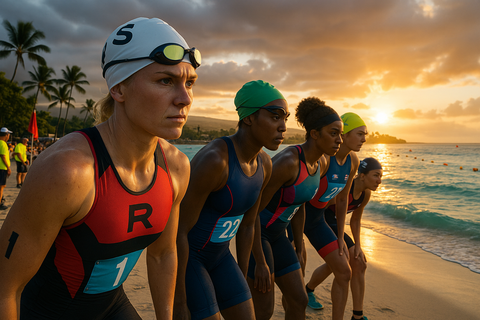
Among the three disciplines in a triathlon, the swim consistently presents the greatest cardiac risk — and Larry Winans' experience reflects exactly why. A 70.3-distance race begins with a 1.2-mile open-water swim. In the moments before the start gun fires, athletes face cold water immersion, elevated cortisol from race anxiety, crowded chaotic conditions, and the sudden demand to sprint from a standing start.
This combination creates a perfect storm of cardiac triggers:
- Cold water shock activates the dive reflex and can trigger arrhythmias, especially in susceptible individuals.
- Sympathetic nervous system overdrive from race-start adrenaline floods the body.
- Limited medical access — rescue personnel cannot reach a swimmer in distress as quickly as a fallen runner on land.
- Reduced visibility — a struggling swimmer in a mass start can be difficult to distinguish from normal race effort.
For athletes with undiagnosed conditions, this opening segment is where the risk peaks.
Warning Signs and Risk Factors That Deserve Serious Attention
Know Your Risk Profile
Not every athlete carries the same cardiac risk. The following factors significantly elevate your chances of having an underlying condition that warrants evaluation:
- Family history of sudden cardiac death — especially a first-degree relative who died suddenly before age 50.
- Personal history of fainting during or immediately after exercise (syncope).
- Chest pain, pressure, or tightness during exertion.
- Palpitations — a racing, fluttering, or pounding sensation during or after training.
- Shortness of breath that seems disproportionate to your current effort level.
- Unexplained performance decline over weeks or months.
- Dizziness or lightheadedness during workouts.
If any of these apply to you, that is not a reason to stop training. It is a reason to get evaluated before your next race.
The Symptoms Athletes Are Most Likely to Dismiss
The endurance sports community has a deeply ingrained culture of pushing through discomfort. That culture saves races. It can also cost lives. Athletes routinely explain away symptoms that deserve medical attention:
"My heart was pounding after that interval — that's normal." … "I felt dizzy, but I was just dehydrated." … "I passed out post-race — it happens when you push hard."
None of these are automatically normal. Sustained palpitations after training ends, exertional syncope, or chest discomfort during effort should be reported to a doctor — not rationalized away.
The Screening Gap
Most recreational endurance athletes never receive a comprehensive cardiac evaluation before competing in high-intensity events. A basic pre-participation physical typically checks blood pressure, listens to the heart with a stethoscope, and reviews general health history. It is not designed to detect the structural or electrical abnormalities that cause sudden cardiac death.
More advanced screening tools include:
- 12-lead ECG (electrocardiogram): Detects many electrical abnormalities, including Long QT syndrome and Brugada syndrome, as well as signs of HCM.
- Echocardiogram: An ultrasound that visualizes heart structure — able to confirm or rule out HCM and other anatomical issues.
- Exercise stress test: Evaluates heart rhythm and function under controlled exertion — useful for older athletes or those with coronary artery disease risk.
The American Heart Association currently recommends a thorough history and physical exam before athletic participation, with ECG screening advocated by many sports cardiologists — particularly for competitive athletes. The European Society of Cardiology recommends a 12-lead ECG as standard for all competitive athletes. Cost is a real barrier — an ECG can range from $50–$200 and an echo may run several hundred dollars without insurance — but compared to the cost of a cardiac event, it is worth the conversation with your doctor.
Emergency Response: The Minutes That Determine Everything
The Chain of Survival
When sudden cardiac arrest occurs, the clock starts immediately. The survival chain depends on every link holding:
- Recognition — Someone identifies the collapse as a cardiac emergency.
- Call for help — Emergency services are activated immediately.
- Bystander CPR — Chest compressions maintain blood flow to the brain and heart.
- Early defibrillation — An AED delivers a shock to restore normal rhythm.
- Advanced care — Paramedics and hospital teams continue treatment.
Bystander CPR alone can double or triple survival rates. Each minute without defibrillation reduces survival probability by roughly 10%. The math is unforgiving.
AEDs: More Accessible and Simpler Than You Think
An Automated External Defibrillator (AED) is a portable device that analyzes heart rhythm and delivers an electric shock if needed. Modern AEDs are designed for use by untrained bystanders — they provide step-by-step audio and visual instructions, and critically, they will not deliver a shock unless the device detects a shockable rhythm. You cannot accidentally harm someone with an AED.
Major endurance events like 70.3-distance triathlons typically station medical personnel and AEDs at transition areas, finish lines, and along the course. The swim portion, however, presents the greatest challenge for rapid response — which is why early recognition by water safety teams and kayakers is critical.
If you witness someone collapse at a race or training session:
- Call emergency services immediately (or shout for someone to call).
- Begin chest compressions — hard, fast, in the center of the chest (100–120 per minute).
- Send someone to locate the nearest AED.
- Continue CPR until the AED arrives or emergency services take over.
Why Every Athlete Should Know CPR
Taking a CPR and AED certification course takes roughly four hours. It is offered by the American Heart Association, Red Cross, and countless local community organizations. If you train with others — whether in an open-water swim group, a cycling club, or a running team — someone in that group knowing CPR is not optional. It is a responsibility.
In Spanish-speaking communities across Latin America and the U.S., CPR certification access varies significantly. If you train with a triathlon group in Mexico City, Bogotá, or São Paulo, advocating for group CPR training is a direct investment in your training partners' lives.
Prevention: What Athletes and Event Organizers Can Do Right Now
For Athletes: Your Pre-Season Cardiac Checklist
Before your next race registration goes on your calendar, add this checklist to your pre-season routine:
- Schedule a cardiac-focused pre-participation evaluation. Ask your doctor specifically about cardiac screening for endurance athletes. Mention your race distances, training volume, and any symptoms — even mild ones.
- Know your family history. Have a direct conversation with your parents and siblings about any history of sudden death, heart conditions, or unexplained cardiac events in the family. This information could be lifesaving.
- Report symptoms — every single one. Chest discomfort, fainting, unusual shortness of breath, and persistent palpitations are not things to train through. They are things to discuss with a cardiologist.
- Take a CPR/AED course. Your heart is not the only one at risk. Anyone around you during training or racing could need you to act.
- Check your event's medical coverage. Before you register, ask: Does this event have medical personnel on course? Are AEDs positioned along the swim course? What is the emergency response protocol?
For Event Organizers: Safety Is a Non-Negotiable Standard
High-quality endurance events invest heavily in athlete safety. Best practices include:
- Adequate AED placement — including along the swim course, transition areas, and finish zone.
- Trained water safety personnel with clear protocols for swimmer distress.
- Pre-race medical screening options or partnerships with local cardiac screening programs.
- Clear communication systems between on-course medical staff.
- Participant education in race communications about cardiac risk and warning signs.
As our triathlon community grows across the Americas — with athletes traveling from Mexico, Brazil, Colombia, and beyond to compete in major events — the expectation for consistent, high-level medical safety standards should travel with them.
Larry Winans' Legacy: What We Carry Forward
Larry Winans did not start a brewery because he wanted to be a businessman. He started it because he loved making something with his hands, sharing it with people he cared about, and watching something grow from nothing. He and Skip Kratzer turned weekend brewing sessions into two thriving locations — surviving a pandemic launch in March 2020, expanding to Williamsport in 2023, and building something their community genuinely loved.
"Every corner of Jackass Brewing Company has Larry's fingerprints on it."
That is also true of every athlete who suits up for a triathlon. Every training session, every early morning swim, every long brick workout — those are fingerprints on the sport. They matter. The people leaving them behind matter more.
The Jackass Brewing team asked for patience and understanding as their community grieves. They committed to keeping both locations open as a tribute to their co-founder's vision. That choice — to honor loss by continuing the work — reflects exactly the kind of resilience that defines both endurance athletes and the communities they build.
Key Takeaways
- Fitness does not equal immunity. Sudden cardiac arrest strikes athletes at all fitness levels, often with no prior symptoms.
- The swim is statistically the highest-risk segment in triathlon due to cold water immersion, elevated adrenaline, and limited medical access.
- Know your warning signs. Palpitations, exertional syncope, chest pain, and disproportionate shortness of breath deserve medical evaluation — not rationalization.
- Early CPR and defibrillation save lives. Every endurance athlete should know how to perform CPR and how to use an AED.
- Pre-participation cardiac screening matters. It is not paranoia — it is preparation.
- Community response makes the difference. Events, training partners, and bystanders are all links in the chain of survival.
What You Can Do Today
- Schedule a cardiac evaluation with your physician before your next race registration.
- Sign up for a CPR/AED certification course in your community.
- Share this article with your training group.
Frequently Asked Questions
-
Q: Can you be too fit to have sudden cardiac arrest?
No. Physical fitness improves cardiovascular efficiency but does not prevent structural or electrical heart conditions. Some conditions — particularly ARVC — may even be worsened by high volumes of endurance training. -
Q: What's the difference between sudden cardiac arrest and a heart attack?
A heart attack is a blockage problem — a clogged artery stops blood from reaching heart muscle. Sudden cardiac arrest is an electrical problem — the heart's rhythm fails and it stops pumping. SCA causes immediate collapse and requires CPR and defibrillation to survive. -
Q: Should I get cardiac screening before doing a 70.3-distance race?
Yes — especially if you have any risk factors, a family history of cardiac events, or symptoms during exercise. Ask your doctor for a cardiac-focused evaluation that goes beyond a standard physical. -
Q: How quickly does someone need CPR after cardiac arrest?
Immediately. Survival rates fall approximately 10% per minute without intervention. After 10 minutes without CPR or defibrillation, survival becomes extremely unlikely. -
Q: Can an untrained bystander use an AED safely?
Yes. Modern AEDs are specifically designed for untrained users. They provide audio guidance, analyze the heart's rhythm automatically, and will only deliver a shock when medically appropriate. You cannot harm someone by using one.
What happened to Larry Winans?
Larry Winans, co-founder of Jackass Brewing Company, suffered a cardiac arrest during the swim portion of a 70.3-distance triathlon and sadly passed away despite medical intervention.
When was Larry Winans involved in the founding of Jackass Brewing Company?
Larry Winans co-founded Jackass Brewing Company with Skip Kratzer after turning a homebrewing hobby into a business, officially opening their first location in Lewisburg in March 2020.
How did the brewery company respond to Larry Winans' passing?
Jackass Brewing Company expressed deep sorrow over Larry Winans' death, highlighting his significant influence on the business and requesting patience from customers as staff and family mourn his loss.
What was Larry Winans' contribution to the community?
Larry Winans was described as a driving force behind Jackass Brewing Company, greatly contributing to its establishment and growth, and he was a beloved figure in the local community.
What plans does Jackass Brewing have after Larry's passing?
Jackass Brewing Company plans to continue operations at both their Lewisburg and Williamsport locations as a tribute to Larry Winans and the vision he helped create.
Source: FOX56 — Jackass Brewing co-founder Larry Winans dies after medical emergency during triathlon event