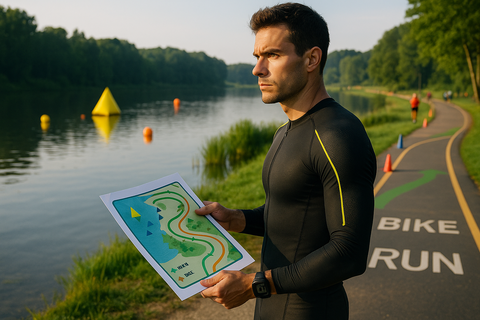
Discover the science-backed benefits of unplugged exercise — and how reducing digital stimuli during workouts can lower mental fatigue and sharpen your athletic performance.
Unplug to Level Up: A Neuroscientist’s Case for Analog Training Sessions
There’s a paradox hiding inside your training plan. You’ve invested in the best GPS watch, dialed in your power meter, and curated the perfect playlist. You show up, you log the miles — yet something still feels off. Your workouts feel harder than they should. Your focus wanders. Recovery seems incomplete.
The culprit might not be your nutrition, your sleep, or your training load. It might be the glowing rectangle in your pocket.
Your senses receive 10 billion bits of information per second — but your brain can only process a fraction of that. Every notification, every scroll, every glance at a metric adds to a cognitive tab your nervous system is quietly running all day long. By the time you hit the gym or the pool, you may already be running on mental fumes.
Dr. Daya Grant, a neuroscientist who has studied the intersection of brain performance and athletic training, makes a compelling case: strategic, intentional unplugging during workouts isn’t a step backward — it’s one of the smartest performance tools available to modern athletes. Here’s what the research says, and how to put it into practice.
The Digital Overload Problem: Your Brain Has a Tab Open Right Now
How Information Overload Impacts Athletic Performance
Think of your cognitive capacity like RAM on a computer. You can run multiple programs simultaneously — but the more tabs you have open, the slower everything runs. In the context of athletic training, that slowdown has measurable consequences.
Modern athletes rarely experience genuine mental stillness. A typical training day might look like this: a morning packed with emails and notifications, a commute with podcasts, a lunch break filled with social media, and then — still fully “plugged in” — a training session with a phone mounted on the handlebars or sitting on the weight room bench.
That constant task-switching — the rapid shifting of attention between competing demands — depletes cognitive resources in a way that accumulates over hours. By the time you begin your workout, you’re not starting fresh. You’re starting in debt.
Mental fatigue is distinct from physical fatigue, but the two interact in ways that directly undermine performance. Research on endurance athletes confirms that a cognitively depleted brain increases your rating of perceived exertion (RPE) — making the same effort feel harder — while simultaneously reducing motivational drive. The workout you planned for and showed up to becomes more of a grind than a training stimulus.
“When the brain is already worn down by the cognitive demands of daily life... a workout may feel less like a reset and more like an additional demand on an already taxed system.” — Dr. Daya Grant
The Science of Phone Use During Exercise: Not All Screen Time Is Equal
What Research Shows About Device Engagement During Workouts
Not all “plugged-in” is created equal. The research reveals a nuanced picture — and one specific exception worth noting.
A key study examined how different types of phone use affect exercise enjoyment, perceived exertion, and intensity. Here’s what it found:
- Texting while on a stationary bike caused participants to perceive their workout as more intense than a control group — without a proportional increase in actual intensity.
- Music listeners achieved higher heart rates than texters or talkers, suggesting music can actually push you to work harder.
- Social media, games, email, and talking during a 30-minute lower-body resistance workout lowered both enjoyment and perceived productivity.
- Phone presence alone — even when silenced — reduces cognitive functioning on complex tasks, according to researchers at the University of Chicago.
The data paints a clear picture:
| Phone Activity During Workout | Effect on Performance |
|---|---|
| Texting | ↑ Perceived exertion, no intensity gain |
| Social media / email / games | ↓ Enjoyment, ↓ perceived productivity |
| Music only | ↑ Heart rate, ↑ work capacity |
| Phone silenced but present | ↓ Cognitive functioning |
| Phone out of sight | Optimal focus available |
The one exception? Music. If your playlist is what gets you through interval training, you don’t have to abandon it. The research consistently shows that music-only use maintains — and may enhance — workout quality. The problem isn’t the device itself; it’s how you engage with it.
Mental Fatigue as a Performance Limiter: The Hidden Variable in Your Training
Why Your Tired Brain Makes Your Workout Harder
There’s a reason so many athletes leave the gym feeling like they didn’t get what they came for — despite checking every box in the training plan. Mental fatigue is a real, measurable physiological state that bleeds directly into physical performance.
Here’s the cascade:
- Daily digital demands accumulate cognitive load through hours of task-switching, notifications, and information filtering.
- Pre-workout scrolling adds a final surge of mental fatigue right before you need peak focus.
- Plugged-in training continues the cognitive demand during the session itself.
- Result: Your nervous system never gets a break — and the workout adaptation you’re chasing is blunted.
One study made this startlingly concrete: participants who scrolled social media for just 30 minutes before a strength workout reported significantly higher mental fatigue and performed worse (measured by volume-load) than a control group who didn’t scroll. The workout was identical. The only variable was pre-workout screen time.
The paradox is painful: most athletes use workouts as a mental escape from the stress of the day. But if the workout is also digitally loaded, you’ve simply moved from one form of cognitive demand to another — never actually giving your brain the reset it desperately needs.
The Power of Presence: What Analog Training Restores
How Being Present Improves Body Awareness and Performance
Here’s something every experienced triathlete eventually discovers: the sport is surprisingly good at forcing you off your phone. Swimming is an obvious digital dead zone. Outdoor cycling in traffic demands situational awareness. Open-water swim-bike-run has a way of pulling you into pure physical presence.
That forced disconnection is, Dr. Grant argues, one of triathlon’s most underappreciated gifts.
“One of the reasons why gritty workouts feel so good is because physical exertion forces us to be present. With so much of the day spent shifting between competing distractions, it’s almost a relief to be where your feet are.” — Dr. Daya Grant
Unplugged training restores mental energy, refocuses attention, and re-establishes the mind-body connection that heavy device use erodes. Over time, it also develops something called interoception — the ability to accurately sense and interpret internal physiological signals like heart rate, breathing rhythm, and muscular fatigue.
That internal feedback system is foundational to advanced athletic performance. Coaches who work with experienced triathletes often describe interoceptive awareness as the difference between athletes who train smart and athletes who just train hard.
Rate of Perceived Exertion: Your Built-In Analog Metric
The most practical tool for unplugged training is Rate of Perceived Exertion (RPE) — a subjective 0–10 scale that measures how hard you feel you’re working, with no device required.
| RPE | What It Feels Like | Example Effort |
|---|---|---|
| 2–3 | Easy, conversational | Cooldown laps in the pool |
| 5–6 | Moderate, slightly breathless | Steady endurance pace |
| 7 | Comfortably hard | Steady-state run |
| 9–10 | Near-maximal effort | Hill repeats, sprint intervals |
RPE values are deeply personal — your 7 is not your training partner’s 7. That personalization is a feature, not a bug. With practice, RPE becomes a precise, reliable, and device-free way to regulate intensity across all three disciplines.
The calibration process takes 2–4 weeks. In the early stages, track both your metrics and your RPE simultaneously. Over time, patterns emerge — and you can begin trusting the internal signal over the external readout.
Practical Strategies for Unplugging: Where to Start
1. Create a Digital Buffer Zone Before You Train
What you do in the 30 minutes before a workout shapes the mental state you bring into it. Research shows this window is surprisingly high-leverage.
Action steps:
- Avoid scrolling social media in the 30 minutes before training.
- Replace screen time with light stretching, visualization, a short walk, or quiet rest.
- Set your phone to airplane mode when you begin warming up.
- Treat pre-workout time as part of the session, not dead time.
This simple habit change costs nothing and has measurable performance benefits — more volume completed, lower perceived exertion, and higher training enjoyment.
2. Put Your Phone Out of Sight — Not Just on Silent
Silencing notifications isn’t enough. The University of Chicago research is clear: the mere presence of your phone drains cognitive resources, even when you’re not actively using it. Your brain allocates background processing to monitoring it.
Action steps:
- Leave your phone in another room during strength and indoor trainer sessions.
- For solo outdoor workouts where safety requires carrying a device, use a dedicated GPS running watch — and keep the phone in your pack, out of eyeline.
- For group workouts, designate one person as the emergency contact carrier.
3. Use RPE as Your Primary Training Metric
Once you’ve built RPE calibration over a few weeks, it becomes a genuinely reliable training tool — and one that improves over time rather than plateauing. Digital metrics tell you what is; RPE tells you what feels like, which is often the more important signal.
A realistic progression:
- Weeks 1–2: Track both metrics and RPE simultaneously (learning phase).
- Weeks 3–4: Use RPE as primary guide; check metrics occasionally.
- Week 5+: Pure RPE for designated unplugged sessions.
4. Gamify Counting Without Tech
Analog doesn’t have to mean boring. Two methods in particular have picked up genuine traction in triathlon training communities:
The Jelly Bean Method (popularized by Triathlete editor Susan Lacke during 100×100 swim workouts)
- Place a container of jelly beans on the pool deck beside an empty container.
- After each lap (or each 100m interval), move one jelly bean to the empty container — or pop it directly in your mouth.
- Visual, tangible, and oddly satisfying progress tracking with zero screens required.
The Alphabet Method
- Assign each lap or set a letter of the alphabet.
- For each letter, silently repeat a quality you want to embody as an athlete: A = Ambitious, B = Bold, C = Composed, D = Disciplined, E = Efficient…
- By the time you reach Z, you’ve completed 26 reps and run a silent motivational script through your mind.
Both methods keep the mind productively engaged without introducing digital stimuli. They also add a ritual quality to training that many athletes find grounding — especially during long, repetitive sets that might otherwise invite phone use.
Frequently Asked Questions
Do I need to unplug for every workout?
No — and that’s not the goal. Even one to two unplugged sessions per week provides meaningful benefits. Sustainable change beats perfect adherence.
What about music? Do I have to give that up?
Absolutely not. Music is one of the few device-based inputs that improves performance metrics. If music is part of your training identity, consider a “music-only” rule for certain sessions: headphones in, but the phone stays across the room.
How do I track progress without metrics?
Use RPE + session duration + subjective difficulty. After four weeks of consistent unplugged training, compare how the same effort feels. If it feels easier — that’s adaptation. That’s progress.
Will unplugging conflict with my structured training plan?
Not at all. Unplugging governs how you execute your training — not what’s on the plan.
What is unplugged exercise?
Unplugged exercise refers to physical activity performed without any digital stimuli, such as mobile phones, TVs, or fitness trackers. This approach promotes focus and allows athletes to engage more fully with their training environment.
How can unplugging improve athletic performance?
Reducing digital distractions during workouts can lower mental fatigue and improve mental focus, helping athletes to experience enhanced performance and better recovery during their training sessions.
What are some tips for unplugging during workouts?
Some tips for unplugging include creating a digital buffer zone by avoiding social media before workouts, putting your phone out of sight, using rate of perceived exertion (RPE) instead of digital metrics, and employing analog counting methods, such as a jelly bean counting system during swimming laps.
What is the rate of perceived exertion (RPE)?
RPE is a subjective scale that ranges from 0 (no exertion) to 10 (maximal exertion) used to assess how hard an athlete feels they are working during a training session. It encourages athletes to tune into their bodies without relying on external devices.
Is it necessary to unplug during every workout?
No, it's not necessary to unplug during every workout, but integrating unplugged sessions at least once a week can enhance mental well-being and training effectiveness, allowing athletes to focus more on their body and relaxation.
Source: triathlete.com — A Neuroscientist’s Case for Unplugged Training