Perfect Six: How Marten Van Riel Dominated Denmark to Secure His World Championship Spot
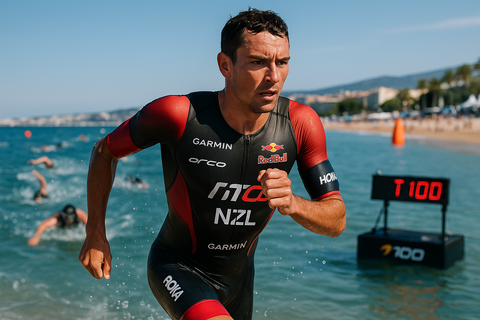
June 21, 2026 — Race Report: 70.3 Elsinore, DenmarkImagine standing at the start line of the most important race of your season, knowing that if you don't perform today, your shot at the World Championships is gone. Now imagine making it look easy. That's exactly what Marten Van Riel did at 70.3 Elsinore — extending one of the most remarkable winning streaks in recent long-distance triathlon history to six consecutive victories, all while securing his qualifying slot for the 70.3 World Championships in Nice.
In a race that started with a cannon fired in front of Kronborg Castle — the very fortress immortalized in Shakespeare's Hamlet — the brilliant Belgian delivered a performance that was equal parts power and precision. Six starts. Six wins. No drama. Just dominance.
This race report breaks down exactly how Van Riel executed his winning strategy across all three disciplines, why the bike segment proved decisive (again), and what this historic streak reveals about elite 70.3 racing in 2026.
The Perfect Streak — Six Wins That Define a Season
What Makes Six Consecutive Wins Remarkable
In the modern era of professional 70.3 racing, consistent excellence across an entire season is extraordinarily rare. Elite fields change from race to race. Course profiles vary dramatically — flat and fast one weekend, technical and hilly the next. Weather conditions, travel fatigue, and the sheer physical demands of back-to-back racing all conspire to prevent any single athlete from stringing together an unbroken winning streak.
Van Riel did it anyway. Six different races. Six different competitive fields. Six victories.
The 2026 Pro Series context matters here. The season's 70.3 Pro Series circuit — featuring 1.9km swims, 90km bike legs, and 21.1km runs — attracts the world's best 70.3 specialists, each gunning for both prize money and precious qualifying spots for the 70.3 World Championships in Nice. Elsinore represented the eighth stop on that circuit, and Van Riel arrived having already won every race he'd entered.
What makes a streak like this truly remarkable isn't just the wins themselves — it's the adaptability they demonstrate. Winning on one course against one field is impressive. Winning on six different courses against six different competitive lineups reveals something deeper: a systematic advantage that doesn't depend on favorable conditions or a weak field.
The Pressure Cooker at Elsinore
If previous races had been relatively low-stakes from a qualification standpoint, Elsinore was different. This was Van Riel's last opportunity to qualify for the 70.3 World Championships in Nice — and he wasn't the only one feeling the weight of that deadline.
Three qualifying slots were on offer. With Valdemar Solok (DEN) already qualified via his 70.3 Poznan win, and Simon Vlain (FRA) locked in after 70.3 Aix-en-Provence, Van Riel needed one of those remaining spots. Athletes like Jamie Riddle (RSA) — described as having "such an unlucky season so far" — and Kristian Høgenhaug (DEN) were also hunting qualification.
High-stakes final qualifiers often produce conservative, defensive racing. Athletes hedge. They race not to lose rather than racing to win. Van Riel responded to that pressure by doing the opposite: he attacked.
Six starts. Six wins. Van Riel didn't race to survive the pressure at Elsinore — he attacked it.
The Swim — Strategic Positioning Over Speed
The Cannon Start Drama at Kronborg Castle
Before a single athlete hit the water, the setting itself deserves a mention. Elsinore's iconic cannon-start in front of Kronborg Castle provided one of triathlon's most atmospheric race launches. Calm, sunny water greeted the field as they dove into Elsinore Harbour, navigating a tight course with multiple turns that rewarded technical swimmers.
From the opening moments, two athletes seized the spotlight: Hannes Butters (GER) and Jamie Riddle (RSA) led the field out of the water, with Butters clocking 21:47 and Riddle right behind at 21:48. There was one moment of minor confusion early in the swim when Van Riel appeared to momentarily stop — which he later explained was simply to allow a jet ski to get fully out of the way. A small detail, but one that illustrates the sharp situational awareness elite athletes maintain even at race pace.
Van Riel's Swim Split: Positioned to Pounce
Van Riel emerged from the water in fifth place with a 21:55 split — just 8 seconds behind Butters, and within a 10-second window that covered the first seven athletes. That's a remarkably tight field for a 1.9km swim.
The key insight? Van Riel wasn't trying to win the swim. He was positioning himself for the discipline that matters most in his race plan: the bike. Think of it like a chess player conserving a queen — Van Riel knew his decisive move would come later. Expending maximum energy chasing an 8-second swim gap at the cost of bike power would have been a poor trade. Instead, he stayed within striking distance, arrived at T1 with his legs fresh, and prepared to make his move.
| Athlete | Time | Gap to Leader |
|---|---|---|
| Hannes Butters (GER) | 21:47 | — |
| Jamie Riddle (RSA) | 21:48 | +0:01 |
| Ben Faeh (SUI) | ~21:49 | ~+0:02 |
| Ollie Turner (GBR) | ~21:52 | ~+0:05 |
| Marten Van Riel (BEL) | 21:55 | +0:08 |
The Bike — Where the Race Was Won and Lost
The Game-Changing Move at 32km
If the swim was about positioning, the bike was about execution — and Van Riel executed with devastating precision. Valdemar Solok (DEN) worked his way to the front early on the bike, and Van Riel was the only athlete in the field capable of going with him. By the 32km mark, the two had broken clear of the rest, sharing the pacing work on a course that featured a slight headwind on the opening section.
That two-person partnership proved immediately race-defining. Two strong athletes working together in a shared effort can generate significantly more speed than a single attacker or a fractured group playing cat-and-mouse. Van Riel and Solok understood this, and they committed to the breakaway together.
Record-Breaking Pace
The results were historic. Both Van Riel and Solok shattered the Elsinore bike course record, each clocking times in the low 1:58s:
- Van Riel: 1:58:04
- Solok: 1:58:18 (just 14 seconds back)
To appreciate how fast this is: the field average for the remaining top-10 finishers hovered around 2:00–2:03. Van Riel's bike split wasn't just a course record — it was a statement that no one else in that field was operating in the same gear.
The Domino Effect: The Gap That Decided Everything
By the time Van Riel and Solok rolled into T2, the race was, for all practical purposes, over. The damage they'd done on the bike:
| Position | Athlete | Gap to Van Riel (T2) |
|---|---|---|
| 3rd | Pierre Dupuy (FRA) | -2:18 |
| 4th | Kristian Høgenhaug (DEN) | -2:24 |
| 5th | Jamie Riddle (RSA) | -2:28 |
| 6th | Ben Faeh (SUI) | -2:30 |
| 7th | Hannes Butters (GER) | -2:34 |
A 2+ minute gap with only a 21.1km run remaining is, in practical terms, insurmountable — unless the leader completely falls apart. Van Riel, as we'll see, was not about to fall apart.
The lesson here for age-group racers is significant: in 70.3 racing, the bike leg is your biggest opportunity to create or destroy a race. The run matters, but a 2-minute deficit on the run requires an extraordinary performance gap to overcome, especially when the leader can adjust their effort accordingly.
A 2+ minute gap heading into the run is, in practical terms, insurmountable. Van Riel built his win on the bike — and then simply refused to give it back.
The Run — Cruise Control to Copenhagen
Managing the Advantage
The run at Elsinore is described as twisty and scenic, winding through the Danish coastal town. It's a course that rewards race management over all-out speed — exactly the kind of run Van Riel needed. Van Riel and Solok ran together through the early kilometers, neither needing to force the pace given their shared advantage over the field.
By the halfway mark (approximately 15km), Van Riel had opened a 36-second gap over his Danish companion, steadily extending his winning margin. His final run split of 1:11:31 was solid but not spectacular — and that's the point. He didn't need spectacular. What Van Riel demonstrated was the ability to manage a race lead rather than simply race for one, a skill that separates good athletes from champions.
The World Championship Subplot
While Van Riel was managing his lead, the real drama of the run was playing out further back. With three qualifying spots available and multiple athletes hunting them, every position mattered. The narrative took a compelling turn when Simon Vlain (FRA) — already qualified via his Aix-en-Provence win — ran through the field to claim third, overtaking both Riddle and Høgenhaug just before the 15km mark with a blazing 1:09:25 run split, the fastest in the field.
Here's where the subplot resolved: because Vlain and Solok were already qualified, their podium positions didn't consume qualifying slots. That meant Riddle (4th) and Høgenhaug (5th) both secured their Nice qualification — a fortunate outcome for two athletes who'd spent the race fighting for their World Championship lives.
Final Podium & Official Results
Marten Van Riel crossed the line in 3:36:03 — a new overall course record — with a 1:14 winning margin over Valdemar Solok (3:37:18). Vlain completed the podium in 3:39:00.
| Pos | Athlete | Nat | Swim | Bike | Run | Overall |
|---|---|---|---|---|---|---|
| 1 | Marten Van Riel | BEL | 0:21:55 | 1:58:04 | 1:11:31 | 3:36:03 |
| 2 | Valdemar Solok | DEN | 0:21:56 | 1:58:18 | 1:12:43 | 3:37:18 |
| 3 | Simon Vlain | FRA | 0:22:42 | 2:02:25 | 1:09:25 | 3:39:00 |
| 4 | Jamie Riddle | RSA | 0:21:48 | 2:00:47 | 1:12:23 | 3:39:37 |
| 5 | Kristian Høgenhaug | DEN | 0:23:02 | 1:59:10 | 1:13:01 | 3:40:14 |
| 6 | Ben Faeh | SUI | 0:21:49 | 2:00:46 | 1:14:59 | 3:42:12 |
| 7 | Thor Bendix Madsen | DEN | 0:23:53 | 1:59:28 | 1:14:11 | 3:42:24 |
| 8 | Lennart Sievers | GER | 0:22:20 | 2:02:26 | 1:12:58 | 3:42:46 |
| 9 | Pierre Dupuy | FRA | 0:22:29 | 1:59:47 | 1:14:09 | 3:43:17 |
| 10 | Rafael Lukatsch | AUT | 0:22:35 | 2:02:51 | 1:13:35 | 3:43:30 |
The entire top 10 was covered by just 7 minutes and 27 seconds — a testament to the depth of the 2026 Pro Series field.
What Van Riel's Winning Strategy Reveals About Elite 70.3 Racing
The Blueprint: Discipline Over Dominance
Van Riel's six-race winning streak isn't built on being the best swimmer, the best cyclist, or the best runner on any given day. It's built on being the most complete and strategically intelligent athlete in the field, race after race. At Elsinore, he was fifth out of the water — and he still won by more than a minute. That tells you everything about how elite 70.3 races are actually decided.
His approach boils down to four principles that any triathlete — from Pro field competitors to age-group podium hunters — can learn from:
- Swim to position, not to lead. Staying within 10 seconds of the swim leaders while conserving energy for the bike is a calculated decision, not a weakness.
- Identify your decisive discipline and execute it fully. Van Riel's bike power is his primary weapon. He doesn't hesitate to use it — even against a headwind at 32km.
- Build tactical partnerships when available. The Van Riel/Solok alliance on the bike wasn't accidental. Two athletes of that caliber working together produces speeds neither could sustain alone.
- Manage the run; don't race it. With a 2+ minute cushion, Van Riel ran 1:11:31 — enough to win comfortably, not enough to blow up chasing a run course record.
Bike Fitness Is the Foundation
The clearest strategic lesson from Van Riel's 2026 season is that bike strength is the most race-decisive skill in modern 70.3 competition. His 1:58:04 bike split wasn't just a course record — it was roughly 4 minutes faster than what most of the top-10 field could manage.
For age-group athletes targeting their own 70.3 goals — whether it's a first finish, a podium at a local race, or a qualification slot — this is the most actionable takeaway: invest in your bike fitness. Not at the expense of swim and run, but recognize that a strong bike creates race-winning buffer that no amount of run speed can easily overcome. Browse our race season essentials to find cycling and triathlon gear built for athletes who train with intent.
Frequently Asked Questions
Who won the 70.3 Elsinore 2026 men's race?
Marten Van Riel won the 70.3 Elsinore 2026 men's race, making it his sixth consecutive victory in long-distance triathlon racing.
What was Marten Van Riel's finishing time at the 70.3 Elsinore 2026?
Marten Van Riel finished the race with an overall record time of 3:36:03.
What was the swim outcome for the 70.3 Elsinore 2026 men's race?
Hannes Butters from Germany won the swim segment with a time of 21:47, narrowly ahead of Jamie Riddle from South Africa.
Which records were broken during the bike segment at the 70.3 Elsinore 2026?
Marten Van Riel and Valdemar Solok shattered the previous bike course record by clocking low 1:58s for the bike segment.
How many qualifying slots for the 70.3 World Championships were available at this event?
There were three qualifying slots available for the 70.3 World Championships in Nice at the 70.3 Elsinore 2026.
Source: tri247.com — 70.3 Elsinore 2026 Men's Results Report