Triathlon on a Carrier: The Unexpected Ways Navy Personnel Stay Fit in the Middle of the Ocean
How the USS Gerald R. Ford turns constrained spaces into competitive fitness arenas—and why it matters for naval readiness
Imagine finishing a triathlon. You've swum, cycled, and run your way to the finish line—exhausted, exhilarated, and miles from the nearest beach. Now imagine doing that same race not on a sun-soaked coastal course, but inside a gymnasium aboard the world's largest aircraft carrier, thousands of miles from home, somewhere in the Mediterranean Sea.
That's exactly what Lt. Allison Denny did on April 12, 2026.
Assigned to Carrier Air Wing 8 aboard USS Gerald R. Ford (CVN 78), Lt. Denny participated in an organized shipboard triathlon while the carrier operated in the U.S. 6th Fleet area of operations—a deployment designed to "support the warfighting effectiveness, lethality and readiness of U.S. Naval Forces Europe-Africa, and defend U.S., Allied and partner interests in the region," according to official U.S. Navy documentation.
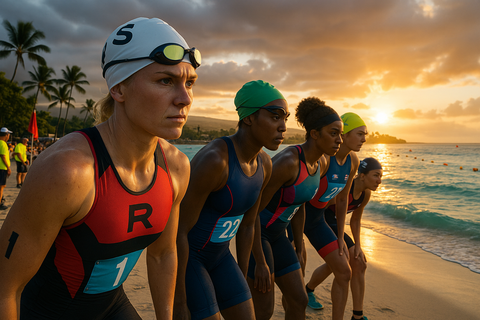
The image, captured by Mass Communication Specialist 3rd Class Jarrod Bury and published through the Defense Visual Information Distribution Service (DVIDS), is striking precisely because of its contrast: the intensity of athletic competition set against the operational demands of one of the most powerful warships ever built. But it's not just a compelling photograph. It's a window into a deliberate, strategically important dimension of modern naval culture—one that treats crew wellness not as a luxury, but as a mission-critical priority.
The Challenge of Staying Fit at Sea
Space and Resource Constraints
Aircraft carriers are engineering marvels, but they are optimized first and foremost for combat capability. Every square foot aboard USS Gerald R. Ford—a vessel stretching over 1,100 feet and displacing more than 100,000 tons—serves a purpose tied to its warfighting mission. Fitness facilities exist, but they compete for space with flight operations, maintenance bays, medical facilities, berthing areas, and dozens of other mission-essential functions.
With a crew exceeding 5,000 personnel, the math becomes immediately apparent. Shared recreational and fitness spaces must work harder than any comparable civilian gym—accommodating rotating shifts, multiple fitness levels, and diverse training goals, all while being designed with ship stability and safety in mind.
Operational Demands on Personnel
Life aboard a deployed carrier is not a nine-to-five proposition. Flight operations run continuously, often around the clock. Sailors and officers routinely work 12-hour shifts or longer, performing safety-critical tasks that demand sustained focus and physical endurance. Add to that the psychological weight of deployment—months away from family, limited privacy, confined living quarters—and the cumulative toll on the human body and mind becomes significant.
Naval deployments typically span six to nine months. That's a long time to maintain peak physical and mental performance under such conditions. The challenge isn't simply keeping sailors physically fit; it's sustaining the cognitive sharpness, emotional resilience, and unit cohesion that effective naval operations require.
The Mental and Physical Health Equation
Physical fitness and mental health are not separate concerns—they are deeply interconnected. Exercise is one of the most well-documented interventions for managing stress, improving sleep quality, and maintaining cognitive function. For a sailor six months into a Mediterranean deployment, access to fitness isn't just about staying in shape. It's about managing the psychological pressures that long-duration operations inevitably generate.
The Navy recognizes this. And the photograph of Lt. Denny mid-triathlon is evidence of that recognition in action.
Organized Fitness Events as Strategic Tools
Structured Competition Creates Shared Purpose
Organizing a triathlon aboard a deployed aircraft carrier is not a simple logistical task. It requires planning, coordination across departments, equipment allocation, and scheduling around the relentless tempo of carrier operations. The fact that it happens at all signals something important: naval leadership treats organized fitness as worth the effort.
Triathlons—combining swimming, cycling, and running—are particularly well-suited to shipboard adaptation. Stationary bikes substitute for road cycling. Treadmills or designated running routes (some carriers have running tracks around the flight deck perimeter) handle the running component. Swimming pools aboard larger carriers like Gerald R. Ford handle the aquatic discipline. What emerges is a genuine endurance competition, compressed into available spaces but no less demanding for it.
Lt. Denny's participation exemplifies what these events are designed to achieve: active engagement, measurable personal achievement, and the simple but powerful act of competing at something that has nothing to do with operational duties. For those interested in understanding what constitutes good triathlon times, even shipboard competitions follow similar performance metrics.
Building Morale and Unit Cohesion
Fitness events aboard deployed vessels serve a function that goes well beyond individual health. When personnel from different departments, ranks, and specialties compete side by side in a triathlon, they build the kind of informal bonds that formal team-building exercises rarely achieve. A lieutenant from Carrier Air Wing 8 racing alongside an enlisted sailor from the ship's engineering department creates a shared experience—a reference point that transcends the hierarchy of daily operations.
This is esprit de corps in its most practical form. The monotony of a long deployment is real, and it erodes motivation in subtle but measurable ways. Organized fitness competitions—with their built-in anticipation, preparation, competition, and celebration—break that monotony deliberately. They give sailors something to train for, look forward to, and talk about.
Leadership Participation Sends a Signal
When officers participate visibly in fitness events, the message to enlisted personnel is clear: wellness matters here, and it matters at every level. This isn't a minor cultural point. In organizations as hierarchical as the U.S. Navy, leadership behavior shapes unit culture more powerfully than any written policy. An officer lacing up for a shipboard triathlon communicates, without a word, that fitness is a professional value—not an afterthought.
Fitness as a Component of Warfighting Readiness
The Mission Statement Connection
The official description of USS Gerald R. Ford's deployment mission is precise: to "support the warfighting effectiveness, lethality and readiness of U.S. Naval Forces Europe-Africa." That language—effectiveness, lethality, readiness—might seem disconnected from a gym-based triathlon. But the connection is direct.
Readiness is not just a function of weapons systems and tactics. It is, fundamentally, a function of human performance. A fatigued, stressed, physically deteriorating crew operates less effectively than a healthy, fit, mentally resilient one. Decision-making degrades under sustained stress. Reaction times slow. Errors in safety-critical environments—like a carrier flight deck—become more likely. Crew wellness, in this light, is not ancillary to warfighting readiness. It is a component of it.
Physical Standards in Naval Aviation
Personnel assigned to Carrier Air Wing 8—the integrated air combat element aboard Gerald R. Ford, comprising multiple squadrons of aircraft and crew—operate under particularly demanding physical requirements. Naval aviators must meet rigorous fitness standards to fly, not least because ejection seat operations place extreme physiological stress on the body. Maintaining those standards during a long deployment, far from the training facilities and routines of home bases, requires deliberate effort and institutional support.
But the fitness imperative extends beyond aviators. Every sailor supporting flight deck operations works in an environment where physical capability, situational awareness, and rapid response can be the difference between a safe recovery and a catastrophic accident. Fitness is not optional in that environment—it is occupational.
The Long View: Retention and Sustainability
There is also a longer-term calculus at work. Sailors who maintain their health through deployment return home in better physical and mental condition—a factor that directly influences retention rates and career longevity. Wellness programs that reduce injury, burnout, and psychological strain contribute to the Navy's ability to keep experienced personnel in uniform. In an era of intense competition for skilled military talent, quality-of-life considerations matter.
Fitness programs signal to current and prospective sailors alike that the Navy invests in its people—not just their technical skills, but their whole-person wellbeing.
Practical Solutions in Constrained Environments
Making the Most of Available Resources
What makes shipboard fitness culture genuinely impressive is its resourcefulness. The constraints are real—limited space, variable schedules, the constant priority of operational demands—but they do not prevent effective programming. They demand creativity instead.
Multipurpose fitness facilities aboard carriers like Gerald R. Ford are designed to adapt. Equipment selection prioritizes versatility and space efficiency: rowing machines, stationary bikes, free weights, and treadmills that can be used by personnel across fitness levels and training goals. In some cases, the ship's own geography becomes a fitness resource—ladders climbed for leg strength, passageways used for interval training, and open deck spaces leveraged for group PT when flight operations permit.
The Triathlon as a Model
The triathlon format is a particularly elegant solution to the shipboard fitness challenge. It combines three disciplines that can each be accommodated with equipment already present on a carrier. More importantly, it offers something that solo gym sessions rarely provide: a structured competitive event with a defined goal.
Training for a triathlon gives sailors a concrete target—something to work toward through weeks of deployment. The event itself creates a defined day of competition and community. And the aftermath, whether you finished first or simply finished, provides a sense of accomplishment that carries real psychological weight in an environment where milestones are few.
This is fitness programming with intentionality. It recognizes that motivation is not self-sustaining in a high-stress, low-variety deployment environment, and it provides the structure that keeps people engaged. For those looking to understand triathlon time limits and standards across different distances, even shipboard events follow similar principles.
Peer-Led Culture
Institutional support matters, but fitness culture aboard deployed vessels is also sustained peer-to-peer. Sailors who prioritize fitness influence those around them. Informal competitions, workout partnerships, and shared fitness goals create a self-reinforcing culture that doesn't depend entirely on top-down programming. When a lieutenant from Carrier Air Wing 8 signs up for the ship's triathlon, other personnel take notice—and some of them sign up too.
Broader Implications: What Shipboard Fitness Tells Us About Modern Naval Culture
Evolution Beyond Technical Readiness
For much of military history, readiness was measured almost exclusively in terms of weapons, platforms, and tactics. The human element was assumed to be manageable through discipline and training. Twenty-first century military thinking has evolved significantly beyond that model. Human performance optimization is now recognized as a readiness variable, not a soft concern.
The integration of wellness programming into deployed naval operations reflects this evolution. It represents a recognition that the most advanced warship in the world is ultimately only as effective as the people who operate it—and that those people require active support to sustain peak performance over months of demanding deployment.
A Model Applicable Across Environments
The lessons demonstrated aboard USS Gerald R. Ford are not unique to aircraft carriers. Any extended-deployment environment—submarines, expeditionary units, overseas bases—faces analogous challenges of space constraint, operational tempo, and sustained personnel performance. The principles that make shipboard fitness programming effective translate directly: structured competition, leadership participation, creative use of available resources, and recognition that wellness supports mission effectiveness.
Recruitment and Public Perception
Images like the one captured by Mass Communication Specialist 3rd Class Jarrod Bury do something else, too. They show the public—and prospective recruits—a dimension of military service that rarely features in recruiting materials: the deliberate, organized effort to support the human beings who serve. A triathlon in a carrier gymnasium, thousands of miles from home, is both a remarkable athletic achievement and a statement about institutional values.
It says: we invest in our people. That message resonates with the kind of talent the modern Navy needs to attract and retain.
Key Takeaways
- Wellness is operational, not optional. Naval leadership treats crew fitness as a direct contributor to warfighting readiness, not an extracurricular add-on.
- Creativity overcomes constraint. Limited space and operational demands do not prevent effective fitness programming—they demand more thoughtful solutions.
- Organized events build more than fitness. Triathlons and structured competitions build morale, unit cohesion, and shared identity across departments and ranks.
- Leadership visibility matters. Officer participation in fitness events signals organizational commitment and shapes unit culture.
- The human factor is the ultimate readiness variable. The most advanced warship on the planet depends on healthy, motivated, mentally resilient personnel to fulfill its mission.
What This Means for You
If you're serving in a deployed environment: The fitness programs available to you are there for a reason. Engaging with them—whether that's a shipboard triathlon, a unit PT session, or an informal workout partnership—is a professional investment, not a break from your duties. Consider exploring AI training apps that can help you structure your workouts even in constrained environments.
If you lead sailors or service members: Model the commitment you want to see. Your visible participation in wellness activities communicates, more clearly than any policy memo, that you value your people's whole-person health.
If you're a military family member: Know that programs like these are part of how the Navy supports your service member through the psychological and physical demands of long deployments. Fitness events give them goals, community, and a sense of accomplishment far from home.
If you're a member of the general public: The next time you see a photograph from DVIDS—a sailor mid-race in a ship's gymnasium, a thousand miles out to sea—look past the novelty of the image. What you're seeing is a deliberate institutional investment in the human beings who operate America's most powerful naval assets. That investment is inseparable from the readiness those assets represent.
The USS Gerald R. Ford is built to project power across the Mediterranean and beyond. But the triathlon in its gymnasium is a reminder that the most essential technology aboard any warship has always been, and will always be, the people inside it.
How do I register or log in to DVIDS?
Use the Register link (/member/registration) to create an account and the Login link (/login or /auth/login) to sign in. You can also use the "Remember me" option for future visits and the "Forgot Password?" link if needed.
How do I download images or galleries from DVIDS?
Open the image page and use the Download Photo or Download Gallery links. Some downloads require you to be logged in and have a validated account (see member options).
What does VIRIN mean and where is it shown?
VIRIN (Visual Information Record Identification Number) is a unique identifier for DVIDS visual assets. It is shown on the image detail page alongside metadata such as date taken, location, resolution and photo ID.
Who is credited for a DVIDS image and what are the copyright rules?
Each image displays the photographer credit (e.g., PHOTO BY SEAMAN JARROD BURY) and a note about copyright/public domain. Users must follow the restrictions listed on the DVIDS Copyright Information page (/about/copyright).
How can I contact DVIDS for web support or customer service?
For web support email dvidsservicedesk@dvidshub.net or call the DVIDS Control Center. For customer service call 1-888-743-4662 or email dma.enterprise-customer-services@mail.mil.
What metadata is provided for an image on DVIDS?
Image pages include metadata such as Date Taken, Date Posted, Photo ID, VIRIN, Resolution, File Size, Location, Web Views and Downloads, plus photographer and unit information.
How do I subscribe to unit alerts or notifications?
Use the Subscribe/alerts link on a unit or asset page to subscribe to updates for that unit. Notifications and a "See All Notifications" page are available when signed in.
How can I use or distribute DVIDS content (placements, social, distribution)?
Signed-in users can connect assets to Placements, schedule social posts, distribute photos or galleries, and create playlists using the provided CMS links (e.g., placement, social compose, distribution). Some actions require CMS access or account validation.
Where can I find press and media request information?
Use the Press Inquiry section (/mediarequest) to create a media request or access the Media Press Kit (/mediarequest/presskit). Contact details are on the Contact Us page (/about/contactus).
What should I do if an image has no controlled vocabulary keywords or tags?
You can add keyword tags if you have an account and appropriate permissions. Tags improve discoverability; otherwise use search filters (Images, Units, Features) to find related content.
Are DVIDS images free to use and how do I check usage restrictions?
Some DVIDS images are public domain, but usage may still be subject to DVIDS restrictions. Always review the copyright statement on the image page and the Copyright Information page (/about/copyright) before reuse.
How can I report a problem with an asset or request support for the site?
Report web issues to dvidsservicedesk@dvidshub.net or call the DVIDS Control Center. For broader customer service issues use the listed phone and email contacts on the site.