A triathlete breaks her elbow eight weeks before race day. Instead of quitting, she discovers that showing up differently is still showing up — and finishes four seconds under her goal.
I heard it crack.
One moment Charley DiAdamo was riding her brand-new purple road bike in a parking lot, trying to unclip from her pedals for the first time. The next, she was pinned under the bike, one foot still clipped in, her left arm bent at an angle no arm should ever bend. She walked home holding it up, told herself it didn't hurt — and sobbed the whole way.
She had broken her elbow. In two places. Surgery was a possibility. And she was supposed to toe the start line of a 70.3-distance triathlon in eight weeks.
This is not a story about the race Charley planned. It's a story about the one she needed — and about what happens when a broken bone, a chronic illness, and an unexpected mentorship from a 50-years-delayed cyclist all collide at the finish line of a race you almost didn't enter.
If you've ever stared down a goal that suddenly seemed impossible, keep reading. Because what Charley learned on the roads of Augusta, Maine applies to every athlete who has ever had to pivot mid-training-cycle and wonder whether adapting is just another word for giving up.
(Spoiler: it absolutely is not.)
Training Through Invisible Illness
Long before the fall, the plan looked clean on paper: run a spring marathon, then pivot immediately to a 70.3-distance triathlon — a 1.2-mile swim, 56-mile bike, and 13.1-mile run — just four months later. Charley had played competitive sports from childhood through prep school, and when she arrived at Colby College, endurance racing became the new arena.
The marathon went well. The triathlon training? That was a different story.
For two years, Charley had been managing symptoms she couldn't explain: constant exhaustion, dizziness, shaking. Dozens of doctor appointments yielded no answers. She eventually received three diagnoses at once — mono, Lyme disease, and dysautonomia, a chronic disorder of the autonomic nervous system that disrupts involuntary body functions like heart rate and blood pressure regulation.
“I was in pain all the time,” she wrote. “I dealt with this, too, largely by ignoring it.”
That coping mechanism — training as both escape and denial — is more common among endurance athletes than most people realize. Dysautonomia, in particular, creates real challenges during exercise: heat sensitivity, blood pressure instability, and an unpredictable heart rate response that can turn a standard tempo run into a survival effort. But she kept showing up.
She purchased a slightly-used road bike — purple, named Barney — the same day her parents helped her move into her Portland apartment at the start of a summer internship at the Portland Press Herald. She was three days away from the fall that would change everything.
Key term: Dysautonomia affects an estimated 70 million people worldwide and often goes undiagnosed for years, particularly in young women. Its impact on exercise tolerance makes endurance sports both more challenging and, for many, more meaningful.
One Fall, Two Breaks, Zero Acceptance
Clip-in pedals are one of cycling's great efficiency tools — and one of its most humbling learning curves. They mechanically attach your shoe to the pedal, which means you have to actively twist your foot to release before stopping. For a new rider on an unfamiliar bike, alone in a parking lot on day one? The margin for error is essentially zero.
Charley fell several times on grass, then pavement. A couple walking by expressed concern. She waved them off. She was getting the hang of it, she thought.
She wasn't.
“It doesn't hurt,” I sobbed, referring to my unnaturally bent left arm. Actually, it did hurt. A lot.”
At urgent care — three days into a new job, in a new city, with a roommate she'd met 48 hours earlier — the doctor confirmed two breaks in the elbow. Surgery was on the table. When Charley asked about the triathlon, the doctor laughed. She thought it was a joke.
The emotional cascade that followed was about much more than the race. It was the hikes she'd planned, the surfing, the summer she'd imagined. Then smaller things: she couldn't put her hair up, couldn't cook, couldn't fold the first-day-of-work outfit sitting on her hamper.
A second opinion the next day offered one thin thread of hope: there was a chance. She joined a gym with stationary bikes.
When Your First Story Mirrors Your Struggle
Sometimes the universe has a dark sense of humor. The first story Charley was assigned as a press intern — wearing her arm in a sling — was about a man completing a cross-country bike ride in Portland. The catch: he'd started it 50 years earlier. On his first attempt, he was hit by a car and had to stop. In retirement, he finally finished.
She stood there with a broken elbow, watching an elderly man ride down the final hill to complete a journey he'd begun half a century before, while his wife held her breath beside her.
“Biking is dangerous,” the wife said, with the exhausted relief of someone who had been waiting 50 years to say it.
The parallel was impossible to miss. An involuntary setback — a car accident, a broken elbow — doesn't have to mean the end of the story. Sometimes it just means the story takes longer to tell.
This encounter planted the seed of a crucial reframe: persistence isn't about the original timeline. It's about whether you eventually get back on the bike.
Choosing a Different Kind of Finish Line
Three weeks before race day, Charley went back to her doctor. She had decided she was racing no matter what. The doctor's response was direct:
“How do you think you're doing that with an arm that won't straighten and can't hold your body weight?”
But there was an option: a relay format, where she would run only the final 13.1-mile leg while teammates handled the swim and bike. She could still cross the finish line. Just not the way she'd planned.
Her initial reaction was pure resistance. If I couldn't do it “right,” I didn't want to do it. This is the “all or nothing” trap that sports psychologists identify as one of the most common — and most damaging — thought patterns in competitive athletes. The belief that a modified goal is a failed goal.
“I agonized, and cried some more, but decided to race.”
That decision — to show up differently rather than not show up at all — is the pivot point of this entire story. She reconnected with a guy from middle school who had run the relay the previous year. They hadn't spoken in years. He was happy to help.
Training continued, modified. On bad dysautonomia days, the heat turned symptoms up and workouts in half. She walked the rest of the way home. She kept going.
For triathletes exploring relay options: The relay format exists precisely for situations like this — injury, recovery, illness, or simply wanting to ease into the full distance. It's not a lesser version of the race. It's a different one. If you're building toward your first triathlon, explore quality triathlon gear designed for relay athletes, and know that the relay is a completely legitimate entry point into this sport.
Learning That Most Endurance Athletes Know Involuntary Suffering
Here's where the story expands beyond one person's broken elbow into something universal.
Charley pitched a feature story about the race to her editor — partly as journalism, partly as a way to feel connected to an event she could no longer fully participate in. While scrolling through a list of human interest angles submitted by race coordinators, she found her own name. The description mentioned her broken arm and dysautonomia diagnosis.
She was embarrassed. She was listed alongside newly postpartum mothers, open-heart surgery survivors, and people who had undergone brain procedures.
“I was ashamed of all my complaining.”
Then she started interviewing people. One athlete, Zach Norman, had run the same marathon as her that spring — finishing exactly one second behind her, their names adjacent in the results. Another, Andrew Emig, had undergone brain surgery and competed in the relay just five months later.
Six athletes. Six stories. All of them dealing with something significant, all of them choosing to race anyway.
What emerged from those interviews was one of the most quietly powerful insights in endurance sports:
“Most people who choose the voluntary suffering that comes with any kind of endurance race have often dealt with some sort of involuntary suffering. There is a lesson in learning to live with the discomfort, and not letting it stop you.”
This observation reframes why endurance athletes are often so resilient: they haven't chosen difficulty despite their hardship. They've chosen it because of it. The marathon, the triathlon, the relay — these aren't escapes from pain. They're deliberate confrontations with it, on terrain where the athlete controls the terms.
Race Day: When Preparation Meets Possibility
The alarm went off at 3:30 a.m.
Charley watched athletes set up their transition areas by headlamp, walked a mile to the swim start with her two friends competing in the full race, and gave them final hugs as they entered the corral. She heard the cannon fire at 6:00 a.m. Then she waited.
She tracked her friends, Andrew's relay team, and Zach on her phone from the transition area, growing “increasingly antsy” while chatting nervously with other women waiting to run. They wished each other luck.
Before she left for the course, she had one message for her competing friends who'd called her during race week, anxious about their training:
“When you're struggling on that bike, remember how much I would kill to be out there.”
The run was hard. It was hot. Because her relay partner had come in faster than anticipated on the swim and bike, Charley found herself running alongside people who had already covered 57 miles that morning — and were still moving faster than her. Her first mile split was unsustainable.
She passed her parents cheering on the course. She passed her friend Sarah, who held a sign reading: “Iron will > broken elbow.”
An older woman spectating alone caught her eye.
“You got this. Keep going.”
She put her head down.
Coming up the last hill, she glanced at her watch. There was a chance. Someone shouted her name — a male voice she didn't recognize. She found out later it was Andrew, the brain surgery survivor she'd interviewed in the office weeks earlier.
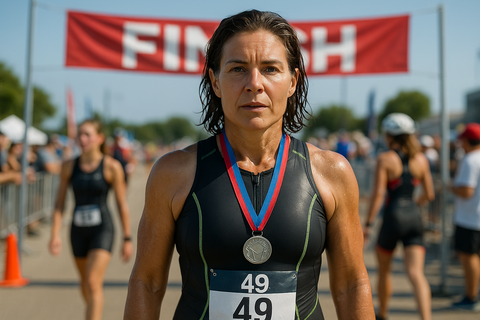
She finished in 1:59:56. Four seconds under two hours.
She stood at the finish line, cheering as other athletes crossed. A woman ahead of her cried as she approached the line.
Charley realized she was crying too.
What This Story Teaches Every Triathlete
Charley's race is a masterclass in the mindset shifts that separate athletes who finish from those who don't — not just physically, but mentally.
Here are the five lessons worth carrying into your own training:
1. Adaptation is not failure. Changing your approach to a goal doesn't diminish the goal. A relay finish is a legitimate finish. A modified training plan is still a training plan. The finish line counts regardless of how you arrived.
2. Invisible illness is real, and it doesn't disqualify you. Dysautonomia, Lyme disease, postpartum recovery, post-surgical rehabilitation — these conditions make endurance sports harder, not impossible. Acknowledging them is not complaining. It's accurate self-assessment.
3. The “all or nothing” trap is a lie. The most dangerous moment in this story isn't the fall. It's the moment Charley almost stayed home because she couldn't race the way she planned. Something is always better than nothing when the alternative is zero.
4. Community over competition. The strangers who nodded on the course, the woman who said “you got this,” her friend's sign, Andrew's voice at the last hill — none of these were teammates. They were fellow athletes recognizing a shared struggle. That recognition matters.
5. Voluntary suffering is a response to involuntary suffering. If you've ever wondered why people sign up for races that hurt, this is your answer. Endurance sports give us an arena where we choose the difficulty, control the response, and define the outcome. For people who have spent years dealing with pain they didn't choose, that agency is profoundly meaningful.
Your Turn
If you've read this far, you probably have a race of your own — one you're training for, one you've been putting off, or one that got derailed by something you didn't see coming.
The question isn't whether obstacles will appear. They will. The question is whether you're willing to show up differently when they do.
Charley didn't get the race she planned. She got four months of invisible illness, a broken elbow, a sling, a stationary bike, and a relay bib. She also got a finish line, a time under two hours, and a story that will outlast any race result.
That's what showing up differently looks like.
Whether you're building toward your first triathlon or gearing up for a relay leg while a teammate handles the swim, the right gear and the right mindset make all the difference.
Frequently Asked Questions
What inspired Charley DiAdamo to participate in the 70.3-distance triathlon in Maine?
Charley DiAdamo was inspired to participate in the long-distance triathlon in Maine after years of playing competitive sports and filling the void with training after starting college. She aimed for personal challenge and athletic achievement through this event.
What injuries did Charley sustain leading up to the race?
Charley sustained an elbow injury after falling from her new bike while trying to clip in for the first time. Specifically, she broke her elbow in two places, which significantly affected her ability to train and participate in the triathlon.
How did Charley adapt her participation after her injury?
After her injury, Charley switched to participating in a relay team instead of competing solo. Despite her initial resistance to this change, she accepted the opportunity to run as part of a relay team and continued her preparations despite challenges.
What was the outcome of Charley's race experience?
Charley completed her leg of the relay with a time of 1:59:56, finishing four seconds under her goal time. Despite the struggles she faced throughout the journey, she found the experience rewarding and emotional.
What reflections did Charley have on endurance and personal struggle from her experience?
Charley reflected on the lessons learned from both voluntary and involuntary suffering through her training and race. She recognized that many endurance athletes share personal struggles and that these experiences contribute to their resilience and determination.
Source: Portland Press Herald — “Anything is possible: My experience at the Maine triathlon”