How to pace race day
The biggest pacing mistake on race morning usually happens before the gun goes off. You look around, adrenaline spikes, everyone seems faster than you, and suddenly the plan you trained for starts to feel too conservative. That is exactly why learning how to pace race day matters. Good pacing is not about holding back for the sake of it. It is about using your fitness at the right time, in the right places, so you can race the full distance instead of surviving the final third.
For beginner and early-stage triathletes, pacing is one of the fastest ways to improve results without adding more training hours. You do not need a heroic first 10 minutes. You need a repeatable effort across swim, bike, and run that matches your current fitness, the course, and the weather. Race-day pacing is discipline under pressure.
How to pace race day starts before the start line
If you want to pace well, do not build the plan on race morning. Build it during training, then simplify it before the race. Your pacing strategy should come from recent sessions, not from your goal fantasy.
Start with one honest question: what effort can you actually sustain today? For a sprint triathlon, you can race harder overall, but that does not mean every discipline should feel like a sprint from the first minute. For Olympic distance and longer, pacing errors compound fast. Going slightly too hard on the bike can turn the run into a shuffle.
A practical plan uses the metrics you trust most. That might be heart rate, power, pace, or rate of perceived exertion. If you are newer to triathlon, perceived effort is often the best anchor because race conditions change. Heat, hills, open water stress, and course congestion can make your usual numbers less reliable in the moment.
Think in ranges, not exact numbers. If your bike target is too rigid, one hill or one windy section can pull you off plan mentally. A better approach is to define a controlled opening effort, a steady middle effort, and a final segment where you can build only if you still feel composed.
Pacing the swim without burning matches
The swim is where many beginners make the race harder than it needs to be. Not because they lack fitness, but because they start above control. The heart rate spikes, breathing gets rushed, technique falls apart, and then the bike starts with unnecessary fatigue.
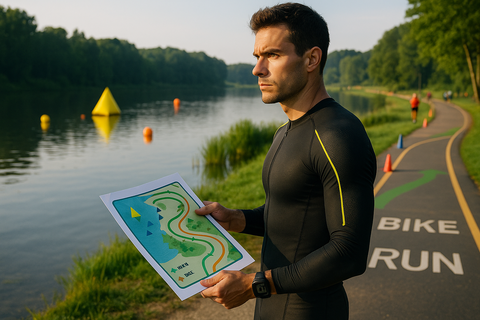
Your goal in the first minutes of the swim is not speed. It is rhythm. That means long exhale, calm stroke rate, and clear water when possible. If you are in a crowded start, positioning matters. Starting too far forward can force you into an effort level you cannot hold. Starting slightly more conservatively often leads to a faster overall swim because you stay smooth.
For most first-time or developing triathletes, the best swim pacing cue is simple: controlled hard, not frantic hard. You should feel like you are working, but still able to settle after the opening surge. If you cannot regain rhythm within a few minutes, you started too fast.
The trade-off is real. A more aggressive swim might gain you a small amount of time, but if it costs composure heading into T1, it is rarely worth it. In triathlon, the race does not reward the athlete who wins the first 300 meters. It rewards the athlete who can keep making good decisions two hours later.
Bike pacing is where your race is made
If you want the clearest answer to how to pace race day, start with the bike. This is the section where athletes can either set up a strong run or quietly ruin it.
Most amateurs ride too hard early, especially after the excitement of the swim and the speed of getting onto the course. The legs feel fresh, the effort feels easy, and the numbers can drift high before you notice. Twenty minutes later, that "free speed" starts charging interest.
The first part of the bike should feel controlled. If you use power, stay patient and keep the effort slightly under what feels exciting. If you use heart rate, expect some lag and avoid chasing a number immediately. If you race by feel, ask yourself whether the effort is smooth enough that you could imagine holding it for most of the ride. If the answer is no, back off.
On flat sections, your pacing should be steady. On climbs, avoid the temptation to surge far above target just to pass people. On descents, keep free speed free. This is where many athletes waste energy by pushing when the course already gives them momentum.
Nutrition also affects pacing more than athletes admit. If you skip fueling early because you feel good, the run often exposes that mistake. A strong bike split is not just the fastest one. It is the one that leaves you able to run close to your real fitness.
For sprint distance, the bike can feel assertive, but it still needs control. For Olympic and longer, patience becomes a performance skill. If you are wondering whether you are being too conservative, the better question is this: can you still run well off this effort?
How to pace race day on the run
The run tells the truth about your pacing. It reveals whether the swim was controlled, whether the bike was smart, and whether your race plan matched reality.
The first kilometer of the run should almost always feel easier than your emotions want it to. Your legs are adjusting, your stride is finding shape again, and your internal sense of pace is usually off after the bike. Many athletes leave T2 feeling amazing, run too fast immediately, and pay for it before the halfway mark.
A good opening run pace feels contained. Let your breathing settle. Let your cadence come to you. Then, once you are fully into the run, build toward your target effort.
If you race with pace data, use it carefully. GPS can be messy around turns, trees, and crowded sections. Effort is often the better guide, especially in hot conditions. If the day is warm, your best pace may be slower than planned even if your execution is correct. That is not failure. That is smart adjustment.
The final part of the run is where good pacing gives you options. If you paced well, you can compete in the final kilometers instead of just protecting yourself from slowing down. That does not always mean a dramatic negative split. It may simply mean holding form, keeping turnover strong, and passing athletes who started the run too aggressively.
Use effort zones, not ego
Race-day pacing gets easier when you assign each discipline a clear effort identity. The swim starts controlled and settles into rhythm. The bike stays steady and economical. The run begins patient and then builds if available. This keeps you from making each leg an emotional reaction.
It also helps to separate race ambition from race execution. Wanting a strong result is good. But if your pacing decisions are driven by what other athletes are doing, your plan is no longer your own. Someone passing you on the bike may be racing a shorter event, having a reckless day, or simply stronger than you. None of that should change your targets.
This is where confidence matters. Confidence is not blind aggression. It is trusting the plan you earned in training.
A simple pacing framework for beginners
If you are racing your first sprint or Olympic triathlon, keep the plan easy to remember. In the swim, settle before you push. On the bike, hold back early so you can stay strong late. On the run, give yourself 1 to 2 km to find control before asking for more.
For half-distance and longer, pacing needs even more restraint. Small mistakes early become major losses later. In these events, the athlete who feels "almost too easy" in the opening phase is often the one racing best by the end.
If you use tools or AI pacing support, keep them in service of clarity, not complexity. One good race plan beats ten clever adjustments. TriLaunchpad-style guidance works best when it simplifies decision-making under pressure.
What to do when the day changes
Even a strong pacing plan may need adjustment. Heat, hills, chop in the water, or a mechanical issue can shift the race. The mistake is resisting reality because you are attached to a number.
When conditions get harder, pace by effort and protect your run. If the swim was rougher than expected, do not try to "make up time" on the bike immediately. If your heart rate is unusually high from heat, respect it early. Smart athletes adjust before the race forces them to.
That is the real value in knowing how to pace race day. It gives you control when the course gets noisy, the competition gets distracting, and your own excitement starts pulling you off plan. Stay patient long enough for your fitness to show up. That is usually where your best race begins.