Are Triathlon Races Beginner Friendly?
A crowded transition area can make a first triathlon look far more intimidating than it is. The good news is that are triathlon races beginner friendly is usually answered with yes - provided you choose the right distance, understand the course, and arrive with a realistic level of preparation. You do not need to look like a seasoned age-group athlete to belong on the start line.
Triathlon is demanding because it combines swimming, cycling, and running. But beginner-friendly races are designed around participation, not just fast finishing times. Many athletes begin with no competitive swim background, an entry-level bike, and a goal that is simply to finish safely. The race experience rewards preparation and calm decision-making much more than expensive equipment.
What makes a triathlon beginner friendly?
A beginner-friendly race reduces unnecessary stress while still giving you a real multisport challenge. Sprint triathlons are often the best entry point. Typical distances are a 400 to 750 metre swim, a 20 km bike, and a 5 km run. That is enough to test your pacing and transitions without requiring the training volume of an Olympic-distance or long-course event.
The distance alone does not determine whether an event is suitable. A flat, well-marked bike course can be friendlier than a short race with steep climbs, rough pavement, heavy traffic, or tight turns. A pool swim or sheltered-water swim is usually less intimidating than an ocean course with waves and currents. Likewise, an event with clear race briefings, visible volunteers, aid stations, and generous cut-off times offers a much better first experience.
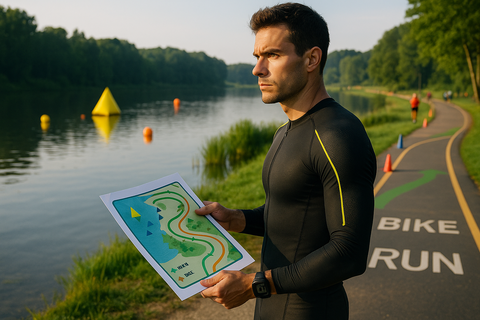
Look at the athlete information before registering. Course maps, elevation, water conditions, start format, cut-off times, and transition rules tell you more than a race photo ever will. If the organiser clearly explains what first-timers need to know, that is a positive sign.
Are triathlon races beginner friendly at every distance?
Not equally. Sprint races are the natural starting point for most adults who can already swim continuously, ride confidently, and run or run-walk for 20 to 30 minutes. Super-sprint events can be even more accessible, particularly for athletes testing the sport before committing to a bigger training block.
Olympic-distance races demand a meaningful step up. The standard 1.5 km swim, 40 km bike, and 10 km run require stronger endurance, better fuelling awareness, and more time in training. They can still work as a first race for a fit runner or cyclist who respects the swim and prepares consistently, but they are not the easiest entry route.
A 70.3 or full-distance IRONMAN is not a casual first challenge. Some highly committed beginners complete them successfully, yet the trade-off is substantial: more training hours, greater fatigue, higher nutrition demands, and more opportunities for small mistakes to become major problems. Start with the distance that gives you confidence and lets you build momentum. Progressing from sprint to Olympic and beyond is not a shortcut-free journey, but it is a smart one.
The three skills that matter most
You do not need to be exceptional in every discipline. You do need a safe baseline in each one.
Swim comfort is more important than swim speed
For many first-timers, the swim is the main source of anxiety. The key question is not, "Can I swim fast?" It is, "Can I stay calm and move forward continuously in the conditions of this race?" Practice in open water if your event uses open water. Learn how your wetsuit feels, how to sight toward a buoy, and how to settle your breathing after a busy start.
If you feel panicked in open water, treat that as useful information rather than something to push through on race day. A pool-based event, extra coached sessions, or another training cycle may be the right call. Confidence in the water is a safety requirement, not a bonus.
Bike handling protects your race
You do not need a triathlon bike for your first event. A well-maintained road bike, hybrid, or mountain bike is accepted at many beginner races, subject to event rules. A properly fitted helmet is non-negotiable.
What matters most is handling: starting and stopping smoothly, drinking while riding, changing gears, cornering with control, and riding predictably around other athletes. Train outside when possible. Indoor cycling builds fitness, but it cannot fully prepare you for wind, surfaces, turns, and the concentration required on a real course.
Run pacing finishes the day well
The run comes after the legs have already worked hard, so it often feels different from a standalone 5 km. New triathletes commonly start too quickly because they are excited to be off the bike. A controlled run-walk strategy is completely legitimate and can produce a stronger finish than forcing a pace you cannot sustain.
Train at least a few bike-to-run sessions. Even 10 to 15 minutes of easy running after a ride teaches your body what to expect and removes much of the surprise.
Choose the race, not just the date
A race close to home can make your first experience easier, especially when it reduces travel logistics, unfamiliar roads, and pre-race stress. In Mexico, consider practical variables such as heat, altitude, road quality, and the time of year. A flat coastal course may bring humidity and warm water; a higher-altitude race can make your usual running pace feel harder. Neither is automatically bad, but both should influence your choice and training plan.
Read the race rules carefully. Some events allow drafting only under specific formats, while most traditional triathlons require athletes to keep distance on the bike. Check whether the swim start is rolling, wave-based, or mass start. A rolling start is often calmer for beginners because it spreads athletes out and lets you enter at a pace that suits you.
It also helps to choose an event where you can arrive early, walk through transition, and attend the briefing. Rushing into an unfamiliar venue five minutes before the start is one of the easiest ways to turn normal nerves into avoidable stress.
Build readiness with a simple training target
For a first sprint triathlon, many beginners benefit from 8 to 12 weeks of consistent training. The exact timeline depends on your current fitness, swimming ability, injury history, and race conditions. Someone who cycles and runs regularly may need to focus heavily on swimming and transitions. Someone returning to exercise may need longer, with a slower increase in workload.
Your training should include each discipline every week, one longer aerobic session, and occasional brick workouts. Recovery belongs in the plan too. Adding volume rapidly because race day is approaching can lead to injury or burnout, which is the opposite of beginner-friendly progress.
Use measurable readiness markers rather than guesswork. Before a sprint race, aim to complete a relaxed swim at least as long as the race distance, ride the race distance comfortably, and run or run-walk the required distance without excessive soreness. Then practise putting the pieces together at an easy effort.
TriLaunchpad's readiness-focused approach can help organise those decisions, but the principle stays simple: train for the event you entered, not the athlete you hope to become overnight.
Race day is allowed to feel unfamiliar
Your first transition may be slow. You may forget the exact order of sunglasses, helmet, and race belt. You may see athletes with carbon bikes and wonder whether you are underprepared. None of that determines your result.
Set out your equipment in a simple sequence, arrive with time to spare, and focus only on your next task. Swim calmly. Ride within control. Begin the run patiently. Follow the rules, listen to volunteers, and respect your body if something feels wrong.
A beginner-friendly triathlon is not one with zero nerves or zero effort. It is one that gives a prepared newcomer a fair, safe way to test themselves. Choose a course that matches your current skills, train consistently, and let your first finish line be the start of a stronger next goal.