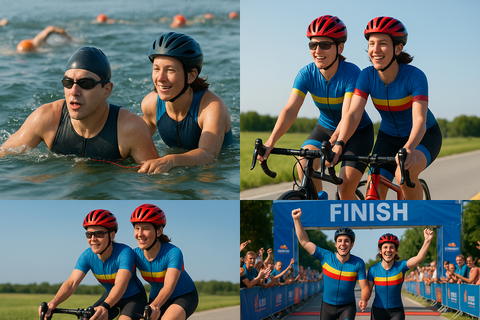
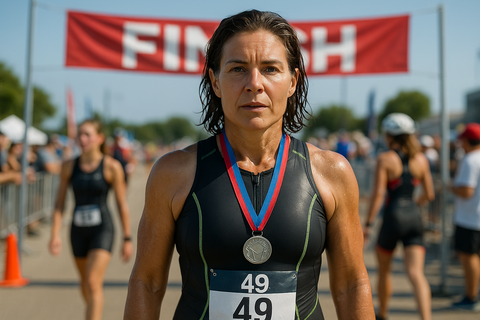
Italy mourns the passing of Alessandro Zanardi, 59, a man who didn't just refuse to accept defeat — he turned catastrophe into championship.
When Alex Zanardi passed away on May 2, 2026, the world lost more than a decorated athlete. It lost a living argument against the word "impossible." His family announced he had "passed away peacefully," a quiet ending to one of sport's most turbulent and triumphant lives. The contrast between that gentle farewell and the chaos that defined his athletic journey tells you everything you need to know about who Zanardi was.
For triathlon and multisport fans, Zanardi occupies a unique space: he was a Formula 1 driver who lost both legs and went on to finish the Ironman World Championship in Hawaii— twice, both times in under ten hours. He was a Paralympic champion, a world record holder, and a man who built not one but two elite athletic careers from the wreckage of near-fatal accidents. Understanding his full story means understanding what human resilience actually looks like when it's pushed to its absolute limits.
This is that story.
Against All Odds: How Alex Zanardi Became Sport's Greatest Comeback Story
The Formula 1 Chapter: A Driver's Foundation
Making His Mark in Motorsport
Alessandro Zanardi — "Alex" to the world — entered Formula 1 in 1991 as a young Italian with the ambition and reflexes to compete at the sport's highest level. Over two seasons, he made 41 starts in F1, driving for teams including Minardi and later McLaren. His best result came at the 1993 Brazilian Grand Prix, where he crossed the line in sixth place — a respectable achievement in one of the most competitive environments in professional sport.
By F1's unforgiving standards, Zanardi's career in that series was solid rather than spectacular. The grid at any given Grand Prix is populated by the best drivers on the planet, and simply qualifying and finishing consistently at that level demands exceptional skill. Zanardi had it. What he hadn't yet found was the right vehicle for his particular brand of talent.
Where Zanardi Truly Thrived: American Open-Wheel Racing
That vehicle turned out to be on the other side of the Atlantic. Transitioning to the American CART Championship — known today as the IndyCar Series — Zanardi discovered a competitive home that suited him perfectly. He didn't just compete; he dominated, winning back-to-back CART Championships in 1997 and 1998.
These weren't flukes or circumstantial victories. Two consecutive championships in an open-wheel series of that caliber mark a driver as genuinely elite. Zanardi had found his level, and his level happened to be the top of the sport. That foundation — the discipline, the risk tolerance, the relentless competitor's instinct — would prove essential when everything he'd built was stripped away in a single moment in Germany.
The 2001 Lausitzring: When Everything Changed
The Crash That Should Have Ended It All
In September 2001, during a CART race at the Lausitzring circuit in Germany, Alex Zanardi was involved in a catastrophic accident. The collision resulted in the amputation of both his legs. For virtually any other athlete — for virtually any other person — that would have been the final entry in the competitive record. Career over. Chapter closed.
Zanardi was 35 years old.
What happened next is why his name is spoken in the same breath as the greatest comeback stories sport has ever produced. Rather than retreating from competition, Zanardi began the painstaking process of rebuilding — not just his body, but his entire athletic identity. He continued racing using prosthetics. He refused to let the accident define the boundary of what was possible for him.
Then he discovered the handbike.
The Pivot That Created a Legend
A handbike is a three-wheeled vehicle propelled by hand cranks, used widely in adaptive cycling and racing. For a man with Zanardi's competitive instincts, exceptional upper-body strength, and decades of racing intelligence, it was a revelation. He had found a new arena — and he approached it with exactly the same intensity that had made him a two-time CART champion.
The pattern that emerged from 2001 onward was consistent and extraordinary: setback → adaptation → dominance. Zanardi didn't just participate in adaptive sport. He became the standard against which everyone else was measured.
Paralympic Glory: 12 World Titles and Four Gold Medals
Rewriting the Record Books
The numbers from Zanardi's adaptive sports career are staggering. He accumulated 12 world titles in handbike disciplines and became a four-time Paralympic champion, claiming gold medals at both the 2012 London Games and the 2016 Rio Games in the road race and time trial events. He competed at the highest level of adaptive sport for nearly two decades after losing his legs.
To put this in perspective: winning a single Paralympic gold medal represents the pinnacle of years of dedicated training and sacrifice. Zanardi won four, across two different Paralympic cycles, in a sport he only took up after the age of 35. The sheer improbability of this trajectory is difficult to overstate.
The Ironman Crossover: Why Endurance Athletes Took Notice
Perhaps the achievement that most resonated with the triathlon and multisport community was Zanardi's move into long-distance racing. Most elite handbike racers compete in track and road events calibrated to their strengths. Zanardi wasn't satisfied with that.
He completed the Ironman World Championship in Hawaii twice — both times in under ten hours. For context, the Ironman is a grueling combination of a 2.4-mile swim, 112-mile bike ride, and a 26.2-mile marathon. Finishing it under ten hours, for any athlete, represents a serious performance. For an athlete without legs, using a handbike for the cycling segment and specialized prosthetics for the run, it represents something that defies easy categorization.
He didn't stop there. Zanardi set a world record at Ironman Emilia-Romagna with a finishing time of 8:26:06 — a benchmark that announced to the endurance world that adaptive athletes don't just belong in Ironman racing; they can redefine what's achievable within it.
Key Achievement Snapshot:
- 41 Formula 1 starts (1991–1992)
- 2× CART/IndyCar Champion (1997, 1998)
- 12 handbike world titles
- 4× Paralympic gold medalist (2012, 2016)
- 2× Ironman World Championship finisher (sub-10 hours)
- World record at Ironman Emilia-Romagna: 8:26:06
The 2020 Accident: The Challenge He Couldn't Overcome
A Cruel Second Chapter
In 2020, Zanardi was involved in another severe accident — a head-on collision with a truck while competing in his handbike. The resulting head and brain injuries were devastating. Unlike the 2001 Lausitzring crash, where the damage was catastrophic but ultimately navigable through adaptation and determination, the neurological trauma from the 2020 accident presented a fundamentally different challenge.
He never fully recovered.
The distinction matters. In 2001, Zanardi lost his legs — physical losses that were irreversible but didn't touch the cognitive and mental machinery that made him a champion. The 2020 injuries struck at the neurological level, at the parts of himself that no prosthetic could replace and no competitive pivot could work around. For nearly six years, he lived with those injuries until his peaceful passing in May 2026 at the age of 59.
Dignity in the Final Chapter
His family's decision to share only that he had "passed away peacefully" and to withhold further details speaks to the same dignity that characterized Zanardi's entire post-2001 life. He had nothing left to prove. Twenty-five years had passed since the Lausitzring. In that time, he had built an adaptive sports career that dwarfed what most able-bodied athletes achieve in a lifetime.
The 2020 accident doesn't diminish the Zanardi story — it completes it honestly. Even extraordinary resilience has limits. The fact that he pushed against those limits for as long as he did is the point.
Legacy: What Alex Zanardi Leaves Behind
Redefining Disability in Competitive Sport
Before Zanardi, the dominant cultural narrative around serious physical disability and elite athletics operated on a simple assumption: one precluded the other. You could be disabled, or you could be a competitive champion. Zanardi didn't argue against that assumption. He simply ignored it, then dismantled it through action.
Amputation, in Zanardi's career, was a transition — not a conclusion. He demonstrated that adaptive athletes can compete at elite levels across multiple disciplines, that Paralympic sport deserves the same respect as able-bodied competition, and that the categories we use to define athletic achievement are far more permeable than we imagine.
The Rare Multisport Pioneer
Consider the full scope of what Zanardi achieved across different sporting disciplines:
- Formula 1 — among the most technically demanding motorsport environments in the world
- CART/IndyCar — two consecutive championships at the elite level
- Handbike racing — 12 world titles and four Paralympic golds
- Ironman triathlon — multiple finishes at world championship level, including a world record
No logical through-line connects these disciplines except for the man competing in them. Zanardi didn't succeed because he was built for any one of these sports. He succeeded because he brought the same qualities to each of them: exceptional discipline, intelligent race craft, tolerance for discomfort, and an unshakeable belief that there was always more left to give.
The Inspiration That Transcends Sport
What makes Zanardi's story resonate beyond the athletic community is that it's fundamentally a story about choice. After the 2001 accident, nobody would have blamed him for walking away from elite competition — or, more precisely, for choosing not to return to it. The world would have applauded him simply for surviving.
He chose differently. He chose to compete again, to discover new sports, to set world records in a chapter of his life that could easily have been defined by what he'd lost. That choice, made repeatedly over two decades, is why his passing prompted mourning not just in Italy but across the entire global sporting community.
Frequently Asked Questions
How did Zanardi complete Ironman races without legs?
Zanardi used a handbike for the cycling segment — the same equipment he raced to Paralympic gold — and specialized running prosthetics for the marathon portion. He swam using his upper body strength. Each element required different equipment and different physical adaptations. For serious training and competition, athletes like Zanardi rely on specialized triathlon suits and equipment designed for optimal performance.
Why does his story matter specifically to the triathlon community?
Zanardi proved that adaptive athletes can compete in Ironman-distance racing not just as participants, but as genuine performers posting elite times. His sub-10-hour Ironman finishes and world record opened a conversation about what adaptive endurance sport could look like at the highest level.
What made the 2001 comeback so remarkable?
Most athletes who sustain amputations don't return to any form of elite competition. Zanardi not only returned — he found a new sport, mastered it, and dominated it for nearly two decades. The statistical likelihood of that trajectory is vanishingly small.
How did his F1 background inform his later career?
Racing at any elite level requires exceptional spatial awareness, mechanical intuition, physical conditioning, and the ability to manage risk under pressure. Those skills transferred directly to handbike racing, where understanding equipment performance and maintaining composure in competition are equally critical.
The Enduring Measure of a Life
Alex Zanardi's career statistics are remarkable on their own terms: 41 F1 starts, two CART championships, 12 world titles, four Paralympic golds, a world record at Ironman Emilia-Romagna. Stack those numbers against any athlete's career and they stand up impressively. Stack them against an athlete who spent the second half of his career without legs, in a sport he discovered after age 35, and they become almost incomprehensible.
But the numbers aren't ultimately what Zanardi leaves behind. He leaves behind a demonstrated proof of concept: that catastrophic limitation, met with the right combination of stubbornness and creativity and sheer refusal to stop, can become the foundation for something extraordinary.
Italy has lost a national icon. The Paralympic community has lost its most visible ambassador. The triathlon and multisport world has lost a figure who proved that the boundaries of adaptive endurance sport are far wider than anyone had previously imagined. For those seeking to understand the limits of human potential, consider investing in quality running shoes designed for endurance performance and professional swimming equipment — the tools that enable athletes to push their boundaries.
What remains is the example — and that doesn't pass away.
Share your memories of Alex Zanardi in the comments below. How did his story change the way you think?
What is Triathlon Today?
Triathlon Today is a news outlet dedicated to triathlon and multisport, providing a mix of race reports, industry news, human interest stories, and profiles of both professional and age-group athletes.
What categories of content does Triathlon Today cover?
Triathlon Today covers various categories including news, race reports, triathlon, duathlon, multisports, and gear. It also features calculators and starter guides for newcomers.
How can I stay updated with the latest news from Triathlon Today?
You can subscribe to the Triathlon Today newsletter to receive weekly updates with their most popular news articles and reports.
Who is the editorial team behind Triathlon Today?
The editorial team at Triathlon Today is comprised of individuals working remotely from all over the world, and they independently decide the news content without influence from advertisers.
Who can I contact for press releases or news suggestions?
For press releases or news suggestions, you can contact Triathlon Today at news@tri-today.com.
Source: https://tri-today.com/2026/05/former-f1-driver-and-paralympic-handbike-legend-alex-zanardi-passes-away/
Discover unique triathlon-themed merchandise, including stylish t-shirts, stickers, phone cases, and home decor - perfect for endurance sports enthusiasts and athletes. Shop now