Why Cross Country Athletes Are Winning at Triathlons—And What It Means for Training
How distance runners from Middleburg and Keystone Heights High Schools are discovering their secret advantage in multi-sport competition — and what every endurance athlete can learn from their summer on the race course.
There's a moment in every triathlon when the running leg begins — and that's exactly when a cross country athlete's eyes light up.
On Sunday, July 26, 2026, athletes from Middleburg High School and Keystone Heights High School lined up at the Game On St. Augustine Triathlon and Duathlon, trading their track spikes for goggles and bike helmets. According to Clay Today, the Clay County runners turned in solid performances at the Northeast Florida event — a result that surprised exactly no one who understands what endurance running does to an athlete's body and mind.
Their success isn't a coincidence. It's a blueprint.
Whether you're a young athlete weighing your first triathlon, a parent wondering if cross-training is worth it, or a coach looking for ways to develop more resilient competitors, what happened in St. Augustine that July morning holds some genuinely useful lessons.
The Game On St. Augustine Triathlon: A Proving Ground for Young Athletes
St. Augustine is no stranger to endurance sports. Florida's oldest city — with its flat coastal roads, reliable summer heat, and proximity to open water — has long been a magnet for triathletes of all levels. The Game On Triathlon and Duathlon series offers both a traditional swim-bike-run triathlon format and a duathlon (run-bike-run), making it accessible to athletes at different stages of their multi-sport journey.
For high school athletes competing in the thick of Florida's summer heat, finishing a triathlon is itself an achievement. Doing it well, coming from a single-sport background, is something worth paying attention to.
The event draws a mixed field — age groupers, seasoned amateurs, and increasingly, younger athletes exploring endurance sports outside their primary discipline. That Middleburg and Keystone Heights sent cross country and track athletes to compete speaks to a growing trend in how forward-thinking programs are building their rosters.
The Natural Advantage: What Cross Country Running Gives You for Free
Here's the thing coaches and experienced triathletes already know: the running leg doesn't just come last in a triathlon — it comes hardest, when your legs are already fatigued from the bike. For most age-group competitors, the run is where races are lost.
For a cross country athlete, it's where races are won.
Distance running builds three things that translate almost directly into triathlon success:
1. Aerobic Engine
Cross country training develops VO2 max — the body's ability to consume and use oxygen during sustained effort — at a level most sport-specific athletes never reach. That aerobic base doesn't disappear when you climb on a bike or jump in a pool. It's the foundation everything else is built on.
2. Mental Toughness
Any runner who has pushed through the final mile of a 5K cross country race in August Florida heat knows how to hurt and keep moving. Triathlons demand exactly this quality — the ability to compartmentalize discomfort and maintain pace when your body is screaming at you to stop.
3. Pacing Intelligence
Good cross country athletes are finely tuned pacing machines. They know the difference between sustainable effort and blowup pace. In a triathlon, going out too hard on the bike is one of the most common beginner mistakes. Runners who understand effort management have a built-in protection against this.
A cross country athlete stepping into their first triathlon already has the most important discipline covered — and brings mental and physiological advantages that can't be faked or shortcut.
The Real Challenge: What Running Does Not Prepare You For
Let's be honest about the gaps. Triathlon is three sports, and excelling at one doesn't guarantee competence in the others. For runners transitioning to multi-sport competition, two disciplines demand genuine investment.
Swimming: The Great Equalizer
Swimming is the discipline that most commonly separates former runners who thrive in triathlons from those who struggle. It's not a matter of fitness — it's technique. Poor swimming form can cost several minutes over a race distance, and more dangerously, it can exhaust an athlete before the bike even begins.
For young athletes considering triathlon, swimming lessons are non-negotiable. Even 8–10 weeks of focused stroke technique work with a qualified coach can dramatically reduce the time gap between a swimmer's fitness and their actual swim split. The earlier this investment is made, the better.
If swimming feels like a genuine barrier, the duathlon format — which the Game On St. Augustine event also offers — is a smart entry point. Run-bike-run eliminates the swim entirely and lets athletes compete in a full multi-sport format while building confidence and bike fitness.
Cycling: A Different Kind of Power
Running builds posterior chain strength — glutes, hamstrings, calves. Cycling emphasizes quads and hip flexors in a completely different motion pattern. Runners who jump on a bike without preparation often find themselves producing weak power or developing soreness in unexpected places.
Beyond muscle adaptation, bike handling skills take time: cornering with confidence, riding efficiently in aerobars, managing gearing on varied terrain. These are learned skills, not transferred ones.
The good news? Cycling is highly coachable and responds quickly to focused training. Most runners can build functional bike fitness within a single off-season, especially if they have access to a cycling club or a coach who can assess their position and pedaling mechanics.
Transitions: The Fourth Discipline
Here's something first-time triathletes often overlook until race day: transitions are timed. The time you spend stripping off your wetsuit, finding your bike, clipping into your shoes, racking the bike, and pulling on your running shoes counts toward your overall finish time.
Practicing transitions is one of the highest return-on-investment training activities for new triathletes. A minute saved in T1 and T2 combined can be the difference between age group podium positions.
Why High School Programs Are Embracing Multi-Sport Competition
The decision by Middleburg and Keystone Heights coaches to send their cross country and track athletes to a triathlon in the off-season reflects a broader shift in how smart programs think about athletic development.
Cross-Training Reduces Injury Risk
Overuse injuries are the silent killer of high school running careers. Stress fractures, shin splints, IT band syndrome — these aren't signs of weakness, they're the predictable result of bodies being asked to perform the same motion pattern thousands of times per week, often on hard surfaces.
Multi-sport training distributes mechanical load across different muscle groups and movement patterns. Cycling provides cardiovascular conditioning without the impact forces of running. Swimming develops upper body strength and shoulder stability that running neglects entirely. Athletes who cross-train meaningfully often arrive at their primary sport's season healthier than those who trained exclusively.
Building Athletic Versatility
There's growing recognition in sports science that early specialization — while it can produce short-term results — often limits long-term athletic development. Athletes who develop proficiency across multiple movement patterns tend to be more resilient, more adaptable, and more likely to remain active throughout their lives.
For high school athletes still developing their physical literacy, a summer triathlon isn't a distraction from cross country season — it's an investment in the broader athletic toolkit that will serve them for decades.
Collegiate Pathway Awareness
Triathlon is a growing collegiate sport, with NCAA Division I, II, and III programs — as well as NAIA and robust club-level opportunities — actively recruiting. Florida, with its year-round training climate and established endurance sports culture, is a natural pipeline for college programs scouting multi-sport talent.
A high school runner who can credibly present swim and bike fitness opens recruiting conversations that their single-sport peers cannot. For athletes whose running times alone may not attract Division I track programs, triathlon can open entirely different doors.
Practical Steps for Athletes Ready to Make the Jump
If the Middleburg and Keystone Heights performances have you curious about your own multi-sport potential, here's a practical roadmap.
For Student-Athletes
- Start with a duathlon if swimming isn't yet in your toolkit — it's a legitimate competitive format, not a consolation prize
- Prioritize swim technique over swim fitness; 20 minutes of drill work with a coach beats an hour of thrashing up and down a lane
- Get a proper bike fit before logging significant saddle time; poor positioning causes knee and back issues that derail training
- Practice transitions deliberately — set up a mock transition area in your driveway and run through it until it feels automatic
- Track all three disciplines in your training log to identify where your time losses are coming from
For Coaches
- Explore local triathlon clubs as training partners during the off-season; many welcome high school athletes
- Develop periodization plans that maintain running base while introducing cycling and swimming stimulus
- Frame multi-sport training as injury prevention, not just competitive preparation — it's an easier sell to cautious parents and athletic directors
- Connect with event organizers for youth-specific race categories that offer appropriate competitive environments
For Parents
- Research local youth triathlon series in Northeast Florida — there are entry points for athletes at every level
- Support the gear investment thoughtfully: a used road bike and basic goggles are sufficient to start; expensive triathlon-specific equipment can wait until commitment is confirmed
- Connect with the triathlon community for mentorship; the sport has a notably welcoming culture toward newcomers at every age
What This Moment Represents for Youth Endurance Sports
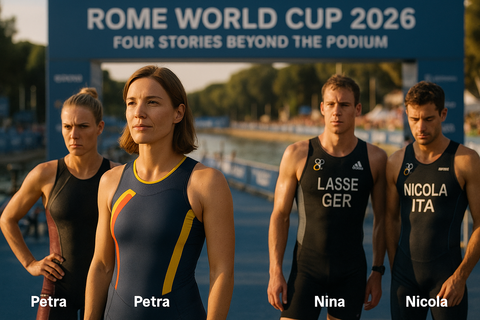
The image of Middleburg and Keystone Heights athletes lining up at a St. Augustine triathlon in July tells a story bigger than one race result. It represents a generation of young endurance athletes who are refusing to be defined by a single discipline — and finding, in the process, that their training has prepared them for more than they realized.
Youth sports are becoming more multi-disciplinary. The athletes who thrive in the long run — pun absolutely intended — are often those who develop broad physical literacy, embrace competitive discomfort across different formats, and stay curious about what their bodies can do.
A cross country finish line is not an ending. For a growing number of high school athletes in Northeast Florida, it's the starting line for something even bigger.
Ready to Explore Multi-Sport Competition?
If you're a young endurance athlete curious about triathlon, the best time to start is now. Look for local sprint-distance triathlons or duathlons in your area — events like the Game On St. Augustine series offer a welcoming environment for first-timers and seasoned age-groupers alike.
Already gearing up for race season? Check out our triathlon gear collection and competition triathlon suits to make sure you have everything you need — without overcomplicating your setup before your first start line.
The swim, bike, and run are waiting. Your cross country base is already working in your favor.
Source: Clay Today, "KHHS/Middleburg Swim, Bike, Run at St. Augustine Triathlon," published August 13, 2026, covering the July 26, 2026 event. Read the original article.
Frequently Asked Questions
What is the current weather forecast for August 15, 2026?
The weather is mostly clear with a temperature of 75°.
How can I access the full article about the St. Augustine Triathlon?
You need to log in to your subscriber account or purchase a new subscription to read the full article.
What options do I have for subscribing to Clay Today?
You can choose to subscribe to a regular subscription or purchase a single day pass for $1.00 for 24 hours of access.
Where can I find the latest news from Clay Today?
Latest news can be found in various sections including News, Business, Crime, Sports, and Lifestyle on the Clay Today website.
How can I contact the Clay Today team?
You can contact the Clay Today team through their 'Contact Us' page on their website.