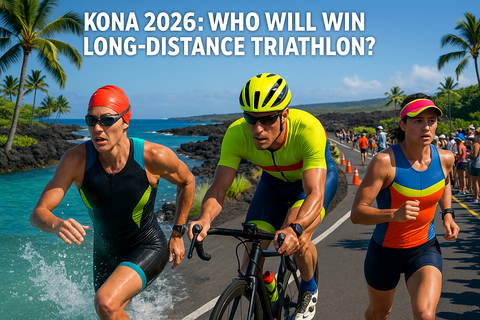
A 3.8 km ocean swim, 180 km bike ride, and 42.2 km marathon stand between athletes and the iconic finish on Ali'i Drive. But the heat, humidity, and open roads of Hawaii's Big Island present challenges that go far beyond simply covering 226 km.
Kona: More Than Just Distance
On Saturday, October 10, professional men and women will race together in Kona for the first time since 2019. This historic moment adds even more excitement for both racers and fans, especially as age-groupers chase their own world championship dreams alongside the elites.
But why is this course considered legendary? It's not just about the distance — the unique demands of the Kona course make it truly special. While 226 km is standard for long-distance triathlons globally, Kona's course pushes athletes in all three disciplines. Decisions made in the swim can have lasting effects hours later, right to the finish line.
This guide breaks down each segment of the Kona course, highlighting the terrain's requirements, the impact of conditions, and crucial insights from experts like Laura Siddall, a former top-10 finisher at Kona. Data from the 2024 and 2025 races gives you a clearer perspective on what to expect.
Whether you're racing, spectating, or dreaming about qualifying for Kona, here's everything you need to know about this challenging triathlon course.
The Swim: 3.8 km in Kailua Bay — Where Positions Form
A Straightforward Starting Point
The race kicks off at Dig Me Beach, near Kailua Pier, with a single-loop swim in Kailua Bay. Athletes start in the water, following a clockwise route around the Body Glove boat and returning to the pier for the first transition.
Siddall describes it simply: "It's a single lap, straight out from the beach, around the Body Glove boat, and back."
However, "simple" doesn't mean easy. The ocean's unpredictability introduces challenges that a pool or calm lake can't provide. Swells can alter your line of sight, constant navigation demands mental focus, and the chaos of hundreds of competitors forces quick decisions about positioning and effort.
Energy Drain Before You Even Get on the Bike
One of the subtle challenges of the Kona swim is how much energy it can quietly consume before you hit the bike. Kailua Bay is buoyant, making swimmers feel higher in the water and reducing drag. This advantage, however, can lead to underestimating the fatigue you'll feel once you transition to the bike. Finding clear water and latching onto a good pair of feet can spike your heart rate and deplete energy reserves — often unnoticed until you're battling through the bike leg.
For professionals, how you swim affects everything that follows. A few seconds here can decide whether you bike comfortably in a group or face an uphill battle across the lava fields.
Why Swim Exit Matters More Than Swim Position
Here's the key strategic takeaway: it's not about who exits the water first. It's about the positioning and gaps that emerge heading into the demanding 180 km bike segment. Aggressively chasing time in the swim for thirty seconds can have profound effects later, especially in the marathon. The first transition is where sound racing tactics come into play — heart rate management and preparation for the extended challenge ahead.
Key stat: The Kona swim is a single loop, emphasizing the importance of pacing in those initial minutes with no second chance to adjust.
The Bike: 180 km Through the Lava Fields — Where Races Are Won and Lost
Navigating the Start: Positioning Through Town
The bike segment begins with a busy stretch through Kailua-Kona town before transitioning onto the Queen Ka'ahumanu Highway — known simply as the Queen K. This early phase is tactical as athletes find their positions after the swim, identify competitors, and settle into their rhythm. Then the scene opens up, and the breathtaking lava fields come into view.
Confronting the Lava Fields: Heat, Wind, and Little Shelter
Kona's bike course presents a visually stunning yet physically taxing landscape. The vast expanse of black lava rock offers no refuge from the elements. The Queen K continuously rolls, and approaching the turnaround at Hawi involves a sustained climb. Two significant factors amplify the challenge in ways raw power numbers rarely reflect:
- Heat: Temperatures on the Queen K push athletes into thermal stress as dark lava absorbs and radiates heat.
- Crosswinds: The winds in Kona are erratic and formidable. In exposed areas, balancing on your bike becomes as crucial as sustaining speed — leaning into a gust can cost you more than a conservative power strategy.
The Climb to Hawi: Expect the Unexpected
Athletes ride toward the northern turnaround at Hawi, which roughly marks the midpoint of the course. Many anticipate a relieving descent back — but Siddall points out an essential truth:
"Once you reach the turnaround, descending from Hawi still involves considerable climbing as you make your way back to the Queen K."
This is where ambition becomes costly. Athletes who ride aggressively in the first half — whether chasing a competitor or misjudging their effort — will find the return journey increasingly grueling. The marathon still awaits. Every extra watt spent beyond a sustainable average on the bike comes out of your running potential.
The Airport Checkpoint: A Critical Indicator
About 10 km before the transition, you'll ride near Kona International Airport. Siddall offers a practical benchmark here:
"If you're still riding strong by the Airport (around 10 km from T2), you're probably doing well."
This moment serves as a valuable self-assessment. If you're struggling — feeling heavy with diminishing power — your bike effort likely exceeded your strategy. If you're pedaling smoothly, your pacing has been spot-on.
Lessons From Recent Races on Pacing
Patrick Lange, 2024 Men's Race: Lange didn't lead into T2. He rode conservatively, preserving his legs for the marathon, ultimately sweeping through the field to secure his third Kona title — a masterclass in patience.
Taylor Knibb and Lucy Charles-Barclay, 2024 Women's Race: Both exited the bike more than five minutes ahead of the competition but ultimately did not finish. The Energy Lab revealed the true cost of their aggressive biking strategy.
The takeaway? The strongest cyclist on race day isn't always the one who finishes first. In Kona, the bike is a means to an end — not the end itself.
Understanding the 20-Meter Drafting Rule
As we look toward 2026 and beyond, remember that the 20-meter drafting rule adds layers of complexity to the bike segment. Group dynamics shift, pacing strategies become chess-like, and positioning relative to other athletes becomes critical for managing energy across the full 180 km.
The Run: 42.2 km via Ali'i Drive and the Energy Lab — Where Champions Are Made
Ali'i Drive: The Exciting Beginning
The marathon kicks off with an out-and-back along Ali'i Drive, Kona's iconic oceanfront stretch. The crowd energy here is among the best in the triathlon world, greeting athletes as they leave T2 after hours of racing. Use that positive energy wisely — it's a brief reprieve before the long road ahead.
Transitioning to Palani Road and the Queen K: Embracing Solitude
As the race progresses, participants climb Palani Road and move onto the Queen K. This segment offers far less crowd support, forcing athletes to confront the accumulated physical cost of the swim and bike. Those who paced effectively will find themselves working hard yet in control. Those who burned too many matches earlier may be scrambling to limit the damage.
The Energy Lab: A Triathlon Landmark
Located at HOST Park — home of the Natural Energy Laboratory of Hawaii Authority (NELHA) — the Energy Lab symbolizes both the psychological and physical trials of the Kona race. It hits during the marathon when cumulative effort feels most daunting. Extreme heat and challenging terrain combine to test even the best conditioned athletes. Siddall's words echo in every competitor's mind:
"The infamous Energy Lab, where what goes in doesn't necessarily come out."
This is where nutrition strategies can falter and perfectly executed fueling plans can collapse. Getting through the Energy Lab while still moving and focused is a feat in itself. Racing through it? That's something else entirely.
Visual moment: Taylor Knibb's challenging run through the Energy Lab in 2025 exemplifies the harsh realities of Kona — despite a strong bike, the conditions and fatigue turned the final kilometers into a survival ordeal.
The Last Push: Palani and Ali'i Drive
Those who survive the Energy Lab still face the return along the Queen K before descending Palani Road and reaching the final stretch through Kona town. The finish on Ali'i Drive is one of the most celebrated moments in endurance sports. For some, it signifies a world title. For many others, it embodies years of training, qualifying races, missed weekends, and sheer determination. Both experiences deserve recognition.
Why Kona Is About More Than 226 km
The Conditions That Connect Everything
Strip away the humidity, winds, and volcanic terrain, and you have a typical long-distance triathlon. Add those elements back, and you have Kona. What makes this course uniquely challenging isn't any single factor — it's how all conditions intertwine. Heat that feels manageable early becomes a significant issue later. Winds that drained energy on the bike reduce the reserves needed for the run. Even the buoyancy felt during the swim can mask fatigue that reappears on the Queen K.
In this race, swimming, biking, and running are deeply interconnected. Every choice in one stage shapes performance in the next.
Balancing Pacing and Judgment
Kona rewards strong athletes, but it rewards judgment even more. Key decisions include how hard to push in those initial swim minutes, whether to chase someone on the bike or hold steady, when to accept a slower pace for proper fueling, and how to mentally regroup when the Energy Lab tests your limits. As race data repeatedly confirms: the strongest competitor early on isn't necessarily the one reaching Ali'i Drive first.
Race Day Checklist: Three Key Moments
✅ Checkpoint 1 — Swim Exit
- Assess: Where do you stand relative to your key rivals?
- Strategy: Manage your position without urgency. Every second here matters less than conserving energy.
- Red flag: Elevated heart rate entering T1 signals too much exertion.
✅ Checkpoint 2 — The Airport (10 km Before T2)
- Assess: Are you still riding well, or are you faltering?
- Strategy: If you're strong here, your pacing has likely been effective. If struggling, prepare for a long run ahead.
- Red flag: A significant power drop indicates you've overspent energy.
✅ Checkpoint 3 — The Energy Lab
- Assess: Can you handle nutrition? Are you managing heat effectively? Are you still moving purposefully?
- Strategy: Focus on steady, consistent fueling rather than speed.
- Red flag: Gastrointestinal issues or pace deterioration signal failed fueling execution.
The Kona Lesson — Valuable Insights for Every Athlete
Kona has a way of humbling even the best-prepared athletes. Taylor Knibb and Lucy Charles-Barclay, top performers in the 2024 women's race, were unable to make it to Ali'i Drive. This isn't a failure story — it illustrates what Kona demands and why finishing this race is a monumental achievement.
The conditions expose weaknesses that less challenging venues never reveal. Heat acclimatization matters. Nutrition needs practice, not just planning. Mental toughness — making sound decisions when your body wants to quit — becomes just as critical as physical conditioning.
Frequently Asked Questions
What are the key distances for the Kona long-distance world championship race?
The Kona race consists of a 3.8 km ocean swim, a 180 km bike ride, and a 42.2 km marathon.
Where does the swim portion of the Kona race take place?
The swim takes place in Kailua Bay, starting near Dig Me Beach, with a single-loop route returning to the Kailua Pier.
What challenges do athletes face during the bike portion?
Athletes face challenges such as extreme heat, humidity, strong crosswinds, and rolling terrain, particularly during the climb to Hawi and on the Queen Ka'ahumanu Highway.
What is the significance of the Energy Lab in the marathon?
The Energy Lab is known for testing athletes' endurance late in the race, where many face critical fatigue and heat management challenges, impacting their overall performance.
How does the course layout influence race strategy?
The course layout requires athletes to balance their energy expenditure across all three disciplines, as overextending in one can affect performance in the following legs. Proper pacing, fueling, and hydration are key to success.
When will the next Kona long-distance world championship take place?
The next long-distance world championship in Kona is scheduled for October 10.