Why Even Fit Athletes Face Risks During Triathlons: Understanding Sudden Cardiac Arrest
The story of Larry Winans — an entrepreneur, dental professional, and passionate triathlete — serves as a poignant reminder that fitness and cardiac safety are not synonymous.
On a race morning in State College, Pennsylvania, Larry Winans entered the water for the swim portion of the Happy Valley Half-Triathlon. He was a retired dentist, a craft brewery co-founder, and a man who had successfully built two careers, living what many would consider his best chapter. Tragically, he never finished that swim.
Winans suffered cardiac arrest during the swim leg of the 70.3-distance race and was transported to Hershey Medical Center, where he later passed away. His death sent shockwaves through Central Pennsylvania — affecting not just the triathlon community, but also the tight-knit world of craft beer enthusiasts, small business owners, and the residents of Lewisburg and Williamsport who had watched him transform a homebrewing hobby into a thriving regional brand.
His passing compels us to confront an uncomfortable truth: being physically active — even at the level required to complete a 70.3-distance triathlon — does not make you immune to sudden cardiac arrest.
This article honors Larry Winans' entrepreneurial legacy while exploring the serious, often misunderstood risks of cardiac events in endurance athletes — and what every triathlete, runner, and weekend warrior needs to know before their next race.
Who Was Larry Winans? A Life Built on Reinvention
From Healthcare Provider to Craft Beverage Pioneer
Larry Winans spent 25 years as a practicing dentist in Lewisburg, Pennsylvania — a career built on precision, community trust, and long-term patient relationships. But like many professionals who reach a certain point in their careers, Winans felt the pull toward something new.
That pull came in the form of a shared hobby with his friend Skip Kratzer: homebrewing. What started as weekend batches of handcrafted beer gradually evolved into something bigger — a genuine business opportunity that neither man could ignore.
In March 2020, Winans and Kratzer officially launched Jackass Brewing Company in Lewisburg. The timing was, to put it mildly, audacious. Opening a hospitality business in the first weeks of the COVID-19 pandemic required either extraordinary courage, extraordinary optimism, or both. Winans, apparently, had plenty of each.
Building Something That Lasts
Rather than retreating after the pandemic's initial blow to the hospitality industry, Jackass Brewing grew. By 2023, the company expanded to Williamsport, taking on an ambitious restoration project: transforming an old warehouse into a large taproom, restaurant, and event space. It was the kind of project that reflects a founder who thinks in terms of community, not just commerce.
Winans eventually left dentistry entirely to focus on the brewery full-time — a rare and meaningful leap that signals just how deeply he believed in what he and Kratzer had built together.
Jackass Brewing has confirmed that both locations will continue operating as a tribute to the dream Winans helped build. That continuity is itself a testament to the foundation he laid.
The "Second Act" That Inspires
There is something deeply resonant about the arc of Larry Winans' life. He mastered one professional identity over 25 years, then had the courage to build a second one from scratch — starting with a hobby, nurturing it into a business, and expanding it during one of the most uncertain periods in modern economic history.
For many readers in the 25–45 age range who dream of a career pivot — whether into endurance sports, entrepreneurship, or both — Winans represents a real-world model of what that leap looks like. It's a legacy worth honoring, and worth learning from.
Being physically active — even at the level required to complete a 70.3-distance triathlon — does not make you immune to sudden cardiac arrest.
The Tragedy: Sudden Cardiac Arrest in Endurance Athletes
What Happened During the Happy Valley Half-Triathlon
The Happy Valley Half-Triathlon takes place in and around State College, Pennsylvania — a scenic, competitive event drawing athletes from across the region. Like all 70.3-distance races, it consists of a 1.2-mile swim, a 56-mile bike ride, and a 13.1-mile run.
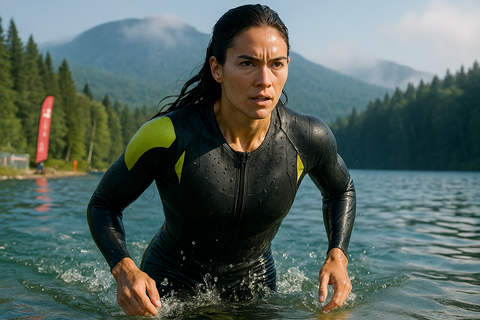
Winans never made it out of the water. He suffered cardiac arrest during the swim portion of the race and was transported to Hershey Medical Center, where he died.
The swim leg of a triathlon — despite being the shortest segment by distance — is consistently identified as the most physiologically demanding and the most medically dangerous. Winans' tragedy follows a pattern that sports cardiologists have studied for years.
Understanding Sudden Cardiac Arrest (SCA) in Athletes
Sudden Cardiac Arrest is not a heart attack, though the two are often confused. A heart attack occurs when blood flow to the heart is blocked. SCA is an electrical malfunction — the heart suddenly stops beating effectively, often due to ventricular fibrillation (a chaotic, ineffective quivering of the heart muscle). Without immediate intervention, loss of consciousness occurs within seconds, and death within minutes.
What makes SCA particularly devastating in athletes is the paradox at its core: the very intensity of training that makes someone capable of finishing a 70.3-distance race can also mask — and in some cases trigger — underlying cardiac conditions.
Key cardiac conditions associated with SCA in endurance athletes include:
- Hypertrophic cardiomyopathy (HCM) — an abnormal thickening of the heart muscle, often undetected and the leading cause of SCA in younger athletes
- Arrhythmogenic right ventricular cardiomyopathy (ARVC) — a progressive disease that replaces heart muscle with fatty tissue, increasing arrhythmia risk
- Coronary artery disease — more common in athletes over 40, often developing silently over decades
- Latent arrhythmias — electrical abnormalities that may only manifest under extreme exertion
- Electrolyte imbalances — prolonged exercise depletes sodium, potassium, and magnesium, all of which regulate heart rhythm
According to research published in the Journal of the American College of Cardiology, the incidence of SCA in triathlon competitors is approximately 1.74 per 100,000 participants — and the swim leg accounts for the majority of fatalities.
Why the Swim Portion Is the Danger Zone
Among triathlon's three disciplines, the swim carries disproportionate cardiac risk — and not just because of cold water. Multiple compounding factors create a perfect physiological storm:
- Cold water immersion triggers the "cold shock response," causing rapid heart rate increase, hyperventilation, and sudden blood pressure spikes
- Chest compression from water pressure reduces breathing efficiency precisely when oxygen demand is highest
- High-intensity start — most athletes go out hard in the swim, spiking heart rate immediately after a potentially anxious pre-race wait
- Limited medical access — a cardiac event in the water is exponentially harder to respond to than one on a run course with spectators and medical staff nearby
- Panic and psychological stress — open-water swimming, particularly in a crowded mass start, creates psychological pressure that compounds physiological load
For athletes with undiagnosed cardiac conditions, this combination can be fatal. It is a convergence of factors that even seasoned triathletes should understand.
The Paradox of Fitness
Here is the uncomfortable reality that Winans' death illustrates: endurance athletes are not automatically heart-healthy. In fact, research suggests that years of intense aerobic training can create structural changes in the heart — sometimes beneficial, sometimes not — that may increase arrhythmia risk in certain individuals.
The "athlete's heart" — characterized by an enlarged left ventricle and lower resting heart rate — is typically an adaptive response to training. But in some people, these adaptations can resemble or mask underlying pathology. Regular training also tends to suppress symptoms; a person might dismiss palpitations or unusual fatigue as just "pushing hard" rather than early warning signs of something serious.
The result? A false sense of cardiac security. "I train for triathlons — my heart is fine." For most people, that's true. But for a meaningful minority, it's a dangerous assumption.
You can be capable of completing a 70.3-distance triathlon and still carry an undetected cardiac condition that becomes fatal under peak physiological stress.
Cardiac Screening: What Every Athlete Over 40 Needs to Know
Pre-Participation Cardiovascular Screening
The American Heart Association (AHA) and American College of Cardiology (ACC) recommend that athletes — particularly those over 35–40 — undergo cardiovascular evaluation before participating in high-intensity endurance events. However, the depth of that evaluation varies enormously in practice.
A basic pre-participation screening includes:
- Personal and family history review — first-degree relatives with early cardiac death is a major red flag
- Symptom screening — chest pain, syncope (fainting), palpitations, or unusual shortness of breath during exercise
- Physical examination — heart murmurs, blood pressure abnormalities
- Resting ECG (electrocardiogram) — can detect arrhythmias, structural abnormalities, and conduction defects
For athletes over 40 or those with elevated risk factors, additional testing may include:
- Stress ECG or stress echocardiogram — evaluates heart function under exertion, much closer to race conditions
- Coronary calcium scoring — a CT scan that detects early arterial plaque buildup
- Holter monitor — 24–48 hour continuous ECG to capture intermittent arrhythmias
- Cardiac MRI — the gold standard for detecting structural abnormalities like ARVC or HCM
The challenge is that not all races require medical clearance, screening costs can be prohibitive, and even comprehensive testing carries false-negative rates. Some conditions simply remain undetectable until they manifest — often catastrophically.
Warning Signs Every Triathlete Should Take Seriously
If you experience any of the following during or after training, stop and consult a physician before your next race:
- ⚠️ Chest pain or pressure during or after exercise
- ⚠️ Unexplained shortness of breath disproportionate to exertion level
- ⚠️ Dizziness or lightheadedness during exercise
- ⚠️ Fainting or near-fainting episodes
- ⚠️ Heart palpitations — fluttering, racing, or irregular heartbeat
- ⚠️ Unusual, persistent fatigue that doesn't improve with rest
These are not signs to push through. They are signals your body is sending that deserve professional attention.
Race Day Safety: What to Look for as an Athlete and Spectator
Not all race organizations are equal in their medical preparedness. Before your next event, ask:
- Are AEDs (Automated External Defibrillators) positioned along the course, including at water entry and exit points?
- Are trained medical personnel stationed at the swim segment?
- Is there a communication system between water safety personnel and land-based medical teams?
- What is the protocol for in-water emergencies?
As a spectator or co-athlete, knowing basic CPR and AED use can be the difference between life and death in the critical minutes before emergency services arrive. In-water cardiac arrest survival rates drop dramatically with each minute of delayed response — which is precisely why swim-leg incidents are so frequently fatal.
Jackass Brewing's Continuation: A Legacy Measured in Community
Business Continuity After Loss
The statement from Jackass Brewing was unambiguous: both the Lewisburg and Williamsport locations will continue operating as a tribute to the dream Winans helped build. Co-founder Skip Kratzer — Winans' friend and business partner from the very beginning — remains at the helm of what they built together.
For small businesses, the sudden loss of a founding partner is one of the most challenging events imaginable. The fact that Jackass Brewing has made a public commitment to continuity reflects both the strength of the foundation Winans helped create and the loyalty of the team around him.
A Taproom Built on Friendship and Passion
The Lewisburg location — opened in March 2020 — represents the original vision: a neighborhood brewery born from a homebrewing friendship. The Williamsport expansion represents ambition: a warehouse restoration project that created a large-scale taproom, restaurant, and event space, transforming a historic industrial building into a community gathering point.
Together, the two locations tell the story of a man who didn't just dream about change — he built it, brick by brick and batch by batch.
How to Honor the Legacy
If you're in Central Pennsylvania, visiting Jackass Brewing is one of the most direct ways to honor what Larry Winans created. Supporting local craft breweries isn't just about good beer — it's about sustaining the people and places that give a community its character and identity.
Lessons from Larry Winans: What We Take Forward
Fitness ≠ Cardiac Safety
The most important lesson from Winans' death — and from the broader pattern of cardiac events in endurance athletes — is that physical fitness is not a substitute for cardiac screening. The two are related but distinct. You can be capable of completing a 70.3-distance triathlon and still carry an undetected cardiac condition that becomes fatal under peak physiological stress.
Screening Is an Act of Responsibility
For any athlete over 40 training for endurance events, comprehensive cardiovascular screening is not excessive caution — it is basic responsibility. To yourself, to your family, to your training partners and race-day volunteers who would have to respond to an emergency.
Schedule that appointment. Get the ECG. Ask your cardiologist about stress testing. The investment is minimal compared to the stakes.
Know CPR. Full Stop.
If you watch endurance events, know CPR and AED use. It takes a few hours to learn and the certification is widely available. In an in-water or on-course emergency, bystander response before EMS arrives is often the only thing that matters.
The "Second Act" Is Worth Pursuing — Carefully
Larry Winans proved that it's possible to build a meaningful second chapter — to transform a passion into a business, to take real risks, and to create something that outlasts you. That is genuinely inspiring, and it should remain so.
But that pursuit of passion — whether in endurance sports, entrepreneurship, or both — is best conducted with clear eyes. That means medical oversight, honest self-assessment, and the wisdom to take warning signs seriously rather than push through them.
Conclusion: A Life Worth Remembering, A Warning Worth Heeding
Larry Winans was a dentist, a brewer, a triathlete, and a community builder. He transformed a 25-year healthcare career into a thriving craft brewery empire, opened not one but two locations, and pursued an active lifestyle that put him on the start line of a 70.3-distance race. By almost any measure, he was living exactly the kind of life we should all aspire to.
His death is not a reason to stop pursuing active, ambitious lives. It is a reason to pursue them more intelligently — with medical screening, self-awareness, and the humility to recognize that the human heart, even in a well-trained body, has its own rules.
If you are an athlete over 40, schedule a cardiovascular screening before your next race. If you watch endurance events, learn CPR and AED use. If you're in Central Pennsylvania, raise a glass at Jackass Brewing in Lewisburg or Williamsport — and remember the man whose passion made that pint possible.
Rest easy, Larry. The taps are still flowing.
Take Action Today
- 🫀 Schedule a cardiac screening — ask your physician about ECG, stress testing, and coronary calcium scoring before your next endurance event
- 🏊 Know your swim risks — understand the physiological stress of open-water swimming and discuss with your doctor
- 🍺 Support Jackass Brewing — visit the Lewisburg or Williamsport locations and honor Winans' legacy in the most fitting way possible
- 🧡 Learn CPR — the American Red Cross and American Heart Association both offer accessible certification courses
- 📣 Share this article — if you know a triathlete or athlete in your life, pass this information on
What happened to Larry Winans, the co-founder of Jackass Brewing Company?
Larry Winans passed away due to cardiac arrest during the swim portion of the Happy Valley Half-Triathlon. He was later pronounced dead at Hershey Medical Center.
When did Larry Winans co-found Jackass Brewing Company?
Larry Winans co-founded Jackass Brewing Company with Skip Kratzer in March 2020.
What notable change occurred to Jackass Brewing Company in 2023?
In 2023, Jackass Brewing Company expanded to Williamsport, converting an old warehouse into a larger taproom, restaurant, and event space.
How long did Larry Winans work as a dentist before focusing on brewing?
Larry Winans worked as a dentist for 25 years before he transitioned to brewing beer full-time.
Will Jackass Brewing continue operations following Winans' death?
Yes, both Jackass Brewing locations will continue operating as a tribute to Larry Winans and the dream he helped build.