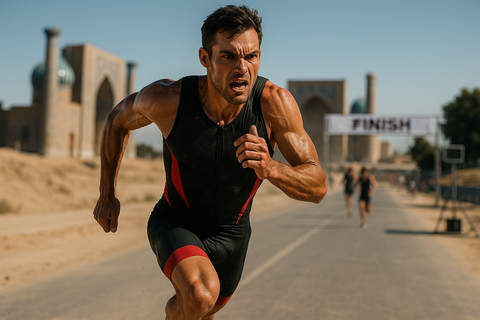
From Rock Bottom to Long-Distance Triathlon: How One Man Used Endurance Sports to Rebuild His Life
When grief, divorce, and alcohol converge, most people retreat. Richard Benevento chose to swim into his fear instead — and over six years, that single courageous decision transformed every corner of his life.
Imagine standing at the edge of a serene lake, heart racing, panic bubbling in your chest — not because of the water, but because of everything you are leaving behind on the shore. This is where Richard P. Benevento found himself: a man who had spent two decades excelling in athletics, yet suddenly felt utterly lost, facing a challenge that had nothing to do with strength or skill.
He grappled with compounding losses. His father had succumbed to leukemia, his marriage had dissolved, and alcohol had become his go-to escape. For someone whose identity revolved around physical mastery — gymnastics scholarships, professional touring, and thrilling performances — that kind of invisible collapse can be the hardest to face and the hardest to recover from.
What shocked those around him was his choice of antidote: triathlon, and specifically open water triathlon — the discipline that terrified him most. This is the story of how that decision transformed his life, and why the lessons from his six-year journey carry meaning far beyond the finish line.
When Life Falls Apart: Three Crises at Once
The Convergence That Changes Everything
Experiencing multiple setbacks simultaneously produces a particular kind of exhaustion — different from facing any single challenge alone. For Benevento, grief compounded relentlessly: the loss of his father, the end of his marriage, and a slow drift into alcohol as a misguided escape arrived almost together.
What makes his story especially relatable for fellow athletes is the paradox at its core. High athletic achievement does not shield anyone from life's hardest moments. Individuals whose identities are tightly bound to performance may actually struggle more intensely when those structures disappear. The gym, the team, the crowd — these provide invisible scaffolding. Remove them, and the free fall can feel catastrophic.
Using alcohol to cope with grief is more common in sports culture than most athletes acknowledge. The discipline that fuels athletic success can paradoxically become a weapon of self-destruction when misdirected. The pivotal moment — for Benevento and for anyone facing similar struggles — arrives when the cost of continuing down a destructive path becomes impossible to ignore.
Choosing Fear Over the Familiar
Why Triathlon? Why Open Water?
What makes Benevento's response to crisis so instructive is this: he did not retreat to the comfort zone of gymnastics. He deliberately chose something that genuinely intimidated him.
Open water swimming strikes fear in many athletes — even strong pool swimmers. Without lane lines or visible walls, panic can overwhelm even the technically skilled. It is not merely a matter of ability; it is a psychological battle fought entirely inside your own head. That is precisely why it became the right challenge for him.
Benevento arrived with impressive credentials. His gymnastics background included a scholarship at the University of Iowa, and he spent five years with the Bud Light Daredevils, an elite trampoline dunk team that performed in front of tens of thousands. He understood physical discipline at a profound level.
Yet triathlon demanded something different. It required learning to manage panic in open water, to regulate the nervous system in an environment where nothing felt familiar. Recovering from a life crisis demands the choice of new challenges rather than a return to familiar ones. The discomfort is not a side effect of the process — it is the process.
The Blue Lake Breakthrough: 2012
Training for a Race, Rebuilding a Life
Journey to Blue Lake, Benevento's memoir, recounts what unfolded when a man in genuine crisis chose to face hard things head-on. The 2012 triathlon was not merely a race; it became a personal laboratory.
Endurance sports offer a recovery path that few other disciplines can match: predictable, measurable, and temporary discomfort. In training, progress is trackable. Last Tuesday's panic in the pool is measurably less intense than last month's. Over time, an athlete accumulates concrete evidence of their own capability. That evidence is quietly transformative.
Benevento's insight is vital: personal rebuilding happens alongside physical training, not after it. The same consistency required to build an aerobic base is exactly what restores emotional stability. The capacity to endure discomfort in the water directly mirrors the capacity to navigate grief on dry land.
Blue Lake became a meaningful symbol — specific, attainable, and significant. Not an abstract notion of "getting better," but a date, a location, a finish line you could point to on a map.
Endurance sports create a distinct environment for psychological growth. The feedback is honest and immediate: you either swam the distance or you didn't; you either stayed calm or you panicked. Either way, you get back to work the next day.
The Six-Year Arc: Sprint Distance to the Full Distance
Scaling the Challenge
Completing a sprint triathlon — approximately 750 meters of swimming, 20 kilometers of cycling, and a 5K run — is a genuine accomplishment. But as seasoned triathletes know, it is only the beginning of a much longer conversation.
Six years after Blue Lake, Benevento crossed the finish line of a full long-distance triathlon: 2.4 miles of open water swimming, 112 miles on the bike, and a full 26.2-mile marathon run — 140.6 miles of uninterrupted movement, typically taking between 8 and 17 hours to complete.
| Distance | Swim | Bike | Run | Typical Duration |
|---|---|---|---|---|
| Sprint | 750m | 20km | 5km | 1–2 hours |
| Olympic | 1.5km | 40km | 10km | 2–2.5 hours |
| 70.3-Distance | 1.9km | 90km | 21.1km | 5–7 hours |
| Full Long-Distance | 3.8km | 180km | 42.2km | 8–17 hours |
The journey from 2012 to 2018 is the real story. It illustrates the process most transformation narratives skip over: sustained commitment year after year, without applause or recognition. Training sessions, recovery weeks, longer bike rides, more hours in open water — and the gradual accumulation of proof that more was possible than he once believed.
The transition from sprint to full long-distance symbolizes a psychological progression from managing crisis to achieving mastery. Each new distance demanded new skills, greater resilience, and an expanded understanding of what the human body and mind can sustain.
Endurance as Life Philosophy: The Transferable Skill
Moving Through Discomfort — in Sport and in Life
Benevento, now retired after 27 years in the IT sector, articulates his entire journey through one lens: "Endurance is a practical lesson in moving through discomfort."
The athlete who learns to manage panic during an open water swim is practicing the exact same mental skills as someone learning to confront grief without reaching for familiar escapes. Running mile 20 of a marathon when every fiber screams to stop mirrors the experience of navigating a career change after decades in one field. These are not metaphors — they are the same skills applied in different contexts.
Here are the transferable principles Benevento's experience reveals:
- Consistency over intensity — Regular effort, even when motivation dips, builds a stronger foundation than sporadic bursts of energy.
- Progressive overload — Gradually increasing challenge builds real capacity. Nobody leaps from sprint to full long-distance in a single season.
- Discomfort as a signal, not a stop sign — Anxiety, fatigue, sorrow, and uncertainty are invitations to go deeper, not reasons to quit.
- Recovery is essential — Rest, reflection, and integration are not contrary to growth; they enable it.
- A systematic approach — Breaking massive goals into manageable training blocks makes the seemingly impossible achievable.
For anyone navigating addiction recovery, career transitions, rebuilding after divorce, or the ongoing demands of creative work, the structure of endurance training provides stability amid chaos. Benevento's approach translates across virtually every domain of human experience.
The Next Chapter: Extending the Message Into 2027
From Breakthrough to Mastery
Journey to Blue Lake chronicles the crisis and the initial breakthrough. But Benevento's story has not ended, and neither has his writing.
His upcoming 2027 project will explore what he calls the "endurance years" following Blue Lake — the physical and personal evolution from that first sprint triathlon to completing a full long-distance race. This phase matters deeply, because most transformation narratives abandon the middle years: the ones without dramatic moments, filled instead with the sustained effort that constitutes real change.
- Book One (Journey to Blue Lake): Crisis → decision → first breakthrough
- Book Two (2027): Sustained growth → escalating challenge → mastery
Together, the two books complete an arc that is rare in sports memoir and personal development literature. They insist that transformation is not a single moment — it is a continuous practice, measured in years and seasons rather than race-day finishes.
What Richard Benevento's Story Teaches the Rest of Us
Five Takeaways Worth Carrying Beyond This Article
1. Crisis can serve as a catalyst — with the right intent behind the response. Benevento's breakdown laid the groundwork for a breakthrough, but only because he made a conscious and difficult choice. Inertia does not produce transformation; decisions do.
2. Endurance is learned, not innate. Even with an elite athletic background, Benevento had to cultivate genuinely new skills — especially the mental capacity to stay calm in uncontrolled, unfamiliar environments. Past achievements do not automatically transfer.
3. Discomfort provides valuable information. The anxiety in the water, the fatigue during training, the grief that surfaces when you slow down — these are cues to engage more deeply, not reasons to retreat.
4. Progression matters as much as the destination. Six years from sprint to full long-distance is not slow; it is necessary. Sustainable transformation demands patience, consistency, and strategic advancement rather than dramatic leaps.
5. Skills transfer across contexts. What works in endurance sport — consistency, progressive challenge, recovery, mental resilience — works equally well in personal recovery. This is not motivational language; it is actionable structure.
Ready to Start Your Own Journey?
You do not need to sign up for a long-distance race tomorrow. But if Benevento's story resonates, consider these concrete next steps.
If you are curious about triathlon as a path to personal growth: Start with a sprint distance. Face your specific fear — open water swimming, cycling, or running — through gradual, targeted exposure. Find a training community for support. Treat the process as personal development first, with athletic achievement following naturally.
If you are navigating a life transition or seeking recovery: Consider whether an endurance challenge might provide the structure and forward momentum you need. A predictable training schedule brings genuine stability during chaotic times. Choose discomfort deliberately rather than defaulting to familiar escapes.
If you would like to follow Benevento's complete journey: Pick up Journey to Blue Lake — available on Amazon, Audible, Google Play, Kobo, and Booktopia. Stay tuned for his 2027 follow-up, which will complete the arc from Blue Lake to the full long-distance finish line.
The lake is always waiting.
Frequently Asked Questions
What is WebWire?
WebWire is a press release distribution service that has been delivering news to the world since 1995. It helps individuals and companies distribute their press releases widely across various news search engines and media outlets.
What services does WebWire offer?
WebWire offers several services including news and press release distribution, targeted media outreach, and various publishing options such as WebPost and WebRelease, which cater to different distribution needs.
How can I submit a press release through WebWire?
To submit a press release, you can create a free account on the WebWire website and follow the submission process outlined there. This allows you to distribute news and updates effectively.
What is the target audience for WebWire's services?
WebWire's services are designed for businesses, organizations, authors, and individuals looking to promote their news, products, or events to a broad audience, including media professionals and the general public.
How does WebWire enhance visibility for press releases?
WebWire enhances visibility by distributing press releases to numerous highly trafficked news search engines, increasing the likelihood of being seen by a wider audience and generating leads for users.
Who is Richard P. Benevento?
Richard P. Benevento is an author and former IT professional notable for his memoir "Journey to Blue Lake," which details his journey into triathlons. He is currently working on a new project focused on his experiences training for and completing a full long-distance triathlon.
Where can I purchase "Journey to Blue Lake"?
"Journey to Blue Lake" is available for purchase on various platforms, including Amazon, Audible, Google Play, and Kobo. Links to these platforms are provided on the book's promotional materials.

![[WATCH LIVE NOW] Ironman 70.3 World Championship Nice: men battle for the world title](http://triathlon.mx/cdn/shop/articles/6796cb07c17754f5be6b41306bfebb7f.png?v=1789360626&width=480)