From Marathon to Triathlon: How a Father and Son Team Are Pushing Boundaries Together
After completing the Boston Marathon three times together, Yonatan and Schoan Quezada thought they had found their groove. Then Yonatan decided groove wasn't enough. This August, the Haverhill father-son duo dives into entirely new territory—literally—as they take on the Boston Triathlon, a three-discipline test that will carry them through open water, onto two wheels, and finally back to the roads they know best. For a pair already familiar with pushing limits, this is their biggest push yet.
Their story isn't just about athletic achievement. It's about what happens when a parent decides that more is possible, and a son shows up to prove it.
The Marathon Foundation: Building an Athletic Partnership
Three Boston Marathons, One Unbreakable Bond
Most families bond over meals, road trips, or shared hobbies. Yonatan and Schoan Quezada bond over 26.2 miles of pavement. Schoan, now 20, lives with cerebral palsy along with other medical complexities—but that reality has never defined the ceiling of his ambitions or his father's. What started as Yonatan pushing Schoan through shorter runs in a specialized stroller-like chair evolved, mile by mile, into three Boston Marathon finishes.
"I saw how happy he got while we were running, and that's what kept me going," Yonatan said.
That sentence carries everything you need to understand about this team. The joy was the fuel. The finish lines were just proof that the fuel worked.
The Inspiration Behind the Commitment
No story of adaptive endurance racing in Massachusetts is complete without mentioning Team Hoyt. Dick and Rick Hoyt—the legendary father-son duo from the Bay State—completed more than 1,000 endurance races together over their careers, including 33 Boston Marathons. Dick pushed, pulled, and carried Rick, who also had cerebral palsy, through marathons, triathlons, and ultramarathons, redefining what was possible for adaptive athletes everywhere.
Yonatan saw himself in that story—and more importantly, he saw Schoan in it.
"If I don't commit now somehow, I will never do it." — Yonatan Quezada
That's the voice of someone who understands that the hardest part of any endurance challenge isn't the race itself—it's deciding to show up for the training before the starting gun ever fires.
Why Running Was the Starting Point
Running made sense as the entry point. It was Yonatan's strongest discipline, required the most accessible specialized equipment, and rewarded consistency over technical skill. Three marathon finishes built more than just race medals—they built the confidence infrastructure needed to attempt something far more complex. Every long training run, every race-day logistics challenge, every hard mile with Schoan in tow was preparation for exactly this next step.
The Triathlon Challenge: Swimming Into Unfamiliar Territory
The Three-Discipline Breakdown
The Boston Triathlon's sprint-distance format looks compact on paper—but each segment presents its own unique demands for a push-assist team:
| Segment | Distance | Location |
|---|---|---|
| 🏊 Swim | 750 meters | Dorchester Bay (open water) |
| 🚴 Bike | 16.4 kilometers | Through South Boston |
| 🏃 Run | 5.5 kilometers | Along the shoreline |
For a solo athlete, this is a solid morning workout. For a push-assist team navigating open water with specialized equipment for the first time, it's a completely different challenge at each transition.
Swimming: The Biggest Hurdle
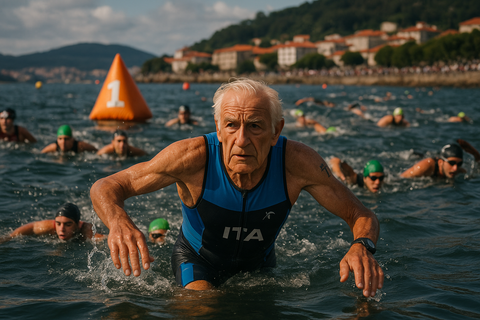
Ask any triathlete what keeps beginners up at night before their first race, and the answer is almost always the swim. For Yonatan, that anxiety is earned. He has never trained competitively in open water, and the mechanics of towing his son through Dorchester Bay represent an entirely new skill set.
"I know how to swim in a family pool, but not to this level," he said. "I'm not going to be Michael Phelps."
During the swim leg, Yonatan will tow Schoan using a rope attachment secured around his own chest, connected to a raft in which Schoan will lie. It's a system that requires not just swimming fitness but coordination, spatial awareness in choppy open water, and the mental steadiness to keep moving forward when nothing about the situation feels familiar.
"I'm not going to be Michael Phelps." — Yonatan Quezada, on realistic expectations and genuine commitment.
Cycling: A New Dynamic
The bike leg brings yet another first. Yonatan will attach Schoan's seat to the back of his bicycle, a configuration that fundamentally changes how the bike handles. Weight distribution shifts, the center of gravity moves, and every turn requires recalibration. This isn't just cycling—it's cycling with a completely different vehicle than the one you trained on.
Training with an Andover cycling group has helped Yonatan get comfortable with the mechanics, but nothing fully replicates race-day conditions. The 16.4-kilometer South Boston course will be the real test.
Running: The Familiar Finale
After navigating open water and a loaded bike course, the final 5.5-kilometer run along the shoreline will feel like home. This is the discipline the Quezadas have spent years refining together—and arriving at the run transition with the swim and bike behind them will be a genuinely earned moment of confidence. Finishing strong on familiar ground is both a strategic advantage and an emotional reward.
Training Regimen: Preparing for the Unknown
Weekly Training Schedule
Yonatan trains four to five days per week across all three disciplines, with Saturdays designated as mandatory rest—a necessary counterweight to the training load and his professional responsibilities as a sales manager for a beauty supply company. His training structure looks like this:
- Swimming: Sessions at Cedardele Health & Fitness
- Cycling: Group training in Andover
- Running: Group training through Tracksmith
- Rest: Saturdays off, always
This is not a professional athlete's schedule. It's a working parent's schedule, built around real-life constraints and held together by real-life commitment. That's exactly what makes it relatable—and exactly why it matters to share.
Balancing Work and Athletic Commitment
One of the persistent myths about triathlon training is that you need to restructure your entire life around the sport. Yonatan's approach challenges that directly. He manages a sales career, trains across three disciplines, and still shows up for his son. The structure is tight, the rest days are non-negotiable, and the focus is consistent.
For anyone in the TriLaunchpad community who has hesitated to attempt a sprint triathlon because life feels too full—this is your counterexample.
Mental Preparation: Confronting the Unknown
The swimming challenge isn't just physical. It's psychological. Entering open water in a competitive context, towing a raft, surrounded by other swimmers—that's a mentally demanding environment for anyone who learned to swim in a family pool. Yonatan's training groups have been essential not just for accountability but for normalizing the discomfort. Every early-morning swim session is a small act of courage that chips away at the doubt.
Beyond the Individual: Disability Representation in Endurance Sports
Schoan's Story: Presence Over Limitation
Schoan Quezada has cerebral palsy along with other medical complexities. He's also a three-time Boston Marathon finisher. Both of those things are true simultaneously, and the second fact doesn't erase the first—it reframes it. His participation in endurance sports doesn't minimize the reality of his disability; it expands the public understanding of what disability looks like in motion.
Yonatan said directly that he wants the triathlon to give Schoan another opportunity to experience competition, and to demonstrate that individuals with disabilities should have "a place on the starting line, not the sidelines."
That's not inspiration rhetoric—it's a logistical argument. Inclusive race categories, adaptive equipment standards, and push-assist divisions make that starting-line presence possible. The Boston Triathlon hasn't had a push-assist duo compete since 2019. The Quezadas are changing that.
The Team Hoyt Legacy
Dick and Rick Hoyt didn't just complete races—they transformed the public conversation about what adaptive athletes could achieve. Their more than 1,000 combined race finishes proved that the category of "endurance athlete" was far wider than anyone had previously imagined. Every family that sees Yonatan and Schoan cross a finish line is receiving the same message, updated for a new generation.
Changing What the Starting Line Looks Like
Growing adaptive athletics representation in events like the Boston Triathlon matters beyond any individual story. It signals to other families, other athletes with disabilities, and other race organizations that inclusion is not an accommodation—it's an enrichment. The field is better for having Yonatan and Schoan in it.
The Emotional Journey: Why They Keep Going
A Father's Deepest Motivation
Endurance sports offer a lot of possible motivations: personal records, physical transformation, competitive instinct, community belonging. Yonatan's motivation is simpler and more durable than any of those.
"I saw how happy he got while we were running, and that's what kept me going."
That's not a training philosophy. That's a parent watching his child experience joy in a world that doesn't always make joy easily available to people with significant disabilities—and deciding to keep building the path toward more of it. No finish line required. The running itself was enough.
The Commitment Philosophy
Yonatan's approach to commitment is worth sitting with: "If I don't commit now somehow, I will never do it." There's a self-awareness there that many athletes recognize—the knowledge that the window of willingness is real, and that second-guessing has a way of closing it permanently. Once committed, he followed through with full structure: training groups, weekly schedules, venue-specific workouts across all three disciplines. The decision to commit wasn't a feeling. It became a system.
Looking Past the Finish Line
The Boston Triathlon isn't the endpoint. Yonatan has already said the plan is to continue building on these athletic achievements with Schoan, taking on more races as the years come. He has even mentioned the possibility of a full long-distance triathlon competition somewhere down the road.
"This is exciting and I am even more committed to it," he said.
That kind of forward momentum—where each finish line becomes a starting point—is the hallmark of endurance athletes who stay in the sport for life rather than checking a box and moving on.
What Their Story Means for the Triathlon Community
The Quezadas aren't just completing a race. They're expanding the definition of who belongs in endurance sports. For the triathlon community—a sport that can sometimes skew toward a specific demographic profile—stories like this are genuinely important.
Here are five takeaways their journey offers:
- Disability is not a barrier to competition—with proper equipment and support, athletes with cerebral palsy can complete demanding multi-sport events.
- Shared goals build lasting bonds—athletic partnership between parent and child creates connection that extends far beyond the race course.
- Start where you're strong, then expand—marathons provided the foundation; triathlon is the evolution.
- Commitment matters more than natural ability—Yonatan had never trained as a competitive swimmer or ridden with an attached passenger seat before this year.
- Representation at the starting line creates inspiration downstream—every adaptive athlete who races makes the path clearer for the next one.
Conclusion: Every Starting Line Is Someone's Breakthrough
Yonatan and Schoan Quezada began their athletic partnership one run at a time, drawn together by something as simple and profound as a father watching his son light up with joy. Three Boston Marathons later, they're preparing to swim through Dorchester Bay, navigate a loaded bicycle through South Boston, and run the final stretch home on the ground they know best.
The Boston Triathlon takes place on August 22, 2026, at CDR Carson Beach in South Boston. It will be the first time a push-assist duo has competed in the event since 2019.
Whether you're a seasoned triathlete, a parent of a child with disabilities, or someone who has been waiting for a sign that a sprint triathlon is actually within reach—the Quezadas' story is worth carrying with you. Because if there's one thing their journey demonstrates clearly, it's this: the starting line belongs to anyone willing to do the work to get there.
Inspired by this story and exploring multi-sport racing? Check out our top gifts for triathletes collection or explore the best triathlon suits of 2025 for everything you need to take on your first sprint distance. And if you're shopping for the endurance athlete in your life, our triathlon suit collection has you covered.
Frequently Asked Questions
Who are the participants in the Boston Triathlon mentioned in the article?
The participants are Yonatan Quezada and his 20-year-old son, Schoan Quezada, who have previously completed the Boston Marathon together.
What past events have Yonatan and Schoan participated in together?
They have completed the Boston Marathon together three times prior to preparing for the Boston Triathlon.
What new challenges will they face in the Boston Triathlon?
They will be racing in unfamiliar territory, engaging in off-road biking and swimming in addition to running.
When is the Boston Triathlon taking place?
The Boston Triathlon is scheduled to take place later this month, specifically in August 2026 according to the article's publication date.
How do Yonatan and Schoan's experiences relate to endurance sports?
Their experiences highlight a journey of endurance, as they have transitioned from marathon running to tackling a multi-sport endurance event like the triathlon, showcasing their commitment to physical challenges and training.
Source: Eagle Tribune — Father and Son Prepare for Boston Triathlon