Kate Waugh's Podium Finish at the 2026 World Triathlon Cup Chengdu: A Photo-Finish Drama in Women's Elite Race
Less than an inch. That's all that separated gold from silver in one of the most dramatic finishes the World Cup triathlon has ever witnessed — and it had the crowd in Chengdu's Jintang District on its feet.
The third stop of the 2026 World Triathlon Cup circuit delivered an instant classic on May 9th. Germany's Laura Lindemann — Paris 2024 Olympic mixed relay champion — edged out a photo finish for the ages, claiming victory ahead of AIN's Valentina Riasova in a sprint so tight that officials needed several minutes to confirm the result. Great Britain's Kate Waugh, returning to short course racing after winning the 2025 T100 World Title, completed the podium with a bronze that sent a clear message: her short course edge hasn't dulled one bit.
With 65 elite women on the start line and 13 seconds separating the entire top eight at the finish, this race had everything — early swim aggression, a 50-athlete peloton biding its time, a dominant mid-run surge that looked unstoppable, and a final-kilometer comeback that rewrote the script entirely. Here's how it unfolded, discipline by discipline.
The Starting Field: 65 Athletes, Zero Certainties
Who Was in the Race?
This wasn't just a deep field — it was historically competitive. Among the 65 starters were:
- Laura Lindemann (GER) — Paris 2024 Olympic mixed relay champion, returning from an injury-plagued 2025
- Kate Waugh (GBR) — 2025 T100 World Champion, back on the short course circuit for the first time since claiming that long-distance title
- Valentina Riasova (AIN) — defending Chengdu champion, carrying momentum from her previous victory at this very venue
- Sian Rainsley (GBR) — consistent World Cup performer
- Julia Bröcker & Selina Klamt (GER) — German depth supporting Lindemann
- Sara Guerrero Manso (ESP) — a name to watch for Spanish-speaking fans following the circuit
- Aspen Anderson (AUS) — described as "young and rapid," pressing hard throughout the run
- Mariana Vargem (POR) — a rising talent chasing the result of her young career
The backstories alone made this compelling. Lindemann returning from injury. Waugh transitioning back from long distance. Riasova hunting back-to-back Chengdu victories. Before a single stroke had been taken, the tactical chess match had already begun.
The Swim: Aggression Pays Dividends Early
Two Athletes Announce Themselves
From the starting gun, Hungary's Fanni Szalai and France's Mathilde Gautier dictated terms. The pair "announced themselves immediately," opening a significant gap before the first buoy through sheer pace and a smarter line choice — hugging the left on the return to the pontoon while the rest of the field went straight.
The gamble paid off handsomely. By the time they hit T1, Szalai and Gautier had built a lead of approximately 20 seconds over the chasing pack.
What the Swim Gap Actually Means
Twenty seconds sounds decisive, but in short course triathlon it's a double-edged sword. It's enough to create psychological pressure on the field, but not enough to sustain a solo bike effort against nearly 50 motivated chasers. The majority of the elite field — including every podium finisher — arrived at T1 together, accepting the deficit as the cost of a measured swim.
The real takeaway: the swim set the stage, but it didn't decide the race. That job belonged entirely to the run.
The Bike: Patience as Strategy
Szalai's Smart Recalculation
Szalai emerged from T1 fractionally ahead and initially attempted to press her advantage solo on the bike. The 17-year-old "quickly thought better of it, easing up to allow a large group to form" — a mature tactical decision that kept her race alive deep into the run leg (she'd eventually finish 6th, an excellent result for someone her age at this level).
The 50-Athlete Peloton
What followed mirrored the men's race earlier that same day. By the halfway point of the bike leg, the lead group had swelled to nearly 50 athletes riding together in a massive train. The collective priority was simple and unanimous: stay safe, avoid crashes, arrive at T2 with legs ready for the decisive 5km run.
Almost every race favourite was present in that peloton — Lindemann, Waugh, Rainsley, Bröcker, Klamt, Guerrero Manso — "all biding their time."
Why No One Attacked
This is one of the defining tactical realities of short course racing with large fields. Any solo breakaway attempt would drain precious energy against a wall of 50 drafting athletes ready to respond. The math simply doesn't work in the attacker's favour. Instead, every serious contender made the same rational calculation: conserve, protect your position, and trust your run.
Key insight for club-level triathletes: When you see elite athletes sitting in a large peloton at World Cup level, it's not passivity — it's intelligent energy management. The race is being run in their heads, not their legs. Yet.
The result? Nearly 50 athletes entered T2 simultaneously, legs relatively fresh, the race entirely undecided.
The Run: Where It All Comes Apart — and Together
The Explosive Start Out of T2
With the field flooding out of transition together, France's Candice Denizot led the initial charge onto the run course. The race, as the transcript puts it perfectly, "was wide open."
For a few hundred metres, the situation was genuine chaos — 50 athletes with equal opportunity and everything to race for. Then Valentina Riasova changed the equation.
Riasova's Dominant Middle Phase
The AIN athlete "wasted no time, moving swiftly to the front of the pack and setting a blistering pace that began shedding athletes one by one." This is elite short course racing at its most brutal: not a gradual acceleration, but a calculated hammer blow designed to break contact.
By the 2.5km mark — the race's midpoint — Riasova had carved out a six-second lead. Her chasers: Waugh, Lindemann, Guerrero Manso, Szalai, Sophie Malowiecki (AUS), and Mariana Vargem (POR), with Australia's Aspen Anderson pressing from behind.
Six seconds over 2.5km in elite short course running is a meaningful gap. At that point, Riasova looked every bit the defending champion. A second consecutive Chengdu victory appeared to be hers.
The Final Kilometer: Refusing to Accept the Gap
This is where champions separate themselves — not necessarily in fitness, but in mentality.
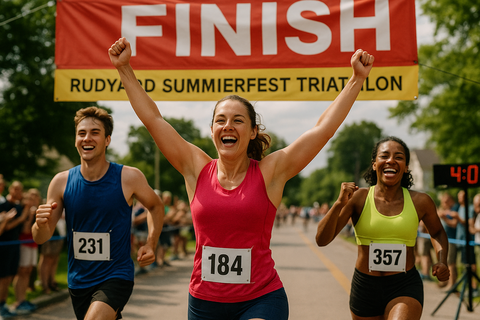
Lindemann and Waugh "ground the gap down meter by meter, never looking back." Not a sudden surge. Not a moment of inspiration. Just relentless, metronomic accumulation of distance, one stride at a time, until the final 180-degree turn into the finish chute — where the German and the Briton caught Riasova on the blue carpet in a sprint that had the crowd on its feet.
The lesson: A six-second lead with 1km to go in short course racing is not safe. In elite fields at this level, it almost never is.
The Photo Finish: Less Than an Inch
A Result That Required Minutes to Confirm
When three athletes hit a finish line within the space of one second, human eyes can't separate them. Officials fell back on photo finish technology, and even then it took several minutes to deliver a verdict.
The result:
| Place | Athlete | Country | Time |
|---|---|---|---|
| 🥇 1st | Laura Lindemann | GER | 00:55:27 |
| 🥈 2nd | Valentina Riasova | AIN | 00:55:27 |
| 🥉 3rd | Kate Waugh | GBR | 00:55:28 |
| 4th | Sara Guerrero Manso | ESP | ~00:55:29-30 |
| 5th | Mariana Vargem | POR | ~00:55:30-31 |
| 6th | Sian Rainsley | GBR | 00:55:35 |
| 7th | Julia Bröcker | GER | 00:55:40 |
| 8th | Aspen Anderson | AUS | 00:55:40 |
Thirteen seconds separated the entire top eight. That is a "stellar top eight" in every sense of the phrase.
What Lindemann's Win Means
For Lindemann, this result is about far more than a World Cup victory. After "a difficult 2025 plagued by injuries," she has returned to the circuit and immediately delivered a photo finish — the same brand of racing that gave her Olympic glory in Paris. The narrative writes itself: the athlete who thrives when the margins are smallest has found her way back.
Riasova's Agonising Silver
For Valentina Riasova, the margin is almost cruel. She led by six seconds with 1km remaining. She held form through the final turn. And she lost by less than an inch. The sport offers few experiences more brutal than that — and yet, the effort she produced in the middle phase of the run was genuinely outstanding. She'll be back.
Waugh's Validation
Kate Waugh's bronze carries real significance beyond the podium position. Switching between long-distance racing (T100 format) and short course World Cup demands different physical and tactical preparation. The fact that she finished just one second behind the winner — having closed a six-second deficit in the final kilometer alongside Lindemann — confirms that her speed, race instincts, and finishing kick remain World Cup-sharp.
For athletes who wonder whether focusing on one distance damages your credentials in another: Waugh's Chengdu performance suggests the answer is a clear no, provided the training foundation is sound.
What This Race Teaches Us About Elite Short Course Triathlon
Whether you're a club racer, a coach, or simply a fan trying to understand why World Cup racing looks the way it does, Chengdu 2026 offers several sharp lessons:
1. The run decides everything in short course
A 20-second swim lead evaporated. A 50-athlete peloton neutralised the bike entirely. The entire race was resolved in 5km of running.
2. Patience on the bike is a weapon, not a weakness
Riding conservatively in a large peloton isn't surrender — it's the strategic choice that enables fresh-legged athletes to produce the kind of final-kilometer running that wins races.
3. A lead with 1km to go is not a safe lead
Six seconds felt significant at 2.5km. It was gone by the finish line. In elite short course racing, no advantage is secure until the tape is broken.
4. Photo finishes reflect a sport at its most competitive
When 13 seconds covers eight elite athletes at the finish, training methods, athlete development, and tactical sophistication across the global field are genuinely converging. These margins aren't accidents — they're the product of extraordinary fitness on every part of the podium.
5. The final 1km is where mental toughness wins
Lindemann and Waugh didn't close a six-second gap on superior fitness alone. They closed it by refusing to accept the alternative.
What Comes Next
Lindemann emerges from Chengdu as a serious threat for the remainder of the 2026 World Triathlon Cup circuit and beyond. Her ability to replicate a Paris-style photo finish victory after a full year of injury rehabilitation is the most compelling comeback story in elite triathlon right now.
Waugh's season now looks genuinely intriguing across multiple formats. A World Cup bronze on her short course return sets up a compelling narrative for however she chooses to race next — whether that's more short course stops or a return to long-distance racing.
And Riasova? She'll be carrying the memory of less than an inch to her next race start line. That kind of motivation is difficult to manufacture in training.
What happened in the women's race at the 2026 World Triathlon Cup in Chengdu?
In the women's race, Germany's Laura Lindemann won with a dramatic photo finish against AIN's Valentina Riasova, with Great Britain's Kate Waugh securing third. A tight competition involving a large lead group characterized the race, with Waugh returning to short course racing after her 2025 win.
Who were the top competitors in the 2026 Women's World Tri race?
The top competitors included Laura Lindemann (Germany), Valentina Riasova (AIN), and Kate Waugh (Great Britain). Lindemann won by less than an inch over Riasova, with Waugh finishing closely behind in third.
What was significant about the finish of the race?
The finish was notable for being incredibly close, with officials taking several minutes to confirm Lindemann's victory by less than an inch. This finish highlighted the competitive nature of the race, reminiscent of her Olympic success.
How did the swim leg impact the overall race?
The swim leg was initiated by Fanni Szalai and Mathilde Gautier, who built a significant lead early on. This set the stage for a tactical bike and run segment, influencing the dynamics of the race and allowing key athletes to stay competitive.
What can we expect from Kate Waugh in future competitions?
Kate Waugh's third-place finish upon her return to short course racing signifies her strong competitive form and potential for future events. She aims to build on this performance as she heads into the next phases of the competitive season.
Source: https://www.220triathlon.com/news/world-tri-cup-chengdu
Discover unique triathlon-themed merchandise, including stylish t-shirts, stickers, phone cases, and home decor - perfect for endurance sports enthusiasts and athletes. Shop now