When the World Stops Racing: Finding Peace in Unprecedented Times
When global crises disrupt the triathlon calendar, how do athletes find perspective? Here are strategies for navigating race cancellations, uncertainty, and training through chaos.
There's a unique kind of dissonance that occurs when you're planning your next training block, only to be interrupted by news of global crises. You came for swim-bike-run updates, but instead, you're faced with headlines about flight disruptions, military alerts, and postponed world championship series. As Triathlete senior editor Susan Lacke candidly put it: "We're a triathlon publication. Why the f*** should we be writing about war?"
It's a fair question, revealing a deeper tension every endurance athlete has felt over the past few years. From COVID-19 pool closures to the ripple effects of the Iran War on international race calendars, triathlon's global nature means it's inextricably linked to the state of the world. This is both its beauty and, at times, its burden.
If you're a triathlete grappling with canceled races, shifting goals, and the uncomfortable feeling of worrying about a hobby when the world is on fire, this piece is for you. We'll explore why these disruptions hit endurance athletes so hard, how to reframe your perspective without dismissing your frustrations, and what practical steps you can take to keep training with purpose when everything feels uncertain.
The New Reality: When Global Events Disrupt Local Training
Triathlon has always marketed itself as a truly global sport. You can find a race on every continent—yes, even Antarctica. That worldwide footprint is a source of pride, but it also means the sport sits squarely in the crosshairs of geopolitical instability.
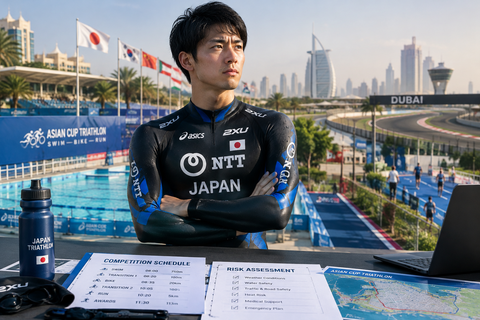
The pattern is becoming familiar. In 2020, COVID-19 obliterated race calendars worldwide, shuttered pools, and introduced triathletes to the phrase "supply chain issues" when new bikes and wetsuits became impossible to find. We thought that was a once-in-a-generation disruption. Then, in early 2026, the Iran War forced the World Triathlon Championship Series (WTCS) to postpone its season opener in Abu Dhabi. The conflict's reach extended far beyond the Middle East—several major airport hubs sit in the region, disrupting travel for athletes heading to March races as far away as Australia.
The effects aren't limited to international circuits. Camp Pendleton, the Marine Corps base in southern California that hosts the beloved Oceanside 70.3, moved to alert level Bravo+ due to the conflict. That single classification change cast uncertainty over one of North America's most popular half-distance races, scheduled for March 28. As reported by Tim Heming, the war has the potential to disrupt calendars for World Triathlon, T100, and Ironman simultaneously—a trifecta of governing bodies and organizers all facing the same unpredictable forces.
The ripple effect is real. A postponed WTCS opener doesn't just affect elite athletes chasing Olympic qualification points. It shifts qualification timelines, alters age-group slot allocations, and creates a cascade of logistical headaches that eventually touch the local triathlete who was using an Ironman-branded race as their A-event for the season.
The uncomfortable truth is that uncertainty is no longer an anomaly in global sport—it's a feature. The triathlon community has now weathered multiple crisis-driven disruptions in the span of just a few years, and the industry is still learning how to adapt.
The Psychology of Uncertainty in Endurance Sports
If you've ever felt an outsized emotional response to a race cancellation—anger, grief, a hollow sense of purposelessness—you're not being dramatic. There's real psychology behind why routine disruption hits triathletes especially hard.
Endurance athletes build their lives around structure. Training plans are meticulously periodized, often months in advance. Weeks revolve around long rides, track workouts, and masters swim sessions. Race day isn't just a competition—it's the gravitational center around which an entire training cycle orbits. Remove it, and you're left floating.
Structured training provides more than physical fitness; it provides psychological scaffolding. Research in sports psychology consistently shows that routine and goal-directed behavior are powerful buffers against anxiety and depression. When the world feels chaotic and uncontrollable, a 90-minute bike ride on a prescribed power curve offers something increasingly rare: predictability. You push the pedals, the watts appear, the work gets done. Cause and effect still function on the trainer even when they seem to have broken down everywhere else.
This is precisely why so many triathletes turn to swim, bike, and run during times of crisis. As Lacke observed, "When These Unprecedented Times become too much to bear, we find 30 minutes or an hour to escape underwater or in the sound of our footfalls on the pavement." That escape isn't avoidance—it's a legitimate coping mechanism. The rhythmic, meditative quality of endurance exercise downregulates the stress response and provides a sense of agency when external circumstances are entirely beyond our control.
But here's the paradox: the very structure that provides comfort also makes athletes more vulnerable to disruption. When a race cancellation removes the goal, it doesn't just eliminate a single event. It threatens the entire narrative athletes have built around their training. Suddenly, the 5 a.m. alarm, the foam rolling, the meal prep—all of it can feel pointless. That's not weakness. That's the natural consequence of investing deeply in a structured pursuit.
Understanding this dynamic is the first step toward building genuine resilience. The goal isn't to stop caring about races or to pretend cancellations don't matter. It's to widen the foundation of your athletic identity so that it can withstand the removal of any single element.
Reframing Perspective: Privilege and Gratitude in Sport
This is the section where things get uncomfortable—and necessarily so.
Lacke didn't mince words in her commentary: "If the biggest problem a triathlete has right now is a canceled (or possibly canceled) race, that person has a charmed life, indeed." It's a statement that might sting, especially if you've invested thousands of dollars and hundreds of training hours into a race that's now in jeopardy. But the sting is the point.
Triathlon is, by almost any global measure, a sport of extraordinary privilege. The equipment alone—bikes, wetsuits, race entry fees, travel costs—places it out of reach for the vast majority of the world's population. The leisure time required to train 8 to 15 hours per week presupposes a level of economic stability and personal freedom that billions of people simply don't have. And the ability to do all of this without worrying about physical safety? That's the biggest privilege of all.
None of this means your frustration about a canceled race is invalid. You're allowed to be disappointed. You're allowed to grumble about your disrupted training plan. But holding both truths simultaneously—that your frustration is real and that your problems are comparatively minor—is what mature perspective looks like. It's not an either/or proposition.
What's remarkable is that this perspective shift doesn't diminish the sport. It actually deepens it. When you step onto the start line knowing that the ability to be there is a privilege, not a right, the experience becomes richer. The gratitude isn't performative; it's genuine. You swim in open water because you can, not because you must. You ride through beautiful landscapes because your roads are safe and your body is healthy. You run because no one is chasing you.
Consider the athletes around the world for whom training isn't an escape but a near-impossibility. Athletes in conflict zones who can't run outside due to airstrikes. Swimmers whose local pools have been destroyed. Cyclists whose roads are cratered by munitions. Their love for the sport is no less than yours, but their access to it has been stripped away by circumstances entirely beyond their control.
This isn't about guilt. It's about gratitude with teeth. The kind that motivates you not just to appreciate your own circumstances but to consider how you might use your privilege constructively.
Practical Strategies for Training Through Uncertainty
Perspective is essential, but it doesn't write your training plan. Here are concrete strategies for maintaining purpose and progress when the race calendar is unreliable.
Build Flexibility Into Your Goals
The traditional model of triathlon training—pick a race, build a plan, execute it—assumes a stable world. That assumption has been tested repeatedly. A more resilient approach is to set process goals alongside outcome goals.
Instead of "Finish Oceanside 70.3 in under 5:30," try layering in goals like:
- Consistency goal: Complete 90% of planned sessions each month, regardless of what happens on the race calendar.
- Skill development goal: Improve swim technique to the point where 100-yard repeats drop by 3 seconds per split.
- Strength goal: Achieve a specific functional threshold power or running pace by the end of the training block.
These goals remain meaningful whether your A-race happens, gets postponed, or is canceled entirely. They give your training an anchor that doesn't depend on external factors.
Create a "Race-Independent" Training Block
If you're in a period of high uncertainty, consider designing a 6-to-8-week block focused purely on building capacity rather than peaking for a specific event. Think of it as a base-building investment in your future self.
- Focus on aerobic volume and consistency.
- Address limiters you've been neglecting (mobility, strength, swim technique).
- Experiment with nutrition and electrolyte strategies without the pressure of race-day performance.
- Test new equipment or bike fits.
This reframe turns a frustrating limbo period into one of the most productive phases of your athletic development.
Develop a Race Pivot Plan
For every A-race on your calendar, identify two or three alternative events you could pivot to if the primary race is canceled. These don't have to be the same distance or even the same sport. A canceled 70.3 could become a marathon, a century ride, or a local sprint triathlon. The key is having options so that a cancellation feels like a redirect, not a dead end.
Lean Into Community
Isolation amplifies uncertainty. When the news is bad and the race calendar is shifting, connection with other athletes provides both practical support (shared information, group training) and emotional resilience.
- Join or create a local training group.
- Participate in virtual challenges or Strava clubs.
- Engage in triathlon forums and communities where people are processing the same frustrations.
- Reach out to a coach or mentor—even a single conversation can reframe a spiral of anxiety.
Training doesn't have to be a solitary coping mechanism. Some of the best sessions happen when you show up not because you're motivated, but because someone else is counting on you to be there.
The Long View
Uncertainty is not going away. The triathlon industry has now been shaped by multiple crises in rapid succession—a pandemic, geopolitical conflicts, climate-related event disruptions—and the athletes and organizations that thrive will be the ones who build adaptability into their DNA rather than treating each disruption as a temporary anomaly.
For the industry, that might mean more flexible registration policies, geographically diversified race calendars, and stronger local racing scenes that don't depend on international travel. For individual athletes, it means holding your goals with open hands—committed enough to pursue them with everything you've got, loose enough to let go when the world demands it.
Susan Lacke captured the tension perfectly: she was frustrated not by the inconvenience of a canceled race, but by the exhausting repetition of crisis after crisis intruding on something she loves. "I'm tired of These Unprecedented Times," she wrote. "I would very much like some precedent."
So would we all. But precedent isn't coming—at least not the kind we once took for granted. What's available to us instead is something harder but ultimately more durable: the ability to find meaning, purpose, and even joy in the practice of our sport, regardless of what the world throws at us.
The privilege to train is not diminished by the awareness that it's a privilege. If anything, that awareness makes every swim stroke, pedal revolution, and footfall a little more sacred.
So lace up. Clip in. Dive in. Not because the world is fine—it isn't—but because the discipline and perspective you build in the water, on the road, and on the trail are exactly what the world needs more of right now. And when you're ready to optimize your training nutrition, consider quality magnesium supplementation to support recovery during these challenging times.
Find the perfect race day essentials at TriLaunchpad — your triathlon journey starts here. Shop all collections →