Three-Time Champion: How Lucy Charles-Barclay Conquered Lanzarote While Building Toward Kona Glory
There's a moment at the finish line of a race that reveals everything about an athlete — not just their fitness, but their character. When Lucy Charles-Barclay crossed the finish tape at Lanzarote on May 23, 2026, the emotion that washed over her face wasn't just the relief of winning. It was something deeper. Less than five months after surgery, she had just become the only woman in history, alongside triathlon legend Paula Newby-Fraser, to win this race three times.
"When I was running down the finish and you said I'd had surgery in January, I just did get a bit emotional," Charles-Barclay told Slowtwitch in a post-race interview. "I was like, yeah, this is actually pretty crazy — to come back from that and be racing the hardest race there is, and to get my third win here, really, really special."
For anyone who follows long-distance triathlon, this story goes beyond a race result. It's a masterclass in strategic resilience — how a world-class athlete manages incomplete fitness, conquers psychological demons from a prior DNF, and uses a brutally difficult race as a launching pad toward triathlon's most prestigious event. Whether you're a competitive triathlete, a coach, or someone just beginning to explore the sport, there's something in Charles-Barclay's approach worth studying closely.
Leading from Start to Finish — Even at Less Than 100%
Lanzarote, held annually in the Canary Islands, is widely regarded as the world's toughest full-distance triathlon. The combination of volcanic terrain, relentless wind, and scorching heat makes it roughly an hour longer in effective effort than a standard-distance long-course race. It demands not just fitness, but race wisdom.
Charles-Barclay displayed both in abundance.
She exited the water in 47:01, beating her own previous course record and arriving nearly four minutes ahead of fellow British athlete Stephanie Clutterbuck (who would later DNF due to severe second-degree blisters sustained while running barefoot across the scorching hot transition surface at T2). On the bike, she posted the day's fastest split — 5:21:05 — and then backed it up with the fastest run of any woman in the field: 3:01:13. Her total winning time of 9:15:39 gave her a margin of over 26 minutes ahead of Switzerland's Nina Derron (9:42:02).
A clean sweep of every segment. And she did it managing effort, not chasing times.
"The bike — I'm definitely not at 100% fitness and I felt that, so I kind of had to judge my effort level and make sure I wasn't pushing too hard, because this is such a tough bike. It's like an hour longer than most other races, so you have to factor that in."
That self-awareness is what separates good athletes from great ones. Rather than racing the fitness she wished she had, Charles-Barclay raced the fitness she actually had — with precision and patience.
Full Podium Results
| Place | Athlete | Country | Swim | Bike | Run | Overall |
|---|---|---|---|---|---|---|
| 1 | Lucy Charles-Barclay | 🇬🇧 GBR | 47:02 | 5:21:05 | 3:01:13 | 9:15:39 |
| 2 | Nina Derron | 🇨🇭 SUI | 54:43 | 5:23:49 | 3:17:57 | 9:42:02 |
| 3 | Nikita Paskiewiez | 🇫🇷 FRA | 59:25 | 5:34:18 | 3:07:00 | 9:47:36 |
| 4 | Rebecca Anderbury | 🇬🇧 GBR | 57:46 | 5:21:13 | 3:25:04 | 9:52:18 |
| 5 | Marit Lindemann | 🇩🇪 GER | 1:04:41 | 5:34:57 | 3:09:52 | 9:56:52 |
Nine Months from Operating Table to Podium
The performance numbers are impressive on their own. In context, they're remarkable.
Charles-Barclay underwent surgery in January 2026. Just four-plus months later, she was toeing the start line of the most demanding long-distance race on the calendar. And not just surviving it — winning every single segment.
Her previous full-distance start had ended in a DNF at Kona 2025, where she was forced to withdraw during the run in the infamous Energy Lab section — a notoriously brutal stretch of the course where heat and accumulated fatigue break even elite athletes. That experience left psychological marks.
"There's definitely parts of me after Kona that were like, oh, do I want to do a full-distance race again? And I decided to go and do the toughest one there is again — and it just reconfirmed that I do want to do this."
That decision — to confront doubt by going back to the hardest possible arena — tells you everything about Charles-Barclay's mental makeup. It's the kind of mindset that coaches work years to build in athletes, and she arrived at it herself, intuitively.
The run was always going to be the unknown. Post-surgery, running a full 26.2 miles in Lanzarote's heat was uncharted territory for her body. Her coaches, Reece and Dan, prepared her for the uncertainty with a simple, elegant focus point.
"He gave me a focus point, just telling me to have a good rhythm. I think he said to run the last half marathon as easy and efficiently as I can. So I took that as slow down!"
Get to the finish line in the best state possible. Not the fastest possible — the best possible. That's smart coaching, and smart racing. The result was a 3:01:13 marathon that was the fastest of the entire women's field.
Joining Triathlon Royalty: The Paula Newby-Fraser Connection
Numbers can only capture so much of what happened in Lanzarote. The emotional weight of Charles-Barclay's third victory goes beyond splits and margins.
Paula Newby-Fraser is often called the "Queen of Kona" — a seven-time champion at the World Triathlon Championship Series long-distance race in Hawaii, and one of the most decorated triathletes in the sport's history. She is also, as Charles-Barclay was quick to note, a personal friend.
Only two women in history have won at Lanzarote three or more times: Newby-Fraser and, now, Charles-Barclay.
"To be in the company of Paula Newby-Fraser, who is a friend of mine but an absolute legend and hero in the sport — to be up there with her is amazing."
When pressed on whether she had ambitions to match Newby-Fraser's seven Kona titles, Charles-Barclay flashed a self-aware grin: "Only seven Kona titles to catch Paula's record now — how hard could it be? I think she might keep that one!"
The humor lands, but it also hints at a long-term trajectory that's impossible to ignore. Charles-Barclay has consistently positioned herself as one of the sport's most dominant long-distance specialists. The Lanzarote record ties a chapter. Kona, in October 2026, begins the next one.
There was also a bittersweet note to the day: this was the final edition of Lanzarote under the Club La Santa branding, a partnership that has defined the race's identity for years. As an ambassador for Club La Santa, Charles-Barclay felt the weight of that closure alongside the joy of her third title.
"It feels very bittersweet," she said. "But yeah, a special day."
Mastering the World's Toughest Long-Distance Race
If you're a triathlete — especially one preparing for your first long-distance race or eyeing a longer-distance event for the first time — Lanzarote offers a fascinating case study in race strategy.
The course demands a different kind of thinking. Its difficulty isn't just about the 2.4-mile swim, 112-mile bike, and 26.2-mile run. It's about sustained environmental stress: volcanic roads, crosswinds that can push riders sideways on descents, and heat that builds relentlessly through the day. Every decision compounds.
Charles-Barclay's disciplined approach broke down like this:
- Swim: Aggressive — broke her own course record, built a lead immediately
- Bike: Conservative — consciously managed effort below maximum capacity, knowing the course punishes overreach
- Run: Adaptive — started cautious, found rhythm, maintained efficiency to the line
The lesson for any long-distance athlete? Your A segment doesn't guarantee your result. Your worst segment determines it. Charles-Barclay protected her run by managing the bike. She protected the bike by knowing exactly what kind of effort the course demands.
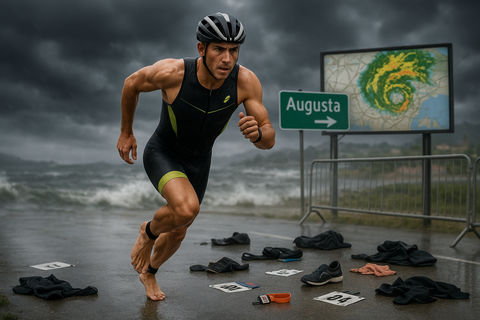
One notable subplot from the race: Stephanie Clutterbuck, who had been one of the stronger swimmers (second out of the water), was ultimately unable to finish. According to reports shared on social media, she sustained severe second-degree blisters on both feet after running barefoot across the super-heated transition surface at T2 — a course management issue that had nothing to do with fitness, and everything to do with the unforgiving nature of this specific race environment. It's a stark reminder that long-distance racing rewards preparation for every detail, not just training volume.
Lanzarote as Kona Proving Ground
With the win secured, Charles-Barclay had accomplished more than earning a trophy. She had collected an entire season's worth of strategic intelligence in a single race day.
Kona qualification: confirmed. Her name is coming off the Hamburg start list. The rushed early-season pressure is off.
"I'm very happy with getting that Kona qualification done and dusted today, and now I can have a little rest before I start training again. It's definitely been a very rushed period at the beginning of the year trying to get this qualification done."
But beyond qualification, Lanzarote gave her coaches Dan and Reece something arguably more valuable: data. Real-race data on how her post-surgery body responds to extreme heat, sustained effort, and marathon-distance running. That's information that can't be replicated in training.
"This race has given me a lot of data points — Dan and Reece will look at that and go, okay, this is where you really need to work and improve to be better in Kona, and that's what we'll do."
Perhaps the most critical data point: she can handle the heat again. After the Kona 2025 DNF, that was an open question — not just physically, but psychologically. Lanzarote answered it definitively.
"I'm happy I can actually handle the heat again — I kind of got rid of those demons out there today."
The plan from here is clear. Kona is the A-goal. She may still defend her 70.3 World Championship title if training supports it — "I feel confident that if we keep building from here, that's a possibility later in the year." Another full-distance race before Kona is on the table if coaches recommend it. And the fitness gaps she acknowledged? They're now mapped and targeted.
When asked whether her Lanzarote win was a "statement" to the rest of the Kona field, Charles-Barclay kept it characteristically grounded:
"I mean, I don't know if that was much of a statement — it was just me getting around the island and trying to enjoy it as much as possible. But if people think it's a statement, I'm happy to take it!"
(She also noted, laughing, that someone called her "Olympic champion" as she exited T2 — technically a mix-up, since her gold medal came in the mixed relay, not the individual event. In Lanzarote, perhaps everyone gets an upgrade.)
What Every Triathlete Can Learn from This Race
Whether you're building toward your first long-distance event or managing a return from injury, Charles-Barclay's Lanzarote victory is packed with applicable lessons. Here's the core of it:
1. Race the fitness you have, not the fitness you want. Acknowledging gaps and managing accordingly isn't weakness — it's the kind of intelligence that wins 9-hour races.
2. Coaching support matters most in comeback situations. A focus point ("good rhythm, easy last half-marathon") is sometimes more valuable than a detailed race plan. Simple cues anchor performance under pressure.
3. Confronting past failures is part of the preparation. Charles-Barclay didn't avoid the heat after Kona 2025 — she ran straight into it at the hardest possible venue. That's how demons get cleared.
4. Qualification strategy shapes training quality. By securing Kona qualification early, she freed herself from reactive racing. Now she can build intentionally, not urgently.
5. Ultra-distance events reward patience across every segment. The athlete who arrives at the run in the best possible state — not the fastest possible — is the athlete who crosses the finish line first.
Frequently Asked Questions
Who is Lucy Charles-Barclay?
Lucy Charles-Barclay is a British professional triathlete known for her exceptional performances in long-distance triathlon races, including winning three titles at the Lanzarote long-distance triathlon.
What significant achievement did Lucy Charles-Barclay accomplish at Lanzarote?
Lucy Charles-Barclay achieved her third win at the Lanzarote long-distance triathlon, tying her with Paula Newby-Fraser for the most wins at this challenging race.
How did Lucy perform in the race?
Lucy led the race from start to finish, posting the fastest swim, bike, and run times of the day, finishing with an overall time of 9:15:39.
What challenges did Lucy face during the race?
Lucy managed her effort levels carefully due to not being at 100% fitness after undergoing surgery in January, which made this race particularly challenging for her.
What are Lucy's plans following her win at Lanzarote?
Lucy plans to focus on building her fitness with the goal of preparing for the Kona long-distance triathlon world championship later this year, potentially defending her title at the 70.3 World Championships as well.
Who were the other top competitors in the Lanzarote race?
The podium finishers included Nina Derron from Switzerland in second place and Nikita Paskiewiez from France in third place.
Source: Slowtwitch — Lucy Charles-Barclay on Lanzarote, surgery comeback, and the road to Kona