
70.3 Mont-Tremblant 2026 Results: Boulanger and Klau Dominate in Quebec
Some races end at the finish line. Others send ripples all the way to a world championship. The 70.3-distance race at Mont-Tremblant, Quebec on June 21, 2026, was firmly the second kind.
In a field composed almost entirely of North American athletes competing at what was virtually the last qualifying opportunity for the 70.3 World Championships in Nice, two athletes delivered performances that will have rivals watching nervously: France's Aurélia Boulanger won the women's race by more than five minutes, and American Ari Klau claimed his first professional victory after a patient, tactically mature race that unfolded like a masterclass in knowing your strengths.
Whether you're a triathlete chasing your first 70.3 finish or an age-grouper trying to understand how elite athletes think about racing, this breakdown has something for you.
What Is a 70.3-Distance Race? (Quick Refresher)
A 70.3-distance triathlon — sometimes called a half-distance event — covers 1.9km of open-water swimming, 90km on the bike, and a 21.1km run (half marathon). The "70.3" refers to the total miles covered. It's a popular format for athletes stepping up from shorter distances, and it serves as a direct feeder to the annual 70.3 World Championships. Think of it as the middle child of triathlon distances: long enough to demand serious pacing strategy, short enough that every second on the bike matters.
Men's Race: Ari Klau's Breakthrough Victory
Starting from Behind — On Purpose
The 1.9km swim belonged to Germany's Joshua Berles, who hit the water in 23:08. Meanwhile, Klau — wearing bib #2 as the highest-ranked American in the field after compatriot Trevor Foley chose to skip the event — exited the water in 24th place, nearly three minutes behind.
That's not a mistake. That's a plan.
Elite triathletes who know their swim is not their strongest leg often make a deliberate choice: don't burn matches fighting the current leaders in the water. Accept the gap, stay controlled, and trust the disciplines where you're built to fly. Klau knew the bike and run were where his race would be won — and lost if he arrived there fatigued from an ego-driven swim effort.
The Bike: A Systematic Takeover
What followed on the 90km bike was a textbook study in consistent power and gap management:
- At 33km: Klau had already climbed to 8th place, now less than two minutes back
- At 66km: The deficit had dropped to just 1:02 — down from nearly three minutes
- At T2: Klau rolled into the bike-to-run transition in 3rd place, just 15 seconds behind Berles
Notice the pattern: no dramatic attacks, no sudden surge to grab the lead. Just steady, relentless progress. This is what well-executed pacing looks like at the elite level — and it's a lesson that applies just as much if you're targeting a four-hour 70.3 finish as it does in the pro field.
The Run: Command Performance
Then came the moment Klau had been building toward all morning.
“Pretty much straight after the start of the run, Klau was in front and in complete command — two minutes up at halfway.” — TRI247
He posted a 1:08:47 half marathon, the fastest run split of the entire men's field, and never looked back. The final margin over Canada's Blake Harris in second was 2 minutes and 26 seconds. Luke Jones (USA) rounded out the podium in third.
This was Klau's first professional win — arriving just one month after a runner-up finish at the 70.3-distance race in Chattanooga. That's a fast learner.
Men's Pro Results — Top 5
| Pos | Athlete | Nationality | Swim | Bike | Run | Overall |
|---|---|---|---|---|---|---|
| 1 | Ari Klau | USA | 27:02 | 2:02:42 | 1:08:47 | 3:41:32 |
| 2 | Blake Harris | USA | 24:31 | 2:05:46 | 1:10:27 | 3:43:59 |
| 3 | Luke Jones | USA | 24:36 | 2:04:49 | 1:12:46 | 3:45:32 |
| 4 | David Reynolds | USA | 24:47 | 2:07:16 | 1:10:27 | 3:45:55 |
| 5 | Zachary Bernier-Michaud | CAN | 24:46 | 2:05:22 | 1:13:37 | 3:47:26 |
Women's Race: Boulanger's Most Dominant Win Yet
A Controlled Swim Deficit
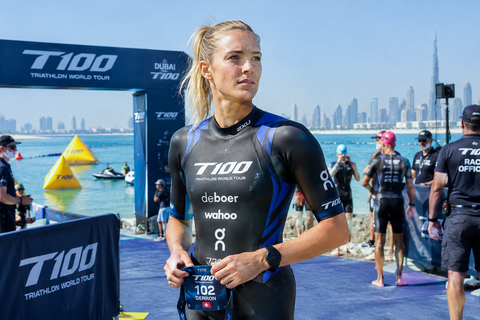
Margarita Ryan (USA) was first out of the water at 23:55. Boulanger — one of only two European women in an otherwise North American field — exited the water 3:44 behind in what looked, on paper, like a significant hole to climb out of.
It wasn't. Not even close.
The Bike: Race Over at 33km
By the time the field had covered just the first third of the 90km bike course — 33 kilometers — Boulanger had erased the entire 3:44 deficit and moved into the lead. That's not just good cycling. That's a completely different level of power output from everything else in the field.
She arrived at T2 with just over a one-minute lead on American Lisa Becharas.
The Run: Dominant, Controlled, Clinical
Boulanger didn't just hold her lead on the run — she extended it. The gap grew to over four minutes at the halfway mark. By the finish, Britain's Lydia Russell had moved up to second, but the final margin was a stunning 5 minutes and 1 second. Becharas dropped to third, 8:42 back.
Boulanger's run split of 1:21:23 wasn't a desperate survival shuffle — it was controlled dominance. She didn't need to run herself into the ground because the race was already decided.
A five-minute winning margin at the elite level is genuinely rare. Most top-tier 70.3-distance victories are settled by 60 to 90 seconds. Five minutes signals an athlete operating at a completely different gear — and at exactly the right moment in the season.
For context on just how significant this victory is: Boulanger had four previous middle-distance wins to her name heading into Mont-Tremblant. According to TRI247's coverage, this performance "comfortably topped them all."
Women's Pro Results — Top 5
| Pos | Athlete | Nationality | Swim | Bike | Run | Overall |
|---|---|---|---|---|---|---|
| 1 | Aurélia Boulanger | FRA | 27:39 | 2:15:45 | 1:21:23 | 4:08:34 |
| 2 | Lydia Russell | GBR | 26:24 | 2:25:19 | 1:17:48 | 4:13:35 |
| 3 | Lisa Becharas | USA | 27:34 | 2:17:01 | 1:28:53 | 4:17:16 |
| 4 | Adele Likin | AUS | 29:22 | 2:24:58 | 1:22:44 | 4:20:44 |
| 5 | Annamarie Strehlow | USA | 29:05 | 2:25:27 | 1:23:21 | 4:21:50 |
3 Tactical Lessons From These Two Performances
Whether you're lining up at your first 70.3 or your fifteenth, Klau and Boulanger's races offer some transferable wisdom.
1. Manage Your Deficit, Don't Fight It
Klau accepted being 24th out of the swim rather than burning himself out chasing faster swimmers. Boulanger absorbed a 3:44 deficit before the bike even began. Elite athletes don't win every segment — they win the race. Know where you gain time and protect your capacity to do so.
2. The Bike-to-Run Combination Decides Most 70.3 Races
Look at the swim leaders: Berles went out front in the men's race; Ryan led the women's swim. Neither won. In middle-distance triathlon at the elite level, what happens between T1 and the finish line tends to be the real race. That doesn't mean neglecting your swim — but it does mean that bike and run fitness might deserve priority in your training block.
3. Patience on the Run Is a Superpower
Klau didn't sprint out of T2 in a panic. He ran his race, moved into the lead immediately, and built a controlled buffer. Boulanger ran 1:21 while holding a massive lead — she didn't redline unnecessarily. Pacing discipline, not raw speed, is what separates champions from chasers.
Championship Implications: Eyes on Nice
Mont-Tremblant served as one of the final chances to secure a slot at the 70.3 World Championships in Nice — and both champions head there with serious momentum.
Boulanger arrives in Nice as a genuine favorite. A five-minute winning margin in a qualifying race isn't just a confidence boost — it's a signal to the rest of the women's field that she is peaking at exactly the right time. Her bike advantage in particular should translate well to any championship course.
Klau enters the worlds with something arguably more valuable than a podium finish: a proven first victory. The psychological lift of converting a runner-up result into a win, combined with his demonstrated ability to close gaps methodically and finish with the fastest run split, makes him a credible podium threat in Nice.
Meanwhile, the same weekend saw Marten van Riel extend his remarkable 2026 season with a sixth consecutive win at 70.3 Elsinore, while Kat Matthews dominated the women's race there as well — meaning the worlds in Nice are shaping up to be a genuinely stacked competition.
Key Takeaways
- Ari Klau (USA) claimed his first professional victory in 3:41:32, with the fastest men's run split of 1:08:47
- Aurélia Boulanger (FRA) won by over five minutes in 4:08:34 — her most dominant middle-distance performance to date
- Both victories came at a critical world championship qualifying event
- Swim leaders did not win either race — a consistent theme in elite 70.3 racing
- Patience and pacing discipline defined both champions' tactical approaches
- Both athletes head to Nice with significant momentum heading into the 70.3 World Championships
Frequently Asked Questions
Who won the 70.3 Mont-Tremblant in 2026?
Aurélia Boulanger from France and Ari Klau from the USA were the winners of the 70.3-distance race at Mont-Tremblant in 2026.
How did Ari Klau perform in the race?
Ari Klau claimed his first-ever professional win at this race, completing the run with a time of 1:08:47, which was the quickest of the day, finishing 2:26 ahead of the second place.
What was the structure of the race?
The 70.3-distance race at Mont-Tremblant consisted of a 1.9 km swim, a 90 km bike ride, and a 21.1 km run.
What positions did Aurélia Boulanger and other female competitors finish?
Aurélia Boulanger won the women's race, with Lydia Russell from Great Britain finishing in second place at 5:01 behind, and Lisa Becharas from the USA in third at 8:42 behind the winner.
What was significant about Boulanger's performance?
Boulanger's victory marked the highest achievement in her career, surpassing her previous middle-distance wins.