
Never Too Old to Dream: How One 71-Year-Old Conquered 50 Long-Distance Triathlon Races
Most people slow down at 71. Tom DeLuca of Agawam, Massachusetts, is just getting started — and his story of 50 long-distance triathlon finishes across more than three decades is one of the most sustained athletic achievements in Western Massachusetts history.
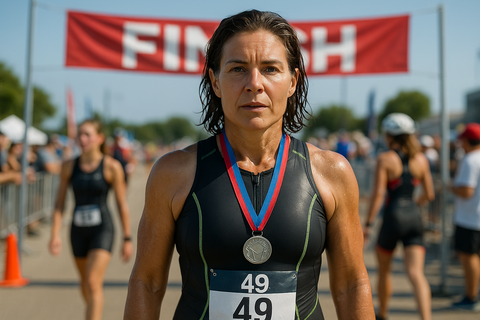
On a Saturday morning in June 2026, the race village at Springfield's MassMutual Center buzzed with a different kind of energy. Amid race-day gear, nutrition tables, and nervous first-timers, the crowd gathered to honor a man who has seen it all — 50 times over. Tom DeLuca was celebrated as a local legend at the 70.3-distance Western Massachusetts triathlon event, recognized for completing an extraordinary milestone: 50 long-distance triathlon races across more than three decades of competition. At 71 years old, he shows absolutely no sign of slowing down.
This is not a story about a former elite athlete maintaining status. It is not about someone who grew up swimming competitively or cycling through college. This is the story of a man who watched a television broadcast in 1991, felt something shift inside him, and spent the next 35 years turning that spark into one of the most sustained athletic achievements in regional history. If you have ever told yourself you are too old, too out of shape, or too far behind to start something meaningful — Tom DeLuca's story is for you.
The Moment Everything Changed
A Television Set, a Triathlon, and a Life Transformed
In 1991, Tom DeLuca sat down in front of his TV and watched the long-distance triathlon world championship. What he saw on screen did not just impress him — it changed the entire direction of his life.
This is worth pausing on. DeLuca was not a college swimmer looking for his next challenge. He was not a competitive cyclist eyeing a new discipline. He was someone who watched other human beings push themselves to extraordinary limits on a screen, and thought: I want to do that.
Transformation rarely announces itself dramatically. Sometimes it arrives quietly, through a television set, on an otherwise ordinary day — and produces 50 race finishes across three decades.
From Spectator to Competitor: Three Years of Preparation
Three years passed between inspiration and action. DeLuca completed his first long-distance triathlon race in 1994, meaning he spent roughly three years building the fitness, knowledge, and courage to toe that first start line. That gap matters. It tells us something important about his approach: deliberate, patient, and serious.
He was already in his late 30s or early 40s when he crossed that first finish line — not the profile most people picture when they imagine an endurance athlete beginning a competitive career. And yet, that start launched a journey spanning 32 years and counting, taking him to iconic race venues including Lake Placid, New York, and beyond.
What Makes 50 Races Truly Remarkable
Understanding the 70.3-Distance Race
Before we can fully appreciate what DeLuca has accomplished, it helps to understand what a 70.3-distance triathlon actually demands of the body and the mind.
- 1.2-mile open water swim
- 56-mile bike ride
- 13.1-mile run (a half marathon)
Athletes tackle all three disciplines back-to-back, with only brief transitions between each leg. Finishing times for age-group athletes typically range from five to eight hours of continuous physical effort. The training required to prepare for a single race can consume 10–15+ hours per week for months in advance. Add race-day travel, recovery time, and equipment costs, and you begin to understand why completing even one of these events is a genuine achievement.
Completing fifty is in a category of its own.
The Math of Sustained Excellence
Quick arithmetic on DeLuca's career reveals something quietly remarkable. Fifty races over 32 years averages out to roughly 1.5 races per year — a pace that is neither reckless nor passive. It reflects an athlete who has learned to treat the sport as a long-term relationship rather than a short-term obsession.
This sustainable rhythm is almost certainly part of the reason he is still racing at 71. Athletes who chase volume at the expense of recovery tend to burn out or break down. DeLuca's career arc suggests a man who has found the balance between ambition and longevity — racing enough to stay sharp and motivated, but not so much that he risks injury or exhaustion.
That kind of discipline is arguably harder to maintain than the races themselves.
The Mindset Behind the Miles
Passion as the Engine
What keeps someone returning to a start line — not once, not five times, but fifty times? The answer is almost certainly not prize money or podium finishes. The more durable fuel is love of the sport itself.
DeLuca's continued participation at 71 points to intrinsic motivation at its purest. When external rewards like trophies and age-group rankings fade in importance, what remains is the joy of movement, the clarity of a long training ride, the satisfaction of crossing a finish line earned through months of preparation. For athletes just starting out — whether in their 20s, 40s, or beyond — this is the most important lesson his story offers: find a why that does not depend on results.
Community as Amplifier
The celebration at the MassMutual Center was not just a nice gesture. It reflects something fundamental about endurance sports culture: these communities are built to celebrate effort over outcome. Whether you finish first or last, whether you are 25 or 75, the long-distance triathlon world has a tradition of honoring commitment and perseverance.
DeLuca's recognition as one of the more noted names at the 70.3 Western Massachusetts event is a testament to what consistent, visible participation in a sport community can build over time. He did not just race — he showed up, year after year, in a region that came to know and celebrate him. That local legend status is earned not through a single spectacular performance, but through decades of showing up.
Age as Teacher, Not Obstacle
Here is a perspective worth sitting with: Tom DeLuca at 71 is not racing despite his age. He is racing with the wisdom his age provides. Thirty-two years of competitive experience means he knows things about pacing, nutrition, injury prevention, and mental management that no 30-year-old first-timer can access.
He has learned when to push and when to back off. He understands his body's signals in ways that only decades of careful attention can teach. His longevity in the sport is not in spite of his journey — it is the journey. This reframe matters for anyone who assumes their best athletic years are behind them. Experience accumulates. Wisdom compounds. And in endurance sports — where strategy and patience often matter as much as raw speed — an older athlete with hard-won knowledge can accomplish things that would genuinely surprise their younger self.
Lessons for Every Aspiring Endurance Athlete
Starting Late Is Still Starting
Perhaps the most actionable takeaway from DeLuca's story is simple: he did not begin until he was nearly 40, and he is still going at 71. The age at which you start matters far less than the decision to start at all. Many people in their late 30s or early 40s assume they have missed their window. DeLuca's career is direct evidence to the contrary. The question is not “Am I too old to start?” The question is: “What is stopping me from starting today?”
Consistency Beats Intensity, Every Time
The allure of high-intensity training — the all-or-nothing approach, the 20-hour training weeks, the aggressive racing schedule — is real. But it is also one of the fastest routes to injury and burnout. DeLuca's career offers a countermodel: steady, sustainable, joyful participation maintained across decades. One and a half races per year. Year after year after year. That is the formula that produces fifty finishes.
For beginners building toward their first sprint triathlon or first 70.3-distance event, this principle applies directly. Build slowly. Race when you are ready. Recover fully. Then go again. The athletes who last are the ones who treat their bodies and their schedules with respect.
Long-Term Goals Create Long-Term Athletes
There is something psychologically powerful about a concrete, distant milestone. Fifty races over a lifetime is exactly the kind of goal that keeps an athlete motivated through inevitable rough patches — the training sessions that feel impossible, the races that do not go as planned, the life circumstances that interrupt preparation. Having a north-star goal means having a direction. And direction, across 35 years of life with all its complexity, is what separates those who keep going from those who quietly step away.
What is your version of “50 races”? It does not need to involve triathlons. The specifics matter less than having a goal big enough to pull you forward on the days when motivation runs low.
Why Stories Like Tom's Matter
Rewriting the Narrative on Aging and Fitness
We live in a culture with deeply embedded assumptions about what physical capability looks like at 71. Those assumptions are incomplete. Tom DeLuca is proof that athletic achievement at 70-plus is not a miraculous exception reserved for genetic outliers. It is the result of 35 years of deliberate choices: training consistently, recovering properly, staying connected to a community, and never letting age become an excuse.
This matters beyond triathlon. It matters for public health, for how we design fitness programs for older adults, and for how we talk about aging in our families and communities. Every time someone like DeLuca crosses a finish line at 71, the ceiling of what is “normal” rises a little higher for everyone watching.
The Ripple Effect of One Person's Commitment
Think about everyone who has seen Tom DeLuca race over 32 years. The fellow competitors who crossed paths with him in Lake Placid and Springfield. The spectators at the MassMutual Center who watched him honored that Saturday morning in June. Each of those people carries a small piece of his story forward. Some will be moved to start training. Others will recommit to a fitness goal they had abandoned. A few might even begin their own long-distance triathlon journey, inspired by a 71-year-old from Agawam who once watched a TV broadcast and decided to see what he was capable of.
That is the mathematics of inspiration. One person's sustained commitment multiplies outward in ways that are impossible to fully trace — but entirely real.
Your First Step Toward Your Own Finish Line
Tom DeLuca's story began with a moment of inspiration in front of a television. Yours might begin right here. If his journey has sparked something in you, here is how to channel it:
- Identify your “why.” What athletic or personal goal would keep you motivated for years, not just weeks? Write it down.
- Start where you are. You do not need to be fit before you start training. A 20-minute walk, a swim at your local pool, a short bike ride — these are the building blocks of a 50-race career.
- Find your community. Look for a local triathlon club, a running group, or an open-water swim group in your area. The accountability and camaraderie are invaluable, especially in the early stages.
- Set a milestone goal. Maybe it is completing a sprint triathlon. Maybe it is finishing your first 70.3-distance race. Give yourself a concrete target with a real date attached.
- Celebrate every finish line. Not just the big ones. DeLuca's community celebrated his 50th race — but race number one mattered just as much. Honor your progress at every stage.
- Gear up intentionally. Whether you are eyeing your first triathlon or shopping for someone who already races, explore our race season essentials to support every stage of the journey.
The Bottom Line
Tom DeLuca of Agawam, Massachusetts, watched a television broadcast in 1991. Three years later, he stood on a start line for the first time. Thirty-two years after that, he was honored at the MassMutual Center for completing 50 long-distance triathlon races — and at 71, he is still not done.
- DeLuca's journey shows that age can be an advantage, not a barrier.
- Community and consistency are vital for long-term success in endurance sports.
- Setting and pursuing meaningful goals drives motivation and fosters resilience.
- Passion for the sport cultivates lasting commitment and fulfillment.
Frequently Asked Questions
Who was honored at the race village event at the MassMutual Center?
Tom DeLuca of Agawam was honored for completing 50 long-distance triathlons at the race village at the MassMutual Center.
How old is Tom DeLuca?
Tom DeLuca is 71 years old.
When did Tom DeLuca start participating in long-distance triathlons?
He started participating in long-distance triathlons in 1994, after being inspired by watching the long-distance triathlon world championship on television in 1991.
Where has Tom DeLuca completed long-distance triathlon races?
Tom DeLuca has participated in various long-distance triathlons, including races in Lake Placid, N.Y., and Western Massachusetts.
Source: westernmassnews.com