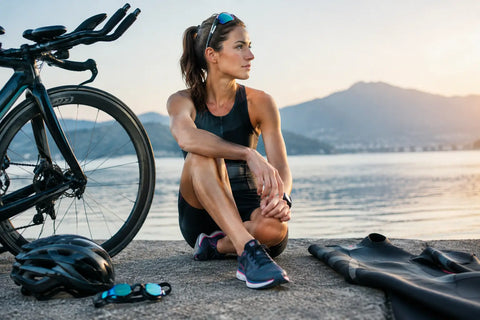
How to Race Ironman Texas in 34°C Heat: A Complete Strategy Guide for Age-Groupers
With race-day temperatures expected to soar to 34°C, sticking to your standard race plan might not be enough. Here's how to adapt, survive, and even thrive when the heat is on.
The Race That Doubles as a Kona Dress Rehearsal
Ironman Texas has carved out a niche as one of the most competitive long-course races of the season. But beyond its competitive allure, it has gained notoriety for its challenging heat. With temperatures often reaching 34°C, elite athletes have begun to see Texas as more than just another race—it's a strategic rehearsal for the heat they hope to face at the Ironman World Championship in Kona.
Take Magnus Ditlev, for example. This Danish powerhouse and Kona contender explicitly chose to race in Texas, not for convenience, but for strategy. In an exclusive interview with Triathlon Magazine Canada, Ditlev revealed that his journey from Copenhagen was driven by a desire to test his preparation and validate his race-day execution plan for Kona. He's not alone; many top professionals are using Texas as a hot-weather rehearsal—a mindset worth adopting.
For age-groupers, the question is practical: How do you race well when the conditions are against you?
The answer lies in three fundamental strategies. Master these, and the heat becomes a manageable challenge. Get them wrong, and it can unravel months of preparation in mere miles.
Why Hot Weather Racing Changes Everything
Before diving into strategies, it's crucial to understand why heat is such a significant disruptor. It's not just about feeling uncomfortable.
When your core body temperature rises, your cardiovascular system faces competing demands. Your muscles need blood to sustain output, while your skin needs blood to dissipate heat. This creates a physiological tug-of-war that your body cannot win indefinitely.
As thermal stress builds, heart rate climbs at any given effort level, perceived exertion increases, and your body involuntarily reduces intensity to protect vital organs. This isn't a mental weakness—it's a survival mechanism. Once core temperature climbs too far, your body will slow you down, whether you want it to or not.
This is why traditional pacing strategies—based on power targets, pace per kilometer, or heart rate zones calibrated in cooler conditions—often fail in the heat. The inputs remain the same, but the physiological cost of maintaining them skyrockets. Understanding this cascade is the first step toward smarter racing when temperatures rise.
Strategy #1: Start Slower to Finish Stronger
The Counter-Intuitive Pacing Approach That Actually Works
Remember this phrase: hot races are rarely won in the first half, but they are often lost there.
Early in the day, conditions can feel deceptively manageable. The sun may not yet be at its peak, your body is fresh, and your normal effort levels may feel sustainable. This is precisely when athletes make their most costly mistakes.
The problem isn't how you feel at kilometer 20. It's what's happening inside your body that you can't yet perceive. Heat stress accumulates gradually and silently. Every kilojoule of energy you produce generates metabolic heat, and in hot, humid conditions, your body's ability to shed that heat through sweat evaporation is significantly limited. The thermal debt builds whether you notice it or not.
A slightly reduced effort early in the race directly limits core temperature buildup—and that has a compounding benefit later. Athletes who protect themselves in the first half of the bike preserve their capacity to run strongly off it. Those who push too hard early often find the run becomes a survival march rather than a race.
If you're wavering between two effort levels, always choose the more conservative option in the heat. You are far more likely to gain time by holding steady in the final third than by banking time in the first. The heat makes patience not just a virtue but a genuine competitive advantage.
Practical adjustments to consider
- Reduce your target power on the bike by 5–10% relative to your standard hot-weather threshold.
- Resist the urge to match competitors who go out hard early—many of them will come back to you.
- Check in with your effort level every 30 minutes rather than relying solely on pace or power data.
- Treat the first third of the bike as an investment, not a performance.
For more insights on pacing strategies in extreme conditions, check out our guide on conquering the Ironman Kona heat.
Strategy #2: Cool Early, Cool Often
Your Thermal Management Game Plan
If conservative pacing is about limiting heat production, proactive cooling is about accelerating heat removal—and in 34°C conditions, you need both working together.
A critical mindset shift: cooling is not something you add when you start suffering. By the time you feel genuinely overheated, you are already behind. Core temperature takes time to climb, and it takes time to bring back down. Waiting until you're in distress to start cooling is like waiting until you're dehydrated to start drinking—the deficit is already there, and you'll spend the rest of the race paying for it.
The approach that works is consistent, proactive, and starts from the first aid station.
On the Bike
- Pour water over your head and torso at every opportunity—don't save water bottles for drinking alone.
- Target the back of the neck and the insides of your wrists where blood vessels run close to the surface.
- If available, use ice in your jersey or kit to provide sustained cooling between aid stations.
- Avoid the temptation to skip aid stations when you feel fine—that's exactly when you should be cooling.
Consider investing in a high-performance tri suit designed for heat dissipation and moisture management.
On the Run
- Place ice inside your race kit wherever your body will tolerate it—the chest, back, and shorts are all effective.
- Pour cold water over your head at every single aid station without exception.
- Use wet sponges on your neck and wrists between stations if available.
- Walk aid stations deliberately if needed—the brief reduction in effort is worth the cooling opportunity.
These interventions work through simple physics. Lowering skin temperature reduces the thermal gradient between your body and the environment, allowing heat to dissipate more efficiently. They also reduce perceived effort, meaning the same physiological output feels easier when you're cooler. Over the course of an Ironman, that psychological benefit compounds into real performance gains.
The athletes who execute this best treat their cooling protocol with the same discipline they bring to their nutrition plan. It's not optional—it's part of the race.
Strategy #3: Adapt Your Execution in Real Time
When to Let Go of the Plan You Trained For
The third strategy is arguably the hardest—not because it requires physical fitness, but because it requires a specific kind of mental flexibility that can be genuinely difficult to access in the middle of a race you've spent months preparing for.
The challenge is this: the targets you established in training were built around cooler conditions. Your functional threshold power, your marathon pace, your heart rate zones—all of it was calibrated without 34°C air temperature factored in. In the heat, those numbers can become not just unhelpful, but actively dangerous if you pursue them stubbornly.
Core temperature rise creates a predictable chain of events: heart rate drifts upward at any given power or pace, effort feels harder than the metrics suggest, and performance begins to decouple from what your fitness should theoretically allow. This is not failure. It is physiology doing exactly what it is designed to do.
The practical response is to shift your primary guide from external metrics to Rate of Perceived Exertion (RPE)—your subjective sense of how hard you are working. Use heart rate as a supporting signal. If something feels harder than it should for where you are in the race, that signal is real and reliable. Act on it.
The athletes who perform best in the heat are not the ones who stick stubbornly to a plan. They're the ones who respond intelligently to the conditions and make decisions in real time.
This means building in mental decision points before race day. Ask yourself: At what point on the bike will I check in and honestly assess my effort? What will I do if my heart rate is elevated but my power looks fine? Having these conversations in advance makes it easier to act rationally when fatigue and heat start affecting your judgment mid-race.
Signs your body is asking you to back off
- Heart rate is 10+ beats per minute higher than expected at a given effort.
- Effort feels significantly harder than your RPE target for that segment.
- You feel hot, flushed, or notice your breathing becoming labored earlier than expected.
- Your mood shifts—irritability and a desire to quit are genuine physiological warning signs.
Responding to these signals early, with small adjustments, keeps the race manageable. Ignoring them until they become a crisis does not.
For more on understanding your body's signals during extreme conditions, read our article on what elite athletes' VO2 max reveals about training limits.
Setting Yourself Up Before Race Morning
The three in-race strategies above are most effective when built on a solid foundation of pre-race preparation. Several factors in the days and weeks before can meaningfully influence how well your body handles the heat.
Heat Acclimatization
If you've been training in cooler conditions, your body is not yet adapted to performing in 34°C heat. Ideally, acclimatization begins two to three weeks before race day. If you're traveling from a cooler climate, arrive early and train in the heat where possible. Even passive heat exposure—saunas, hot baths after workouts—can trigger some adaptation. Your plasma volume expands, your sweat response becomes more efficient, and your cardiovascular system handles the competing demands more effectively.
Learn more about heat preparation protocols for early season races.
Hydration and Nutrition Adjustments
You will lose significantly more sodium through sweat in hot conditions than in cool ones. Standard nutrition plans may not account for this. Consider increasing your sodium intake in the days before the race, and plan to consume electrolytes at every aid station on race day—not just calories. Hyponatremia (low blood sodium) is a genuine risk in long-distance hot-weather racing and often presents deceptively similarly to dehydration.
Ensure proper electrolyte balance with magnesium citrate supplements or potassium-magnesium electrolyte blends.
Equipment Considerations
- Helmet: Prioritize ventilation over aerodynamics in significant heat. The performance difference is negligible compared to the thermal cost of a poorly ventilated aero lid over 180 kilometers.
- Race kit: Choose lighter colors and materials designed for heat dissipation where possible.
- Sunscreen: Apply it generously and plan to reapply if there are opportunities on course—sunburn adds to your thermal load.
- Hydration setup: Ensure your bike hydration system allows for easy drinking without disrupting your aero position—you need to drink more frequently than in cooler races.
Protect your eyes from sun glare with quality UV-protective swim goggles for the swim portion.
Mental Preparation
Prepare yourself explicitly for the fact that the race will feel harder than training. Set your expectation before you start that you will need to let go of some targets, and that this is smart racing, not defeat. Athletes who arrive with rigid performance expectations often struggle more with the psychological weight of adjusting than with the physical demands of the heat itself.
For mental strategies, explore our guide on inspiring age-group triathlon stories that demonstrate mental resilience.
Key Takeaways: Your Hot Weather Racing Framework
The heat at Ironman Texas is not a problem to overcome with fitness alone. It requires a fundamentally different approach to race execution—one built around three non-negotiable principles:
- Protect your early effort. Conservative pacing in the first half is not timid racing—it's the most aggressive move available to you in hot conditions.
- Cool proactively, not reactively. Start your cooling protocol from kilometer one and maintain it consistently throughout the bike and run.
- Lead with effort, not numbers. RPE is your most reliable guide in the heat. Trust it, respond to it, and build decision points into your race plan before you start.
Your Pre-Race Action Plan
- Adjust your target power and pace downward based on the forecast temperature.
- Map the aid station locations and plan your cooling strategy for each one.
- Practice your cooling techniques in training before race day so they feel automatic.
- Develop your RPE awareness through effort-based training sessions in heat where possible.
- Build two or three explicit decision points into your race plan where you will honestly assess how you're doing and adjust if needed.
- Review your nutrition plan with an eye to increased electrolyte requirements in hot conditions.
The professionals traveling to Texas—many of them deliberately choosing this race for exactly the conditions it presents—understand that the heat is not an obstacle. It's information. It's an opportunity to learn something about their preparation that cooler conditions never could.
You have access to the same lesson. Race it wisely.