What I Learned Racing a 70.3-Distance Triathlon as One of the Youngest in a 2,500-Person Field
A first-timer's honest race report from Valencia — covering the swim, the mountains, the mental breakdown, and why community makes all the difference.
With less than 10km to go, my body was shutting down and my mind went blank. This was far beyond physical pain. This was me versus my own head — the exact reason I had come to Valencia in the first place, to find out what I was truly made of.
A year earlier, I was on the same streets with a camera in my hands, photographing my mum race this very event. I watched 2,500 athletes pour through Valencia's sea, streets, and mountains and made a quiet promise to myself: I'll be back. And next time, I'll be racing.
Eight months, 5,161 minutes of training, and one sodium tablet later — I crossed the finish line of the 70.3-distance race in Valencia in 6 hours and 40 minutes. This is the honest, unfiltered account of how that happened.
Whether you're a first-timer eyeing your first long-distance event, a returning athlete dusting off the bike after years away, or just someone who needs proof that "nothing is truly impossible" isn't just a bumper sticker — this one's for you.
The Journey Back to Racing
From Arts to Athletics — A 12-Year Gap
My earliest memories of sport are tied to triathlon. I started in a small swimming club near Gatwick, then got pulled into multisport by my older brother. For a few years, I chased him through the age groups — always a step behind, always pushing harder. Then, at 12, I quit.
Art called louder. Musical theatre, photography, performance — I followed those passions fully and don't regret a moment. But sport has a funny way of finding you again.
It was photography that brought me back to Valencia. Shooting the race, watching my mum dig deep across 113.1km, something shifted. Standing on the sidelines with a camera, I saw something in every finisher's face that I wanted for myself. So I made that promise. One year. One race. Mine.
Eight Months of Preparation
The ticket went straight on my bedroom wall the morning after I registered. Every morning, before anything else, I saw it. That small rectangle of paper became the most powerful training tool I had.
Here's the humbling part: in July, I couldn't complete a 5km run. By April race day, I was toeing the line of a 1.9km swim, 90km bike, and 21.1km run. The transformation didn't happen by accident. Winter months meant turbo trainer sessions, building an aero position from scratch, and slowly — sometimes painfully slowly — rebuilding a fitness base I'd abandoned over a decade earlier.
The process wasn't glamorous. But the race ticket on the wall never let me forget why it mattered. If you're preparing for your first long-distance event, structured training apps can help you stay consistent through the months ahead.
Pre-Race Mindset in Old Town Valencia
Race morning in the old town was something else. Cool air filled the tight cobblestone streets, delivery trucks humbled the silence, and every joint in my body spoke to me with each step. I knew the training was done. What I didn't know yet was whether I could stay calm.
Walking through transition at sunrise — checking my bike, squeezing the tyres for what felt like the hundredth time, packing enough nutrition to feed a small family — I noticed something unexpected. Complete strangers helping each other. Competitors pumping up each other's tyres, offering tips on bike setup, laughing through the nerves. In a field of 2,500 athletes, the atmosphere was warm, generous, and entirely human.
Being one of the youngest men on the start line felt intimidating. But in that transition area, age didn't matter. We were all just people who had shown up to try something hard.
The Swim — Strongest Discipline, Unexpected Chaos
Race Start Strategy
The start system filtered us five athletes at a time, with a loud beep every five seconds and four quieter tones between. My heart was hammering through my wetsuit as I stood in the channel, 113.1km of racing stretched out ahead of me. I expected to feel overwhelmed. Instead, I felt strangely numb — focused.
The sea was calm. My preparation swim the day before had revealed a sandbar about 20 meters out, so I stayed upright as long as possible before diving in. Being on the larger end of the field — both vertically and horizontally, as I put it — meant minimal contact at the start. One small advantage of occupying more space.
The Unexpected Groin Strike
Everything changed at the first buoy.
Taking a confident inside line, I swam over the feet of the competitor ahead. They weren't kicking at the time — but my arrival prompted an immediate, firm heel directly to the groin. An expulsion of air from my lungs and a gasp, which prompted some underwater expletives. If I wasn't fully awake before that, I most definitely was after.
Open-water racing is unpredictable by nature. No matter how well you prepare, the sea does what it wants — and so do other athletes' heels.
Swim Exit and the Sand Problem
I exited the water in 34 minutes — a strong performance that reflected my swimming background. What followed was less triumphant: a 100-meter run through ankle-deep, bone-dry sand that felt like quicksand. Being near the front of the swimmers meant the beach hadn't been compacted by dozens of wet wetsuits ahead of me. Every step was energy-sapping.
The solution? Three paddling pools at the edge of transition. I channeled my inner five-year-old and splashed straight through all of them — the most effective sand-removal strategy available.
Lesson learned: Pack a bigger towel. Or plan for the paddling pool.
The transition area itself was excellently organised — multiple benches, clearly marked bags, smooth flow from beach to bike. A swift changeover and I was on the saddle. Proper transition footwear can save critical seconds during these crucial changeovers.
The Bike — Mountains, Drafting, and a Breakthrough Moment
The Drafting Gauntlet (First 20km)
The course exits Valencia via motorway, and the first 20km are best described as a drafter's paradise — whether you want it to be or not. The field was dense, separation from other competitors proved nearly impossible, and a large group of us ended up riding together in a way that race officials technically couldn't ignore. One moped-mounted official slowed long enough to issue a warning to our general cluster.
Rules are rules, though. If you're planning your first 70.3-distance race, know that drafting — riding within a set distance of the competitor ahead — is illegal in age-group triathlon and can result in time penalties. In busy race conditions, staying legal requires active positioning, and that's sometimes harder than it sounds.
The Emotional Turning Point
At kilometer 20, the first aid station came into view — and something cracked open inside me.
It suddenly hit me that this race was actually achievable. I thought about the ticket on my wall. Eight months of early mornings on the turbo. The July day I couldn't run 5km. Tears ran down my cheeks at 30kph. Not from pain — from the dawning realisation that I was actually doing this, and that not everyone gets to feel this.
If you've ever wondered whether the emotional moments in endurance sport are real or just dramatic storytelling: they are absolutely, completely real.
Into the Mountains
The course pushed into mountain terrain — gentle hillside villages giving way to hairpin roads climbing to proper summits. About halfway up the main climb, a very mature thought crossed my mind: perhaps maintaining 30kph as a 100kg+ triathlete on this gradient wasn't the most sensible strategy.
By the time I reached the top, that mature thought had completely evaporated. The descent happened at whatever speed the laws of physics permitted. Blind corners, sharp rocks in the roadside ditches — the risk calculus was clear, and I chose speed anyway. I'm convinced if my mum had witnessed some of those corners, it would have caused 18 more years of nightmares.
The Pine Forest and Finding the Aero Position
The next 40km rolled through the pine forests of the Valencia hills — flatter, faster, and mentally restorative. This was the stretch where all those winter hours on the turbo trainer paid off. Locked into the aero position I'd spent months developing, I hit my highest sustained speed of the race for a full hour. Sometimes training specificity is everything.
The Final Push — Cramps, Headwinds, and an Hour Ahead of Schedule
The final two hours brought a mentally draining out-and-back section with a slight upward gradient on the outbound leg. Watching competitors fly past on the return like fighter jets while I ground forward — feeling every gram of my Christmas dinner from four months ago slowing me down — was a test of patience.
Leg fatigue set in. Then came the moment that arguably saved my race: a sodium tablet.
Electrolyte depletion causes muscle cramping, and without that single tablet I'm convinced I was minutes away from quad cramps and a roadside finish. If you're preparing for your first long-distance event, sodium supplementation isn't optional — it's essential, especially in 30°C heat.
Re-entering Valencia was its own battle. A headwind funneled through the city's tall buildings turned every pedal stroke into a slog. Ten minutes felt like an hour. Then the staggering Arts and Sciences Centre came into view, cheers flooded down from the bridge, and I looked at my watch.
Bike split: just over three hours. A full hour ahead of schedule.
The bliss lasted approximately three minutes.
The Run — Mental Breakdown and the Power of Community
When Your Weakest Discipline Becomes Your Only Option
The run is my weakest discipline. It always has been. And after a bike leg that burned through energy reserves I didn't know I'd depleted, it became the most honest test of the day.
My feet felt like bricks and were quickly going numb. Calves and quads tightened with every stride until running felt mechanical and joyless. Morale dropped. The internal voice that asks whether this was one step too far got very loud.
The Moment the Crowd Became My Engine
Then I heard it.
Cheers from a bridge ahead, loud enough to sound like a stadium. Spectators screaming a name — my name — in every language imaginable. "Edward, Edward, Edward." "Come on, it's go time now."
That's the moment the race changed. I had Valencia behind me, and an entirely new reason to finish what I started.
The Two-Hour Blur
I'll be honest with you: I remember almost nothing of the next two hours. My mind and body collectively shut down. I ran five minutes at a time, watching my heart rate climb into territory I'd never visited. The 30°C heat was relentless and I had nothing left to give physically.
What I do remember — vividly — is the people. Thousands of spectators from hundreds of countries: "Vamos," "Let's go," "Almost there" — shouted in Spanish, English, French, Italian, whatever language found me first. Competitors pouring water over each other, calling out encouragement.
A sport that is entirely reliant on a single athlete feeling, impossibly, like a team sport. There was something almost magical in the collective heartbeat of everyone on that course.
That community dragged me out from the depths of pain and across the line.
The Finish Line
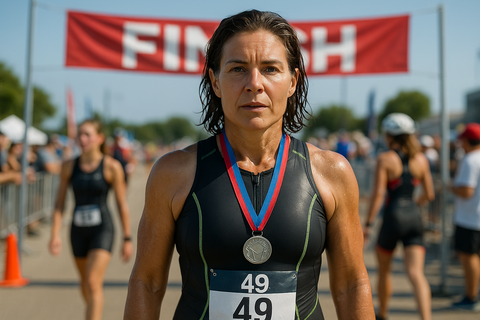
The red carpet appeared. Six hours and 40 minutes after standing on a cool beach feeling like a lost boy who'd signed up for something too big, I was a finisher.
5,161 minutes of training. Eight months of sacrifice. The person who couldn't complete a 5km in July had just finished a 70.3-distance triathlon.
Slow motion, tears, my best friends and my mum — a moment I will never forget, and can't fully describe. Nothing is truly impossible.
Key Lessons for First-Time 70.3 Racers
This race offers a masterclass in what to expect — and what to prepare for differently. Here are the most actionable takeaways.
Pacing: Don't Let the Bike Steal Your Run
Running a full hour ahead of bike schedule sounds like a win. It isn't. Aggressive biking at 100kg+ created an energy deficit that turned the half marathon into a survival exercise. For first-timers, conservative bike pacing — even when it feels slow — preserves the muscular glycogen your legs desperately need for 21.1km of running.
A useful rule of thumb: if the bike feels easy, you're probably doing it right. Understanding realistic pacing benchmarks helps you avoid this common mistake.
Sodium Supplementation Is Non-Negotiable
One tablet prevented a race-ending cramping episode in the final bike kilometres. In hot conditions — Valencia hit 30°C on race day — sodium loss through sweat accelerates dramatically. Build electrolyte supplementation into your race nutrition plan from the start, and don't wait for cramp warning signs. Quality magnesium and electrolyte products are worth every cent of the investment.
Train Your Transitions
Know your transition plan before race day: where your bag is, what order you're putting things on, which shoes go where. Seconds saved in transition require zero extra fitness. Pack a larger towel if you're racing a beach swim start with sandy exits. A quality triathlon suit designed for quick transitions can also make a meaningful difference across all three disciplines.
Mental Resilience Is a Trainable Skill
The final 10km of the run were won entirely in the head — not through physical reserves that weren't there. Daily motivational rituals, pre-race community connection, and the willingness to accept a mental shutdown without quitting were what separated finishing from a DNF. Consider practicing this in training: run the last 20 minutes of a long session on empty, and practice finishing anyway.
Use the Crowd
Spectator support is a legitimate performance tool. Research in sports psychology consistently shows that external encouragement reduces perceived effort in endurance events. Position your support crew at psychologically strategic points — the midpoint of the run, the final 2km, the finish. And if you're racing solo, lean on the strangers cheering around you. They mean it.
Travel Tips for Racing in Valencia
Where to Stay
The old town, around Valencia's central market, is a beautiful area that functions as its own destination. The key strategic advantage: distance from race chaos. Staying slightly removed from transition and start/finish areas allows you to arrive calm rather than wired from pre-race energy. For first-timers especially, the ability to decompress in your accommodation matters more than proximity to the start line.
Getting Around
The start line is approximately a 15-minute drive from the old town. Book your taxi or rideshare the night before — race morning logistics add stress you don't need. The old town also borders the park that hosts the run segment, making it ideal for shake-out runs and nerve-calming walks in the days before the race.
Post-Race
Valencia's old town has no shortage of excellent restaurants — the perfect reward after 113.1km of effort. Give yourself at least one full rest day before attempting any sightseeing on foot. Your legs will thank you.
Frequently Asked Questions
What is the 70.3-distance triathlon in Valencia?
The 70.3-distance triathlon in Valencia consists of a 1.9 km swim, a 90 km bike ride, and a 21.1 km run, taking place in the city of Valencia, Spain. It is designed for athletes looking to challenge themselves and experience a large-scale competition, typically involving over 2,500 participants.
How do I prepare for my first triathlon?
Preparing for your first triathlon involves training in swimming, cycling, and running, as well as practicing transitions between these activities. It is also essential to develop a nutrition plan for race day and to familiarize yourself with the event's logistics and venue.
What should I expect on race day at a 70.3-distance triathlon in Valencia?
On race day, expect a bustling environment with intense energy as thousands prepare for the event. You will need to check in, set up your transition area, and attend any pre-race briefings. The swim starts first, followed by the bike segment and then the run, with plenty of support along the course from spectators and volunteers.
How important is nutrition during the race?
Nutrition is critical during the race to maintain energy levels and performance. It is important to consume adequate hydration and energy sources such as gels and bars throughout the event, particularly during the bike and run segments.
What gear do I need for a 70.3-distance triathlon?
Essential gear includes a triathlon wetsuit, bike, helmet, running shoes, and suitable clothing for each segment of the race. It is also advisable to have nutrition supplies, goggles for swimming, and a transition kit with towels and other necessities.
Where should I stay when participating in a triathlon in Valencia?
It is recommended to stay in the old town of Valencia, which is close to the race venue and offers a homely atmosphere with plenty of dining options. This location allows for easy access to the event while providing a welcoming environment for racers.
Source: 220triathlon.com