70.3-Distance Race in Omaha 2026: Nebraska's First Long-Distance Triathlon Draws 2,000 Athletes and 8,000 Spectators
On June 7, 2026, the Cornhusker State made history — and the Missouri River was there to witness it.
Imagine this: hundreds of athletes streaming across the Bob Kerrey Pedestrian Bridge, legs burning after 56 miles on the bike, with the Missouri River glittering below them in the early June light. Behind them, 8,000 spectators line the banks of Gallup Riverfront Park, cheering strangers like old friends. At the finish line, a man named Marco Toapanta collapses into the arms of his son Dante. A volunteer named Mary Passmore gently places a cool towel over the head of an exhausted competitor settling into an ice bath. Julie Halvorson of Chanhassen crosses the line and bows her head as a medal is draped around her neck.
This was the inaugural 70.3-distance triathlon in Omaha, Nebraska — the first long-distance triathlon branded event in the state's history — and it was everything endurance sport is supposed to be.
What Is a 70.3-Distance Triathlon? Breaking Down the Race
Before we dive into the human drama, it helps to understand what these 2,000 athletes actually endured.
The Race Format: Three Disciplines, One Unforgettable Day
A 70.3-distance triathlon gets its name from the total mileage competitors cover across all three segments. The math is straightforward; the execution is anything but:
- Swim: 1.2 miles in open water (in Omaha's case, the Missouri River)
- Bike: 56 miles of cycling through the Omaha metro and surrounding areas
- Run: 13.1 miles (a full half marathon) to the finish line
- Total: 70.3 miles from start to finish
For context, that swim alone is the equivalent of crossing a lake more than twice. Add 56 miles in the saddle and then ask your legs to carry you through a half marathon — and you begin to understand why Malachi Lehman of Minneapolis was photographed collapsing the moment he crossed the finish line.
The 70.3 Distance as an Entry Point to Long-Distance Triathlon
The 70.3 format sits in a sweet spot: it's demanding enough to require months of structured training, yet accessible enough that athletes competing in their first long-distance event can realistically cross the finish line. While a full long-distance triathlon covers 140.6 miles, the 70.3 format attracts a broad range of competitors — from seasoned multi-sport athletes chasing personal records to ambitious newcomers checking off a bucket-list goal.
Training for a 70.3 typically demands 16–20 weeks of dedicated preparation, blending swim sessions, long rides, tempo runs, and brick workouts (back-to-back disciplines practiced in a single session). It's a serious undertaking — but one that's achievable for athletes who commit fully to the process.
The 70.3 format rewards patient, structured commitment — the kind that gets you out of bed before sunrise for months on end, not knowing exactly what you're capable of until race day proves it.
The Athletes: Profiles in Perseverance
What transforms a race into a story is the people who show up to run it. Omaha's inaugural event brought competitors from across the region and the country — proof that Nebraska's new race had already earned attention far beyond the state's borders.
A Geographic Patchwork of Endurance
Athletes converged on Gallup Riverfront Park from:
- Nebraska: Lincoln, Elkhorn
- Minnesota: Minneapolis, Chanhassen, Big Lake
- South Dakota: Sioux Falls
- Iowa: Coralville, Fort Dodge
- Arkansas: Bentonville
- California: San Francisco
That Kristina Koepke flew in from San Francisco to race in Omaha on a June Sunday speaks volumes about the draw of inaugural events — and about how quickly word traveled within the triathlon community that this was a race worth traveling for.
Faces at the Finish Line
The finish line at Gallup Riverfront Park was a theater of raw human emotion, captured brilliantly in photo documentation by Omaha World-Herald photographer Joseph Ciembroniewicz.
Kade Layton of Big Lake was photographed in the final meters of the race — head up, legs driving forward, still running with purpose after 70.3 miles. Moments later, he crossed the finish line.
John Matson of Elkhorn paused just before the finish to greet his family. After hours of racing through swim, bike, and run, he took a moment to connect with the people who made the journey matter — then crossed the line.
Marco Toapanta embraced his son Dante at the finish line in one of the day's most memorable images. It's the kind of moment that reminds observers why athletes endure months of early-morning training sessions: not just for the medal, but for what it means to the people watching.
Malachi Lehman of Minneapolis collapsed after crossing — a visceral image of what 70.3 miles does to the human body. It wasn't defeat. It was the truest expression of everything he had left on the course.
Kathryn Schneider of Elkhorn was captured mid-run, checking her watch — the universal language of an athlete who came with a goal and intended to keep it.
Marcelo Costa of Bentonville poured water over his head after crossing. The simple gesture said everything: I made it. It's over. It was worth it.
The Unsung Moment: Transition Two
Between the bike leg and the run, athletes arrive at Transition 2 — exhausted, legs heavy with lactate, needing to shift mentally and physically from cyclist to runner. It's one of the least-photographed moments in triathlon coverage, yet it captures something essential about the sport.
At Omaha's inaugural event, Allie Kirby hugged Terry Crawford in the transition zone — a moment of human connection in the middle of athletic suffering. Miguel Secor of Fort Dodge rested briefly, gathering himself before the final 13.1 miles. These quiet moments between disciplines are where the race is often decided — not by speed, but by resolve.
The Course: Omaha's Triathlon Landscape
The race organizers didn't just find a flat, forgettable loop somewhere in the metro. They built a course around Omaha's most dramatic natural feature.
The Missouri River Swim
Athletes launched into the Missouri River at Gallup Riverfront Park for the 1.2-mile open water swim. Open water racing is a different beast from pool swimming — currents, reduced visibility, and the psychological weight of swimming in moving water all factor in. For many competitors, this is the segment that triggers the most pre-race anxiety. For those who had trained for it, emerging from the river and running into the transition zone was the first major milestone of the day.
The 56-Mile Bike Leg
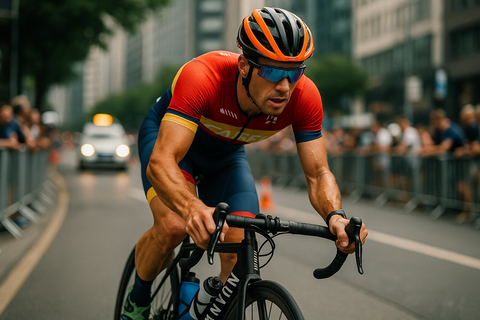
Thomas Woods of Lincoln and Charlie Montang of Minneapolis were captured in full stride during the bike leg, powering through the Omaha metro on a course that wound through urban and suburban terrain. Todd Walter of Coralville was also photographed mid-ride, maintaining form well into the segment.
The 56-mile bike leg represents more than half the total race distance, and it's where many athletes make or break their finishing time. Pacing on the bike is critical — push too hard, and those legs won't carry you through the run. Hold back too much, and the clock works against you.
The Run: Bob Kerrey Bridge and the Missouri River Corridor
The 13.1-mile run is where Omaha truly shone as a race venue. Athletes ran along the Missouri River, with the city skyline providing a backdrop that few triathlon courses in the Midwest can match. The signature moment of the run — and perhaps the entire event — was the crossing of the Bob Kerrey Pedestrian Bridge, a 3,000-foot cable-stay bridge that spans the Missouri River between Nebraska and Iowa.
Macy Masteller of Sioux Falls was photographed crossing the bridge, as were dozens of other competitors. Michael Leonard of Sioux Falls was captured mid-stride on the run course, still racing with urgency deep into the final segment. The bridge crossing became the visual symbol of the inaugural event: athletes suspended above the Missouri River, Omaha behind them, the finish line ahead.
Athletes suspended above the Missouri River, Omaha behind them, the finish line ahead — the Bob Kerrey Bridge crossing became the defining image of Nebraska's first long-distance triathlon.
Community Impact: How Omaha Showed Up
A race lives or dies by the community that surrounds it. Omaha's community showed up — loudly, warmly, and in force.
8,000 Spectators Transform Gallup Riverfront Park
Eight thousand spectators descended on the venue throughout race day, transforming Gallup Riverfront Park into something that looked less like a sporting event and more like a community festival. Multi-generational families lined the course. Children cheered for parents they could barely pick out of the crowd. A fan captured in one image leans toward the finish line, arms extended, urging runners through.
Katy Barrett and her daughter Mollie cheered for family member Leigh Barrett as he crossed the finish line — three generations of one family united by one person's achievement. This is what endurance sport does to communities: it gives people a reason to stand outside and cheer for each other.
The Volunteers Who Made It Possible
No long-distance triathlon runs without volunteers, and Omaha's inaugural event was no exception. Mary Passmore exemplified volunteer dedication, placing a cool towel over Dale Hemmie's head as he recovered in an ice bath after crossing the finish line. It's a small gesture that carries enormous weight after 70.3 miles in June heat.
Transition zone volunteers coordinated the flow of hundreds of athletes switching disciplines simultaneously. Medical staff stationed throughout the course ensured that the physical toll of the race never became dangerous. The volunteer network is the invisible infrastructure of every endurance event — and Omaha's inaugural race had it in abundance.
Why This Race Matters for Nebraska
Nebraska had never hosted a long-distance branded triathlon before June 7, 2026. That fact carries more weight than it might initially appear. Endurance sports tourism is a significant and growing economic driver. When 2,000 athletes travel to a race city, they bring families, friends, and support crews — filling hotel rooms, restaurants, and local attractions.
More importantly, hosting a premier endurance event signals to the national triathlon community that Omaha is a destination — a city with the infrastructure, the venues, and the civic enthusiasm to welcome the sport at the highest level. That reputation, once earned, compounds.
The Human Element: Why 70.3 Miles?
There's a question worth asking about every person who toed the start line at Gallup Riverfront Park: Why?
The Pursuit of Something Difficult
Endurance athletes rarely have simple answers. Some are chasing personal records. Some are raising money for causes that matter to them. Some made a bet with themselves years ago — that they could do this if they trained hard enough — and race day is the day they find out. What they share is a willingness to spend months getting up early, saying no to comfortable evenings, and doing the unglamorous work of swim-bike-run-repeat until the race becomes possible. The 70.3-distance format rewards that kind of patient, structured commitment.
The Finish Line as a Mirror
The finish line images from Omaha's inaugural event are instructive. Some athletes cross with arms raised in triumph. Others collapse. Some pause to embrace family. Some bow their heads as medals are placed around their necks. Every single expression is authentic, because nothing strips away pretense quite like 70.3 miles.
Malachi Lehman falling to the ground after crossing isn't a failure image — it's a testament image. It says: I gave everything I had to this course, and there is nothing left. That's not weakness. That's exactly the point.
The Sport's Growing Community
Long-distance triathlon has expanded dramatically over the past two decades, with events now taking place on every inhabited continent. The 70.3-distance format in particular has grown because it sits at the intersection of achievable and genuinely hard — the kind of challenge that changes how people see themselves when they complete it. Nebraska athletes now have a home race. That matters for the local triathlon community in ways that are hard to quantify but easy to feel.
Looking Ahead: What Comes Next for Omaha Triathlon
The success of the inaugural event — 2,000 athletes, 8,000 spectators, a course showcasing some of Omaha's most dramatic geography — sets a strong foundation for what could become an annual tradition on the Midwest endurance sports calendar.
For aspiring athletes who watched from the sidelines this year: the training journey for a 70.3 is long but well-mapped. Triathlon clubs, structured training plans, and a growing community of local athletes make Nebraska a genuinely viable place to start that journey. Consider beginning with a sprint or Olympic-distance triathlon to build your foundation, then targeting a future long-distance event in your own backyard.
For spectators and volunteers: the event needs you to return. The energy that 8,000 people brought to Gallup Riverfront Park was itself a kind of athletic performance — sustained enthusiasm, family presence, and community pride that pushed tired athletes through their final miles.
For the Omaha community at large: this event is an asset. A long-distance triathlon that draws competitors from San Francisco, Minneapolis, and across the Midwest is a billboard for what Omaha can offer — and an annual argument for why endurance athletes should consider Nebraska as their next race destination.
Key Takeaways
- June 7, 2026 marked the historic inaugural 70.3-distance triathlon in Omaha — the first long-distance branded triathlon event in Nebraska's history
- 2,000 athletes from across the region and country competed across a 70.3-mile course spanning the Missouri River, Omaha metro roads, and the Bob Kerrey Pedestrian Bridge
- 8,000 spectators created a festival atmosphere at Gallup Riverfront Park, supporting competitors through swim, bike, and run
- The course showcased Omaha's natural geography — making the Missouri River and the iconic pedestrian bridge signature elements of the race experience
- Volunteers, families, and community members were as essential to the event's success as the athletes themselves
- Nebraska's entry into the long-distance triathlon calendar positions Omaha as an emerging destination for endurance sports tourism
Ready to Be Part of It?
Whether you crossed that finish line on June 7 or watched from the riverbank wishing you were out there — the next chapter of this story is already being written. If you're thinking about training for your first long-distance triathlon, explore the gear and essentials that help beginners build smart, sustainable training habits. Our triathlon suit is a great place to start, and our swimming goggles will have you ready to hit the water.
Frequently Asked Questions
What is the Ironman 70.3 Omaha triathlon?
The Ironman 70.3 Omaha triathlon is a long-distance triathlon consisting of a 1.2-mile swim, a 56-mile bike ride, and a 13.1-mile run, making it the first Ironman branded event in the state of Nebraska.
When did the first Ironman 70.3 Omaha take place?
The inaugural Ironman 70.3 Omaha triathlon took place on June 7, 2026.
How many athletes participated in the Ironman 70.3 Omaha?
Around 2,000 athletes participated in the inaugural Ironman 70.3 Omaha triathlon.
What was the location for the Ironman 70.3 Omaha triathlon?
The event was held at Gallup Riverfront Park in Omaha, Nebraska.
How many spectators attended the Ironman 70.3 Omaha?
Approximately 8,000 spectators turned out to support the athletes during the event.
Source: Omaha World-Herald
Discover unique triathlon-themed merchandise, including stylish t-shirts, stickers, phone cases, and home decor — perfect for endurance sports enthusiasts and athletes. Shop now

![[WATCH LIVE NOW] Women's European Ironman Championship in Hamburg](http://triathlon.mx/cdn/shop/articles/d7d0945868953eee3a8feae2aa7e5193.png?v=1780895362&width=480)