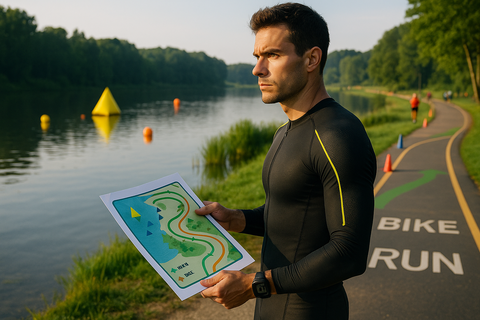
The 29-year-old Norwegian just ran a 2:29:25 marathon — after already swimming and cycling 114 miles. Here's what makes his approach so transferable.
Imagine running a 2:29:25 marathon. For most people, that alone would be a career-defining achievement. Now imagine doing it after you've already swum 2.4 miles and cycled 112 miles at race pace. That's exactly what Casper Stornes did in Nice, France, in September 2025 — on his full-distance triathlon debut — to win the World Championship in a time of 7:51:39.
The 29-year-old Norwegian is, by any measure, one of the most exciting athletes in endurance sports right now. What makes him even more fascinating, though, is how relaxed he is about it. No obsessive macro-tracking. No ice baths. No revolutionary training system. Just a set of clear, repeatable principles that he executes with remarkable consistency.
Stornes spoke to us from his home in Bergen, Norway, coached by two fellow world champions — Gustav Iden and Kristian Blummenfelt — and signed with performance swim brand Zone3. His insights aren't just for elite triathletes. Whether you're training for your first sprint triathlon, chasing a marathon PR, or simply trying to get more out of your weekly workouts, these six lessons translate across the spectrum.
1. Find Your Team: Why Elite Athletes Don't Train Alone
The most surprising thing about Stornes's coaching setup is how informal it is. He first made a name for himself with a third-place finish at the 70.3-distance Middle East Championships in 2018 — finishing just behind his countrymen Gustav Iden and Kristian Blummenfelt. Today, that same podium trio forms a training unit, with Iden and Blummenfelt serving as Stornes's coaches.
But don't picture rigid periodization plans and clipboard-carrying coaches. The arrangement is more like three friends from Bergen who share a training philosophy.
We're three guys from the same city, with the same lifestyle, so it's all quite relaxed," Stornes explains. "[Training myself] does put pressure on me, it means I can't just program easy sessions. But Gus, Kris and I all have the same philosophy, so it works well.
That last part matters more than it might seem. Shared philosophy beats famous credentials. The reason the arrangement works isn't because Iden and Blummenfelt are world champions (though that helps) — it's because all three operate from the same values: consistent volume, patience, enjoyment, and mutual accountability.
The lesson for everyday athletes isn't "find two world champions to train with." It's simpler: identify two or three people who train with similar intentions and a compatible lifestyle. Shared values create natural accountability. When everyone in the group is committed to showing up, skipping sessions gets harder — and quality stays higher.
Actionable step: This week, identify one or two potential training partners with aligned goals. You don't need a formal coaching arrangement — just people who take their preparation seriously and share your approach to the sport.
2. Show Up Every Day: The Unglamorous Truth About How Champions Are Built
If you ask Stornes to describe his training week, he'll tell you it's "a very simple, standard week." That kind of understatement from someone logging 30–35 hours of training at peak periods is either false modesty or a sign that consistency has become so embedded it genuinely feels routine.
It's the latter.
Here's how his week actually breaks down:
| Day | Focus | What It Includes |
|---|---|---|
| Monday | Half rest day | Up to 5K swim + 75–90 min run + strength work |
| Tuesday | Threshold focus | 70–80 min hard bike + 3–4K hard swim + easy 1 hr run |
| Wednesday | High volume (6–7 hrs) | 6×1K swims + 1 hr run + 4 hrs on the bike |
| Thursday | Mixed intensity | Threshold run + 5K swim + 90–120 min bike |
| Friday | Build toward weekend | Same as Monday — gearing up |
| Saturday | Long mountain run | 3–3.5 hrs running in Bergen mountains + optional swim |
| Sunday | Moderate volume | 60–70 min bike + 7–9 miles running |
Wednesday is the monster day — six to seven hours of deliberate training. But notice what surrounds it: structured recovery, manageable intensity, and a predictable rhythm. This isn't a program that peaks and crashes. It repeats, week after week, building compounding adaptation.
At 30–35 hours per week during heavy blocks, Stornes accumulates roughly 1,600+ hours of deliberate training per year. That number doesn't come from heroic individual sessions. It comes from not missing Mondays.
You don't need his volume to apply this principle. The point is to build a weekly template you can actually repeat. A consistent 8–10 hour week executed faithfully for 52 weeks will outperform a chaotic program that swings between 20-hour weeks and burnout recovery. Training apps can help you maintain consistency by automating your weekly structure and tracking progress over time.
Actionable step: Draft your own weekly template — not an ideal week, but a repeatable one. Build in one higher-volume day and protect your lighter days from creeping intensity. Then execute it for four consecutive weeks before adjusting anything.
Key terms: Threshold work refers to sustained effort near your lactate threshold — hard but controlled, typically around 80–85% of max heart rate. Periodization is the structured variation of training intensity over time.
3. Look Forward to Fuel and Recovery: Why Flexible Nutrition Beats Obsessive Macro Counting
Here's where the Stornes blueprint gets genuinely surprising: the man who just ran a sub-2:30 marathon in the middle of a long-distance triathlon is not tracking his macros.
I'm not strict at all," he says, smiling.
His morning fuel of choice? Nutella in oat milk coffee. ("It's rocket fuel," he says.) Carbonara disappears in front of him by the plate-load. When he needs a calorie top-up between training sessions, candy works just fine.
Before you swap your protein shake for a Nutella spoon, context matters: Stornes is burning through an extraordinary amount of energy every week. At 30+ hours of training, his body's primary nutritional demand is calories, not macro ratios. The flexible approach works because the volume creates the demand.
But the underlying principle is transferable: obsessing over micronutrients often creates anxiety that undermines performance more than imperfect food choices do. For most athletes training 8–12 hours per week, hitting caloric and protein targets consistently matters far more than the precise source of those carbohydrates. Magnesium supplementation can support muscle recovery without requiring complex macro tracking.
Recovery follows the same logic. Stornes doesn't use a sauna or ice bath. What he does do:
- Sleep — his primary recovery tool, and non-negotiable
- Foam rolling — regular maintenance, done at home
- Power naps — 30 minutes with an eye mask whenever he can fit them in
The absence of expensive recovery modalities from his routine is a quiet reminder that the fundamentals — sleep and consistent soft-tissue work — deliver the most return. The fancy tools are largely noise.
Actionable step: Audit your recovery hierarchy this week. Are you getting 7–9 hours of sleep consistently? If not, no amount of foam rolling or contrast therapy will make up the deficit. Start there.
4. Quiet the Mind Through Practice: The Power of Pre-Race Planning and Pace Discipline
Anyone who has ever tried to hold a target pace — even in a 5K — knows what happens in the final third: your mind starts lobbying for slow. Now imagine maintaining that discipline for 26.2 miles, after a full day of racing, while competitors try to break you with early surges.
Stornes's solution isn't willpower. It's preparation so thorough that race-day decisions become automatic.
Never take yourself by surprise on race day," he says. "Practice and know you're gonna run at this pace, this pace and this pace. It's about being as efficient as you can and getting used to that speed in training.
His approach to Nice was meticulous: he knew the wind patterns, identified the sections where he could accelerate, understood where the course would slow him, and had a predetermined mile marker for unleashing full effort. When competitors made aggressive early moves, he didn't react. He trusted the plan.
This is the tortoise-and-hare principle applied to elite sport. Consistency beats a jittery runner every time. The athlete who responds to a competitor's early hammer with a counter-surge often pays for it at mile 20. The athlete who stays disciplined usually runs them down.
The training application: practice your race pace before race day. Build the neural pathways for that specific effort so that holding it becomes familiar rather than frightening. If you've run your goal marathon pace eight times in training, sustaining it on race day is an extension of practice — not a leap into the unknown. Quality running shoes designed for marathon pace work can make the difference in maintaining consistent effort over long distances.
Actionable step: For your next goal race, create a simple plan with predetermined splits for each segment at least four weeks out. Then run your goal pace in training at least three or four times before the event. Eliminate the surprise.
5. Don't Neglect the Hips: The Hidden Key to Endurance Performance
Here's the piece of Stornes's routine that most athletes skip — and the one that may matter most for injury prevention and sustained performance.
Training at 30–35 hours per week is relentless on the body. The accumulation of swim strokes, pedal revolutions, and running strides creates compounding stress on the hips — the power center for all three disciplines. Stornes addresses this directly, with regular hip and hamstring work done at home, woven into his recovery days.
I work on the hips and hamstrings at home," he says. "In heavy training periods of 30-35 hours per week, I can struggle to keep my form right.
When his hips feel "slightly locked up" mid-session, he has a tactical response: shift the load to his calves to drive forward momentum while the hips recover within the effort. But there's a crucial nuance to the flexibility work that follows:
You still need a little bit of snappiness in the calves. You don't want to be too loose.
This is the flexibility paradox: endurance athletes often over-stretch in pursuit of mobility, inadvertently reducing the elastic energy stored in the calf complex that contributes to running economy. The goal is functional mobility — enough range of motion to maintain form, but not so much that you lose the spring in your stride.
A simple hip-focused home routine (glute bridges, clamshells, lateral band walks, hip flexor stretches) done three or four times per week takes 15–20 minutes. For athletes logging heavy training blocks, this is often the difference between finishing a season and spending part of it injured. Joint support supplements can complement your hip mobility work during intense training phases.
Actionable step: Add three sessions of hip-focused work per week — even 15 minutes each. Monitor hip mobility as an early warning sign of overtraining. When hips start feeling restricted, that's a signal, not just a nuisance.
6. Find the Fun: Why Enjoyment Is a Performance Tool
Stornes is remarkably candid about the obvious: training 30-plus hours a week is exhausting. The schedule laid out above is enormous. Anyone looking at it honestly should feel a little tired.
If his weekly training plan above feels exhausting, it's good to know that Stornes feels the same.
So how does someone sustain that volume — year after year — without burning out? The answer isn't a sophisticated periodization model. It's simpler and more human:
I really enjoy being outside and using my body and being active," he says. "Plus, when I'm with Gus and Kris, it's like being at camp with my friends. It's much easier to do a four-hour ride when you're sore if your friends are there.
This isn't soft reasoning. Intrinsic motivation — training driven by genuine enjoyment rather than external pressure — is one of the strongest predictors of long-term athletic consistency. The athletes who burn out are often those who train as a means to an end, grinding through sessions they resent. The athletes who improve for decades tend to love the act of training itself.
Social facilitation amplifies this. Research consistently shows that perceived effort decreases when you train with others. A four-hour ride with training partners doesn't just feel more pleasant — it's physiologically easier, enabling athletes to complete sessions they might cut short alone.
Stornes doesn't frame Saturday's three-hour mountain run through Bergen as a training obligation. He pops in his Deadmau5 playlist, heads into the hills with his friends, and by his own account, actually looks forward to it.
Actionable step: Identify which aspects of training you genuinely enjoy — specific disciplines, specific routes, specific training partners. Protect those sessions. Strategically schedule group training for your hardest or longest workouts, where social support makes the biggest difference.
Putting It Together: Six Principles You Can Apply This Week
Stornes's approach to long-distance triathlon is elite in execution but democratic in principle. You don't need his genetics, his training volume, or his coaching partners to benefit from his philosophy. You just need to start somewhere.
Here's the condensed framework:
- Build your team — find 2–3 athletes with aligned values and train together consistently
- Prioritize consistency over intensity — a repeatable weekly template beats an optimized-but-unsustainable one
- Simplify your recovery hierarchy — sleep first, foam rolling second, everything else is optional
- Plan obsessively, execute calmly — eliminate race-day surprises through preparation and pace practice
- Protect your hips — 15 minutes of hip and hamstring work three times per week prevents the injuries that derail seasons
- Find what you love — sustainable high performance requires genuine enjoyment, not just discipline
The most remarkable thing about Casper Stornes running a 2:29:25 marathon in the middle of a 140-mile race on his full-distance debut? He describes his training as "a very simple, standard week." That simplicity — consistently applied, over many months and years — is the actual secret.
You don't need to train like a world champion. But you can absolutely think like one.
Ready to build your triathlon toolkit? Explore premium triathlon suits and high-performance swimming goggles to get your gear dialed before your next event.
Which of Stornes's six principles will you implement first? Share your training goals in the comments below — and tag a training partner who needs to read this.
What are the key training strategies of Casper Stornes, the long-distance triathlon World Champion?
Casper Stornes emphasizes six main strategies: 1) Find your team for support and accountability, 2) Show up every day with consistent training, 3) Focus on nutrition and recovery, 4) Quiet the mind through meticulous race planning, 5) Prioritize hip flexibility and strength, and 6) Find joy in your training.
How does Casper Stornes manage his nutrition while training for long-distance triathlon competitions?
Stornes maintains a relaxed approach to nutrition, enjoying foods like Nutella in coffee and carbonara without strict dietary restrictions. He prioritizes fueling his body adequately and doesn't shy away from indulging in sweets when necessary.
What does Stornes' weekly training schedule look like?
Stornes' training week includes a mix of swimming, cycling, and running, with a main focus on volume and consistency. He typically trains six to seven hours on Wednesdays, combining various exercises across the week to build endurance and strength.
What mental strategies does Casper Stornes use during races?
Stornes emphasizes detailed race planning to control his pace and approach during competitions. By practicing and knowing his strategy thoroughly, he can avoid distractions and maintain focus, trusting in his training and preparation.
Why is hip flexibility important for triathletes like Stornes?
Hip flexibility is crucial for optimizing efficiency and power during running and cycling. Stornes incorporates hip and hamstring exercises into his training routine to address potential tightness from rigorous training loads, ensuring he maintains proper form.