
When Kat Matthews crossed the finish line in Kona in October 2025 with a record-breaking 2:47:23 marathon split, she was still running conservatively. She had more in the tank — on purpose. For anyone watching from the outside, that single fact tells you everything about where women's long-distance triathlon is headed right now, and why 2026 feels genuinely historic.
Matthews has stood on the podium at the long-distance world championship three times: St George in 2022, Nice in 2024, Kona in 2025. Each time, silver. Each time, with the quiet nagging sense that she hadn't yet shown the world — or herself — what she's truly capable of.
That question is the engine driving her entire 2026 season. Not the podiums. Not the records. Not even the three consecutive Pro Series titles she's chasing. The question is simpler and more relentless than any of those things.
"What motivates me is basically a personal case study," she says with a smile. "How good can I get?"
This is the story of a British athlete who came from a military family, trained as an Army physiotherapist, turned pro in 2019, and has since become one of the most formidable long-distance triathletes on the planet — while still insisting she hasn't found her ceiling. In 2026, she might actually find it.
The Effortless Champion Who Isn't Effortless at All
The Smooth Style That Hides Everything
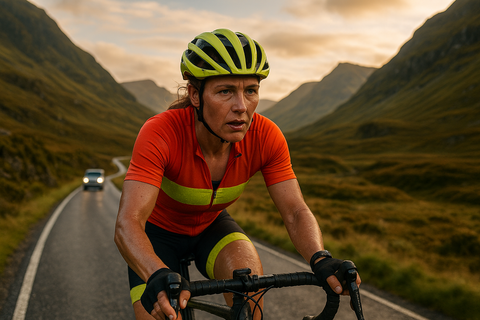
Watch Kat Matthews race and you could be forgiven for thinking it all comes naturally. She glides. She doesn't grimace. On the bike, she looks like she's commuting. On the run, like she's out for a morning jog that happens to follow 180km on the bike.
Don't be fooled.
"When you say I made it look easy, it still hurts," she says directly. "It's still really hard."
That understated toughness — composed on the outside, ferociously disciplined on the inside — has become her signature. It's not theatrics, and it's not natural talent alone. It's the result of years of structured, intelligent training layered on top of a childhood that didn't really know how to spell "optional."
From Army Physiotherapist to World Podium
Matthews competed in her first full long-distance race as a professional at the end of 2019. By 2022, she was standing on the world championship podium. By 2025, she had collected 7 long-distance wins, 7 half-distance wins, 2 consecutive Pro Series titles, and 3 world championship silver medals.
Her background as a British Army physiotherapist gives her a perspective most elite athletes simply don't have. She understands training stress from the inside — how the body adapts, where it breaks down, what "healthy sport" looks like versus what professional sport demands. That tension between health and performance isn't just academic for her. It shapes every decision she and her husband and coach Mark make together.
Career Highlights at a Glance
| Achievement | Details |
|---|---|
| Long-Distance Triathlon Pro Series Titles | 2x (2024, 2025) |
| World Champs Podiums | 3x runner-up (2022, 2024, 2025) |
| 70.3 World Champs Podiums | 2x runner-up (2023, 2024) |
| Sub8 Project (2022) | 7:31:54 (controlled format) |
| Long-Distance Wins | 7 |
| Half-Distance Wins | 7 |
| Personal Best (Standard Race) | 8:05:13 (Hamburg 2025) |
The Reset: Why Durability Beat Volume This Winter
A Calf That Said "Enough"
The 2025 season ended on a frustrating note. A persistent calf injury flared after Kona, then struck again during the 70.3 World Championship in Marbella — forcing a DNF. For an athlete of Matthews' caliber, a did-not-finish is rare enough to sting.
But the response was characteristically thoughtful rather than reactive. Instead of jumping straight into a high-volume winter block, Matthews and Mark stepped back and asked a harder question: had she overdone it?
"Maybe I overdid it a bit last year," she admits. "This winter was about reining that back in and focusing on really good quality, consistent bike and run training."
The protocol included targeted strength work, new footwear choices designed to reduce calf load (more on those below), and a deliberate recalibration of training volume. Sometimes the bravest training decision is to do less.
Two Weeks of Intentional Chaos
Before any of that structured rebuild could begin, though, Matthews did something that might surprise casual observers of elite sport: she completely switched off.
Two weeks. Paris with friends. A spa day with family. And, by her own cheerful admission — "I said 'afternoon drinking' earlier, but all-day drinking is probably more accurate."
More importantly: no performance tracking. None. No metrics. No data. No Garmin uploads.
"I take off all the performance tracking," she says. "If I get sick, I get sick. It's just normal life."
This isn't laziness — it's strategy. For an athlete whose daily existence revolves around discipline, structure, and data, removing all of it for two weeks resets something psychological that's genuinely hard to quantify. Elite performance requires mental recovery, not just physical recovery. The two-week reset is the foundation the entire season is built on.
Takeaway for age-groupers: If you're training year-round without a true off-season break — including a period where you actively ignore your metrics — you may be accumulating psychological fatigue that undermines your physical gains. Schedule the break before you need it.
New Zealand: Fitness Confirmed
The proof that the rebuild had worked came at Ironman New Zealand in Taupō on March 7, 2026. It's a course with a reputation for honesty — rough roads, unpredictable climate, no hiding places.
Matthews expected to exit the water in a deficit. Her husband Mark predicted roughly 90 seconds down. Matthews, the more pessimistic of the two, estimated five minutes. The reality: somewhere between two and three minutes. Already in a solid position.
The plan was to hunt down the leaders gradually across the bike. What actually happened was more interesting.
"My instinct was that it might take most of the bike to get there," she recalls. "But when I caught the front at around 40km I realised I hadn't actually put in that much effort. And that was the moment where I thought: 'okay, if I can catch them this easily, the rest of the bike will be fine.'
She won the race. Her verdict? "My fitness is adequate."
Classic Matthews.
The Sub-8 Obsession: One Number, Enormous Symbolic Weight
Why 8:00:00 Became Everything
Here's where it gets interesting — because Matthews is not, by her own description, someone who chases records for the sake of records. Results matter less to her than the process of discovery. And yet.
"I have a bit of an unhealthy obsession with it," she admits, referring to the sub-8-hour barrier in women's long-distance triathlon. "It just feels like this big barrier in women's sport. I don't know why it stuck with me, but it did."
Athlete Times Comparison
| Athlete | Time | Race | Year |
|---|---|---|---|
| Anne Haug | 8:02:38 | Challenge Roth | 2024 |
| Laura Philipp | 8:03:13 | Hamburg (official record) | 2025 |
| Kat Matthews | 8:05:13 | Hamburg | 2025 |
| Kat Matthews | 7:31:54 | Sub8 Project (controlled format) | 2022 |
That last row is the critical one. In 2022, as part of a specially organized single-race format with pacemakers, Matthews clocked 7:31:54. Sub-8 is physiologically achievable. The question has never been whether it's possible — it's been when, and under what conditions.
"With the right day and the right conditions, even with last year's fitness, I think it's possible," Matthews says. "It could happen before Roth. Maybe in Texas or even Hamburg."
The Competition Is Closing In
Matthews is clear that she doesn't see herself as the only contender. "I definitely don't think I'm the only athlete who could do it. There are a few women who are close."
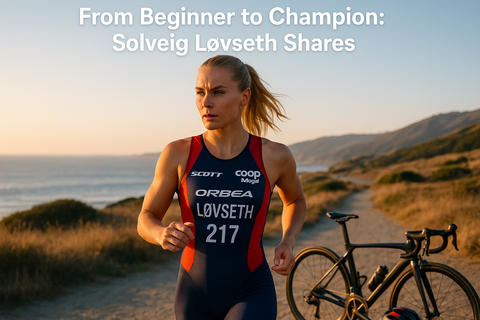
Germany's Laura Philipp holds the current official long-distance record at 8:03:13. Anne Haug set the Challenge Roth course record at 8:02:38. Norway's Solveig Løvseth — who beat Matthews to the Kona title in 2025 — is another name in the conversation. The field is deeper and faster than it has ever been, which is actually driving the times down.
The conversation in 2026 has already shifted. It's no longer "Can women break 8 hours?" It's "Who will be first, and at which race?"
For Matthews, though, the framing stays personal. "It's not about the number," she insists. "It's about seeing how fast I can go."
The Race-Day Weapon: ON Cloudboom Strike LightSpray
Footwear Built for the Final 42km
Matthews' running shoe of choice for race day is the ON Cloudboom Strike LightSpray — the laceless version specifically. The choice isn't accidental. She's experimented with the standard laced version but prefers the laceless for a reason that's part psychology, part feel.
"They just give me a little more confidence," she says simply.
The shoe's upper and aggressive rocker geometry create what Matthews describes as extra "pop" in her stride — that energy return that matters enormously when you're trying to sustain sub-4-minute kilometer pace off the back of a 180km bike leg.
But the more interesting insight is where Matthews says the real performance gains actually happen.
"The psychology of knowing you've got the best shoe helps," she says. "But more important is being able to train consistently in their training shoes. That's where the real performance gains happen."
It's a reminder that race-day equipment is only as valuable as the training consistency that leads up to it. The shoe doesn't make the athlete. The thousands of kilometers in training shoes do — and the race-day shoe helps you express what's already built.
For triathletes building their kit: If you're investing in race-day running shoes, think about the full ecosystem — what you're training in matters just as much as what you race in. Consistency of feel across the training block reduces adaptation stress on race day. Browse our race season essentials for gear that supports that consistency from start to finish.
Finding the Limit: The Paradox at the Heart of Elite Performance
The Question That Has No Answer Yet
Here's the tension that defines Kat Matthews as an athlete in 2026. She is remarkably consistent — perhaps the most consistently elite female long-distance racer in the world right now. And consistency, it turns out, might be her biggest obstacle.
"What is the edge? I think this is the question that challenges me the most actually in sport," she says. "I think I'm getting closer to knowing where this edge is, but I'm still too cautious."
She's watching athletes around her who go over the edge — who push into DNF territory in pursuit of world titles — and winning them. Meanwhile, Matthews stays reliably under the edge. Reliable, consistent, and second.
"I think maybe why I'm able to perform so consistently is that I'm not as brave as I want to be. I don't take massive risks. I want to get better at pushing myself to then maybe make mistakes."
That's a rare thing to hear from an elite athlete. Most would never admit to caution in a competitive context. Matthews not only admits it — she's actively trying to change it.
The Kona 2025 Case Study
The clearest example of what she means came at the 2025 world championship in Kona. She ran a 2:47:23 marathon — the fastest women's marathon split in the history of that race, at a 6:22-per-mile pace. She finished second.
And she knows she had more.
"My bike was actually quite a lot slower than what I know I can do," she admits. "And the run was very controlled. I should have been more brave."
What is Kat Matthews aiming for in the 2026 triathlon season?
Kat Matthews is aiming to break the sub-eight-hour barrier for a long-distance triathlon, a goal that she believes is within reach in the 2026 season.
What has been a key focus of Kat Matthews' training?
Matthews' training has focused on building durability and recovery, addressing previous injuries to ensure she can perform consistently.
How does Kat Matthews handle race-day mental challenges?
Matthews employs a strategy of setting small mental goals throughout the race to maintain focus and emotional control, eschewing panic and frustration.
What are some of Kat Matthews' career achievements?
Kat Matthews has won multiple long-distance triathlon events, holds the record for the fastest women’s marathon split at the long-distance world championship, and has been a runner-up in both the long-distance world championship and half-distance world championship multiple times.
How does Kat Matthews view the concept of performance limits?
Matthews is motivated by the question of how good she can become, continually seeking to push her limits while balancing the risk of injury and performance.
Source: https://www.220triathlon.com/news/athletes/kat-matthews-sub-8-is-possible-this-year
Discover unique triathlon-themed merchandise, including stylish t-shirts, stickers, phone cases, and home decor - perfect for endurance sports enthusiasts and athletes. Shop now