
By the time most people are lacing up their first pair of running shoes, Richard Sollee had already set a world record.
Today, Sollee is building the digital backbone of a city of over 900,000 people by day — and pushing the absolute limits of human endurance by night. As Jacksonville prepares to host its inaugural long-distance triathlon on May 16, 2026, this MIT-educated technologist and hometown son stands as one of the event's most compelling participants: someone who embodies the spirit of the race not just as an athlete, but as a citizen deeply invested in the city hosting it.
This is the story of a man who refuses to choose between two demanding callings — and what the rest of us can learn from how he does it.
The Tech Innovator: Building Jacksonville's Digital Future
From Code to Citizen Services
Richard Sollee's day job isn't glamorous in the traditional sense. There are no Silicon Valley ping-pong tables, no splashy product launches watched by millions. Instead, he works in the City of Jacksonville's Technology Solutions Department, quietly reshaping how nearly a million residents interact with their local government.
In nearly two years in the role, Sollee has already racked up a portfolio of civic tech wins that would impress any product manager. His contributions include a full revamp of Jacksonville.gov, a new pet adoption app making it easier for residents to find four-legged family members, and an AI-powered chatbot designed to help citizens navigate the often confusing world of city services. These aren't flashy consumer apps — they're tools built to solve real problems for real people, from the parent trying to pay a water bill online to the family searching for a lost dog.
This is the kind of work that doesn't always make headlines, but it quietly democratizes access to government. When a city's digital infrastructure works well, people don't notice it — and that's exactly the point.
The MIT Advantage
Sollee's path to public-sector technology runs through one of the most demanding academic institutions in the world. He earned dual undergraduate degrees in Computer Science and Physics from MIT, followed by a Master of Engineering in Computer Science — a rare combination that trains the brain to think in systems, patterns, and elegant solutions to complex problems.
That interdisciplinary foundation matters more than it might first appear. Physics teaches you to model the world with precision; computer science teaches you to build solutions at scale. Together, they create a problem-solver who can zoom out to see the whole system and zoom in to fix a specific broken component — whether that component is a line of code or a city service workflow that hasn't been updated in a decade.
For Sollee, this analytical mindset didn't stay in the classroom. It followed him straight into Jacksonville's City Hall.
Why Jacksonville? The Hometown Factor
It would have been easy — arguably expected — for an MIT graduate with Sollee's credentials to head to Boston, San Francisco, or Seattle. The tech industry would have welcomed him with open arms and outsized compensation packages.
Instead, he came home.
Sollee is a lifelong Jacksonville resident with deep roots in the community. Three generations of his family have ties to The Bolles School, one of Jacksonville's most storied private institutions, where Sollee himself first started rowing competitively. That kind of multigenerational connection to a place doesn't fade when an elite university comes calling — it deepens.
His decision to return and contribute his talents to his hometown's digital transformation reflects a growing trend of mission-driven tech professionals choosing community impact over corporate prestige. For Jacksonville, it's a quiet win hiding in plain sight.
The Athlete: From Rowing Lanes to Finish Lines
The Competitive Foundation: Where It All Began
Before Sollee was logging brick workouts at 5 a.m., he was pulling on an oar. Competitive rowing at The Bolles School set the foundation for everything that would follow athletically — the discipline, the tolerance for suffering, the understanding of pacing over long efforts.
He didn't just participate in rowing; he excelled at an elite level. After continuing the sport at MIT with national-level competition, Sollee set a world record in the 100-kilometer rowing machine event for lightweight men 19 and under — a feat that requires not just raw power, but extraordinary mental fortitude over hours of sustained effort.
That world record matters beyond the bragging rights. It tells you something essential about who Sollee is as a competitor: he's built for the long game. World records in ultraendurance events don't go to athletes who burn bright and fade. They go to athletes who manage resources, push limits strategically, and refuse to quit when it gets uncomfortable.
Those are the same qualities that define great long-distance triathletes.
The Evolution to Endurance Sports
Post-graduation, Sollee channeled his competitive drive out of the boat and onto the road — and eventually, into the water and onto the bike. The transition from rowing to triathlon is more natural than it might seem; both demand cardiovascular efficiency, disciplined pacing, and the ability to suffer productively.
His endurance résumé is already remarkable:
- Two marathon completions, including the 2025 Boston Marathon — one of running's most prestigious and qualifying-required events
- Five long-distance triathlon half-distance events completed, culminating in the 2025 long-distance triathlon half-distance World Championships
For context, a long-distance triathlon half-distance — also called a "half-distance triathlon" — consists of a 1.2-mile open water swim, a 56-mile bike ride, and a 13.1-mile run. Qualifying for the World Championships at that distance requires not just finishing, but finishing well enough to earn a coveted slot in a competitive field. It signals that Sollee isn't just checking boxes — he's racing to perform.
Now, he's stepping up to the full long-distance event: a 2.4-mile swim, a 112-mile bike ride, and a full 26.2-mile marathon run. Most athletes require 10 to 17 hours to complete the full distance. Even at the front of the amateur pack, it's a test of everything a human body and mind can endure.
The Psychology of Endurance
What drives a person to keep signing up for this?
The honest answer is probably that it's not one thing — it's the accumulated weight of a competitive identity built over decades. Sollee's athletic DNA was forged early, on ergometers and in racing shells, in a context where pushing past discomfort was the expectation, not the exception.
There's also something deeply meditative about long-distance training. Hours in the pool, on the bike, and running along Jacksonville's waterfront create a kind of enforced stillness — a space where complex problems either resolve themselves or temporarily disappear. For someone whose professional life involves managing the digital complexity of a major American city, that unstructured mental space may be as valuable as the fitness itself.
Endurance athletes often describe their sport not as something they do but something they are. For Sollee, it appears the same is true of his work. Both pursuits are expressions of the same underlying drive: to build, to improve, to push toward a finish line that's always a little farther away.
The Balancing Act: Excelling at Two Demanding Lives
Time Management as a Core Skill
Let's be honest about something: training for a full long-distance triathlon while holding a demanding full-time technology role in city government is not a casual undertaking. Elite amateur triathletes typically log 10 to 20 hours of training per week — swimming, cycling, running, plus strength work and recovery. Stack that on top of a full-time professional role and a relatively new marriage, and the math gets complicated quickly.
What separates people who manage this balance from those who burn out comes down to systems. Early morning training sessions before the workday begins, strategic use of lunch breaks, and carefully planned weekend long sessions are the architecture of a dual-pursuit life. Every hour has a purpose. Rest is scheduled, not an afterthought.
This kind of intentional time architecture is something any ambitious professional can learn from, whether or not they're training for an endurance race. The discipline of the training plan bleeds into the discipline of the workday — and vice versa.
The Support System That Makes It Possible
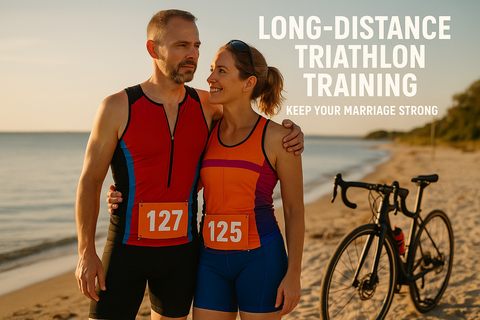
Behind Sollee's dual achievement is a support system that deserves its own recognition. His wife doesn't just tolerate his training — she actively participates in it. She joins him on runs from her bike, keeping pace alongside him while he logs the miles. And when race day comes, she puts her medical expertise to work, volunteering in the medical tent at race events.
This kind of partnership is not peripheral to the story — it's central to it. Ambitious goals pursued in isolation tend to collapse under their own weight. Goals pursued with an engaged, invested partner tend to sustain themselves. Sollee's wife isn't a spectator in his athletic life; she's a collaborator.
For anyone wondering whether a demanding dual pursuit is sustainable long-term, the presence of that kind of support is often the deciding factor.
Where Code Meets the Open Road
Here's the insight that rarely makes it into stories about high-achieving athletes: the skills that make Sollee a strong technologist also make him a strong endurance racer, and the reverse is equally true.
Both domains reward disciplined data analysis. Just as Sollee uses metrics to evaluate the performance of Jacksonville's digital platforms, he almost certainly applies the same analytical approach to his training — heart rate zones, power output on the bike, pace per mile, recovery indicators. The people who excel in both tech and endurance tend to be fluent in the language of performance data.
Both domains also require breaking down enormous challenges into manageable components. A city-wide platform redesign is not launched in a day; it's decomposed into sprints, milestones, and iterative improvements. A long-distance triathlon is not conquered in one heroic push; it's broken into the swim, the first half of the bike, the second half, the first 13 miles of the run, the last 13. Strategic chunking is a meta-skill that transfers across contexts.
And perhaps most importantly, both domains require comfort with sustained discomfort — the ability to keep moving forward when results are not yet visible and fatigue is very real.
The Ironman Jacksonville Connection: Bringing It Home
A Race That Fits the Moment
The timing of Jacksonville's inaugural long-distance triathlon — May 16, 2026 — couldn't be more resonant for someone in Sollee's position. As the city undergoes one of the most significant technological transformations in its recent history, it's also welcoming one of the most prestigious endurance events in the world for the first time.
Sollee's participation in that event as both a competitor and a city employee gives the moment a symbolic dimension that goes beyond sports. He represents, in a very tangible way, the kind of citizen who drives a city forward: technically skilled, athletically driven, deeply rooted, and committed to showing up — whether that means debugging a chatbot or running a marathon at mile 100 of a triathlon.
What It Means for Jacksonville
Hosting a long-distance triathlon is no small feat for a city. It requires coordinating road closures, volunteer networks, medical infrastructure, and athlete services across a course that spans the city's most iconic geography. The economic impact of bringing hundreds of international and national competitors — plus their families and support crews — to Jacksonville hotels, restaurants, and businesses is substantial.
But beyond the economics, there's something harder to quantify: the inspiration that comes from watching people do extraordinary things in your own backyard. When a Jacksonville resident sees a fellow neighbor crossing a finish line after 140.6 miles, something shifts in their sense of what's possible — both for themselves and for their city.
Sollee, as both a participant and a civic contributor, sits at the exact intersection of those two dimensions.
Lessons for Anyone Building Something
Whether you're building a career, a business, a family, or a fitness base, Sollee's story carries lessons that don't require an MIT degree or a world record to apply:
- Roots matter. The decision to invest your talents in your hometown, rather than always chasing the next opportunity, creates compounding returns — professionally and personally.
- Dual pursuits reinforce each other. The discipline you build in one domain doesn't stay there. It migrates into every other area of your life.
- Support is infrastructure, not luxury. A strong support system isn't a nice-to-have; it's load-bearing. Build it deliberately.
- The finish line is always farther than you think — and that's the point. Whether it's a city platform redesign or a 26.2-mile run at the end of a 140-mile day, the challenge is the point.
The Bigger Picture: Excellence as a Way of Being
Reframing "Balance"
We often talk about work-life balance as if it's a static state to be achieved and maintained — as if the scales, once level, stay that way. Sollee's life suggests a different model: work-life integration, where different domains of excellence are not competing with each other but feeding each other.
This is not "having it all" in the clichéd sense. It comes with real costs — early mornings, exhausted evenings, opportunity costs, and the ever-present risk of doing too much. But for people who are genuinely energized by multiple pursuits, the traditional either/or framing may be the wrong framework altogether.
The question worth asking isn't "How does he find the time?" It's "What does he prioritize, and why?" The answer, for Sollee, appears to be: work that matters, races that challenge, community that grounds him, and a partnership that sustains it all.
What This Story Is Really About
At its core, this is not a story about being exceptional. It's a story about being intentional.
Sollee didn't stumble into a world record, a MIT degree, a civic tech role, and five long-distance triathlon finishes by accident. Each of those outcomes is the downstream result of choices — about where to invest time and energy, what to pursue with genuine commitment, and who to surround himself with.
That kind of intentionality is available to anyone. The specific achievements will look different, but the underlying architecture — clarity of purpose, disciplined execution, and a support system built to last — is replicable.
For the ambitious professionals, the working athletes, and the community builders reading this: the question Sollee's story poses is not "Could I do what he does?" It's "Am I being as intentional about what I'm building as he is?"
Key Takeaways
- Excellence in multiple domains is possible — but it requires systems, not superhuman ability
- Hometown commitment and career ambition aren't mutually exclusive — Sollee's Jacksonville roots inform and strengthen both
- Athletic discipline and professional discipline are the same skill expressed in different contexts
- Support systems are infrastructure — Sollee's wife's involvement is not peripheral; it's structural
- The skills built in one high-performance domain transfer — data thinking, strategic pacing, and tolerance for discomfort translate across every area of life
Your Turn
Will you be lining the course for Jacksonville's inaugural long-distance triathlon on May 16, 2026? The finish line on the St. Johns River will be worth witnessing — not just for the race, but for what it represents: a city and its citizens committing to something excellent.
And if Sollee's story sparked something for you — whether you're a working professional who used to train, an athlete figuring out how to build a career, or someone just wondering if both/and is really possible — we'd love to hear from you. Share your own dual pursuit in the comments below.
Looking for gear to support your next race or training block? Check out our triathlon race suits, swimming goggles, and premium running shoes — whether you're toeing your first start line or your next big race.
Who is Richard Sollee?
Richard Sollee is a City of Jacksonville employee in the Technology Solutions Department, where he modernizes the digital interaction between residents and city government. He is also an long-distance triathlete, training for endurance races in his spare time.
What achievements has Richard Sollee accomplished in athletics?
Richard Sollee has completed two marathons and five long-distance triathlon half-distance events. He was also a competitive rower, setting a world record in the 100-kilometer rowing machine event for lightweight men 19 and under.
What contributions has Richard made to the City of Jacksonville?
Richard has contributed significantly by redesigning the city’s website, developing a new pet adoption app, and implementing an AI chatbot to help residents navigate city services.
How does Richard Sollee balance his work and training?
Richard balances his work and training by dedicating his evenings to rigorous training sessions while managing his professional responsibilities during the day. His wife supports his training by joining him on runs and volunteering in medical support at races.
When is Jacksonville's first-ever Ironman triathlon?
Jacksonville's first-ever long-distance triathlon is scheduled to take place on May 16, 2026.
![[WATCH LIVE NOW] Women's European Ironman Championship in Hamburg](http://triathlon.mx/cdn/shop/articles/d7d0945868953eee3a8feae2aa7e5193.png?v=1780895362&width=480)