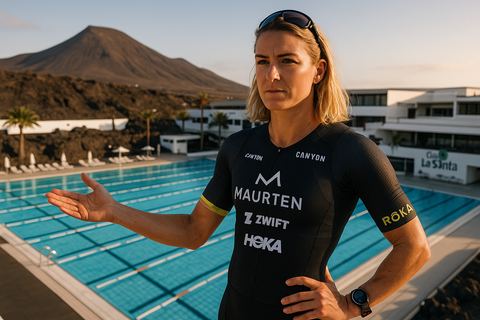
The 2026 Pro Series European season kicks off this weekend in the picturesque region of Provence, promising one of the most competitive and unpredictable half-distance fields in recent memory. With defending champions, Olympic-caliber athletes transitioning from short courses, and XTERRA specialists making their road debuts, the sun-baked streets of Aix-en-Provence are set to challenge even the most seasoned competitors. The hilly French terrain will undoubtedly separate the pretenders from the contenders.
Race details: 70.3 Pays d'Aix | Aix-en-Provence, France | Sunday, May 17 | 6:30 AM CEST
Live coverage: Available on long-distance triathlon.com, YouTube, DAZN, L'Équipe, and iQIYI
Whether you're a seasoned triathlon enthusiast, an age-grouper gearing up for your own 70.3 season, or simply curious about why elite athletes race down mountain roads at breakneck speeds, this preview has everything you need. Let's dive in.
The Course: Where Bikes Win Races
Before we delve into the athletes, it's crucial to understand the arena. At Pays d'Aix, the course itself is as much a competitor as anyone on the start list.
The race begins with a single-lap lake swim just outside the city—a relatively neutral segment that won't drastically split the field. But then, the course transitions to the bike, where the real story unfolds.
The numbers: 1,077 meters of elevation gain (3,533 feet) spread across classic, twisty French roads—akin to the Nice course. Most climbs are moderate in gradient, but the descents are technical and fast. This isn't just about raw power; athletes need genuine bike-handling skills to stay safe and fast on the way down.
The race-defining moment? The final big climb at approximately 67 kilometers into the bike leg—described as "punchy," meaning steep enough and late enough to expose any athlete who has misjudged their pacing or fueling strategy. By that point, the strongest riders will surge; everyone else will be managing damage.
After T2 in the heart of the city, athletes tackle a three-lap run course through Aix's city streets. The abundance of turns creates a tactical chess match—athletes can see competitors ahead of them at every corner, making the psychological pressure relentless. For spectators, those same turns offer incredible viewing opportunities throughout the race.
The bottom line: Pure swimmers and pure runners won't win here. This course rewards balanced athletes with strong bikes, technical descending skills, and the ability to pace intelligently over 90 kilometers of rolling terrain.
Women's Race: Deep Field, No Dominant Favorite
With 38 women on the start list, finishing in the top ten is an impressive feat. Here's who to watch—and why.
Marjolaine Pierre — The Defending Champion
The French favorite returns to defend her 2025 title and her own course record. Racing in her natural habitat—hilly French terrain, home crowd, familiar roads—Pierre combines genuine cycling prowess with what the preview describes as "incredible running." She is an outright podium contender.
However, she faces a significantly tougher field than last year. The question isn't whether she's capable of winning—she clearly is. The question is whether she can impose her will as she did in 2025.
Laura Philipp — The Favorite With a Question Mark
If she starts, Philipp may be the most talented athlete on the women's start list. The German is an elite run specialist with a career pedigree that makes her a threat even at less than 100%.
The catch? She hasn't raced yet in 2026 and was recently hospitalized for what she described as "very strong stomach and back pain." Her race readiness is genuinely unknown.
As Sarah Bonner writes on Slowtwitch: "An athlete of her calibre, especially on the run, cannot be counted out for the overall win if she takes the start line."
That word—if—carries enormous weight this weekend.
Tanja Neubert — The Intriguing Wildcard
Here's the storyline that has the triathlon world buzzing. Neubert is primarily a short-course (Olympic-distance) specialist, but her two career 70.3 starts have produced remarkable results: 2nd at 70.3 Bahrain in 2024, and 3rd at the 70.3 World Championships in 2025, finishing behind Lucy Charles-Barclay and Taylor Knibb.
Can short-course speed translate to half-distance demands on a hilly course? Bonner frames it well: "Her lack of experience might be a deficit, especially on such a hilly course, but it also leaves the door open."
Neubert's presence asks a fascinating question about where elite triathlon is heading—and we may get a loud answer this weekend.
Other Athletes to Watch
| Athlete | Nation | Key Strength | Watch For |
| Lisa Perterer | Austria | All-around; strong 2025 season | Opening her 2026 season after DNS at Texas due to illness |
| India Lee | GB | Supreme swim-bike combo | Early race aggression; question is run durability |
| Imogen Simmonds | Switzerland | Won Aix in 2021; T100 Gold Coast 3rd | Proven on this course; always dangerous |
| Daniela Kleiser | Germany | Elite run speed | Will exit water near the back; watch her run down the field in final kilometers |
The midpack battle will also be fierce. Lizzie Rayner, Hanne De Vet, Katrine Christensen, and Fenella Langridge are all regular podium contenders who will make top-ten placement genuinely hard-earned.
Men's Race: 55 Athletes, Zero Clear Favorites
With 55 men on the start list and no single dominant figure, the men's race could produce a genuinely unpredictable outcome. That's exactly what makes it compelling.
Rico Bogen — The 70.3 World Champion
Bogen won the 2023 70.3 World Championship and, despite shifting focus toward T100 racing in recent years, he remains a serious contender at this distance. His strategy is straightforward: push hard on the bike, then rely on his T100-sharpened run speed to close out the race. He finished 5th at Marbella last year, and his current form suggests he's capable of a podium here.
Rudy Von Berg — Inconsistent but Always Dangerous
Von Berg is the kind of athlete whose name appears in every preview for good reason—but whose results keep analysts guessing. He has already raced heavily in 2026: 5th at Texas (described as the "unofficial world champs preview"), 15th at Oceanside, and 7th at Dallas.
The Slowtwitch assessment is honest: "Results wise, he is inconsistent when it comes to 70.3 racing. There are plenty of hungry competitors that might foil the long distance specialist's ambitions."
He could win. He could also finish outside the top ten. That's just who Von Berg is.
Kristian Høgenhaug — The Bike Weapon
Høgenhaug may be the most fascinating tactical puzzle in the men's field. His bike is genuinely world-class: at long-distance triathlon Frankfurt in 2025, he out-biked Kristian Blummenfelt by eight minutes and held off two other Norwegians on the run to finish second. At Texas this year, he was first off the bike before finishing 12th overall.
His own social media post after Texas acknowledged he was racing ahead of peak fitness, hoping to be "in better form in a few months." That was one month ago.
Can he translate that improved fitness into a complete performance here? Bonner captures the tension: "Høgenhaug has the goods, but whether it's too early in the season for him to be on form is the question."
The technical French descents—where pure bike handling matters as much as raw power—could suit him perfectly.
Kyle Smith and the T100 Crossover
Like Bogen, Kyle Smith has been primarily racing on the T100 circuit. But his 4th-place finish at the 2024 70.3 World Championships proves he has half-distance speed. He opened 2026 at long-distance triathlon New Zealand (11th) before heading straight to T100 Singapore. He has podium speed—the question is whether the constant format-switching affects his race execution.
Expect Jamie Riddle, Pierre Le Corre, and Justus Nieschlag to be among the early swim leaders, setting up an aggressive first transition.
Simon Viain — The French Threat
Defending champion Kristian Blummenfelt is not returning, but Simon Viain is. The Frenchman has finished 4th, 2nd, and 3rd on this course over the past few years. His podium last year—just 78 seconds behind Blummenfelt and 47 seconds behind Casper Stornes—was arguably his career best.
Racing on home roads, with the crowd behind him and deep course knowledge, Viain is not to be underestimated. As Bonner notes: "He has beaten some of the best in the world on this course, so he might be able to do it again."
The XTERRA Exodus: A Story Worth Following
Perhaps the most compelling subplot at Pays d'Aix isn't about any individual podium battle—it's about a broader shift happening in professional triathlon. Multiple elite XTERRA athletes are making deliberate moves to road racing, and this weekend we get to see how that experiment plays out on a technical French course that, ironically, might suit their skills perfectly.
Jens Emil Nielsen (Denmark) — In his first road season in 2025, Nielsen finished just 25th at this race. But he ran a 1:08 half marathon—the fifth fastest run split of the day. That's a remarkable calling card. He's been training in the lead-up to this race alongside compatriot Høgenhaug, which suggests he's taking this season seriously.
Arthur Serrieres (France) — A five-time XTERRA World Champion, Serrieres has dabbled with road racing before, but his recent win at the Cannes International Triathlon signals something more intentional. He's not experimenting anymore; he's committing.
Felix Forissier (France) — This weekend marks Forissier's pro road debut. As a member of the Triathl'Aix club based in Aix-en-Provence, he literally trains on these roads. Local knowledge and home crowd support are real advantages in a race this technical.
Solenne Billouin — On the women's side, Billouin is also making the transition from XTERRA to road racing, adding another dimension to an already stacked women's field.
Why does this matter? XTERRA athletes bring technical bike handling—learned on mountain bikes over uneven terrain—that may translate surprisingly well to fast, twisty French descents. And their run fitness, built on trails, often transfers effectively to road half marathons. This could be the beginning of a new talent pipeline into professional triathlon.
Key Storylines to Watch on Race Day
Can short-course speed beat half-distance veterans? Tanja Neubert and Kyle Smith both suggest yes, but a demanding hilly course with 1,077m of climbing is the sternest test yet.
Will the XTERRA athletes make an impression? Nielsen's run split last year was a clear signal. Serrieres has podium-level talent. Forissier has home advantage. Watch the bike segment closely—this is where XTERRA backgrounds could shine.
Home court for the French? Pierre (women), Viain and Forissier (men) all carry local knowledge and crowd energy. On twisty, technical roads, that familiarity is worth something real.
The fitness unknowns. Philipp (recent hospitalization), Perterer (DNS at Texas due to illness), and Lee (also missed Texas) all carry question marks. Uncertainty breeds opportunity—both for them and for rivals.
What happens at the 67km climb? This is your race-defining moment in both fields. Whoever crests that climb with a gap and strong legs has a genuine path to victory.
Race Day Cheat Sheet
What to watch — Women's race:
- 🏊 Swim exit: Lee and Simmonds up front; Kleiser near the back
- 🚴 First climb: Where does Philipp position herself? (Fitness indicator)
- ⛰️ 67km climb: Who leads over the top? (The decisive moment)
- 🏃 Final 5km: How much of the field can Kleiser run down?
What to watch — Men's race:
- 🚴 Bike exit: Høgenhaug, Bogen, or a wildcard leading off T2?
- ⛰️ Høgenhaug's form: Is he sharper than Texas?
- 🌲 XTERRA athletes: How do Nielsen and Serrieres handle the course?
What is the long-distance triathlon 70.3 Pays d’Aix?
The long-distance triathlon 70.3 Pays d’Aix is a triathlon event that takes place in Aix-en-Provence, France. It features a one-lap swim in a lake, followed by a challenging bike course with significant elevation gain and a technical run course through the city.
When is the 2026 long-distance triathlon 70.3 Pays d’Aix scheduled?
The 2026 long-distance triathlon 70.3 Pays d’Aix is scheduled for Sunday, May 17, 2026, starting at 6:30 AM local time.
Who are the top female contenders for the 2026 race?
The top contenders for the women's race include defending champion Marjolaine Pierre, Laura Philipp, Tanja Neubert, and Lisa Perterer. Each athlete has notable strengths, particularly in cycling and running.
Who are the leading male athletes competing in 2026?
Leading male athletes include Rico Bogen, Rudy Von Berg, and Kristian Høgenhaug. These athletes have demonstrated strong performances in previous triathlon events and bring considerable experience to the race.
What is the course like for the long-distance triathlon 70.3 Pays d’Aix?
The course features a one-lap swim, a challenging bike segment with 1,077 meters of elevation gain on hilly, technical roads, and a three-lap run course primarily on city streets with many turns that can become strategic points for competitors.
How can I watch the 2026 long-distance triathlon 70.3 Pays d’Aix?
The race will be broadcast live and free on various platforms including long-distance triathlon's official site, YouTube, DAZN, and L’Équipe, among others.
#Triathlon70.3 #TriathlonRace
Discover unique triathlon-themed merchandise, including stylish t-shirts, stickers, phone cases, and home decor - perfect for endurance sports enthusiasts and athletes. Shop now
Source: https://www.slowtwitch.com/triathlon/2026-ironman-pro-series-european-opener-preview-70-3-pays-daix/