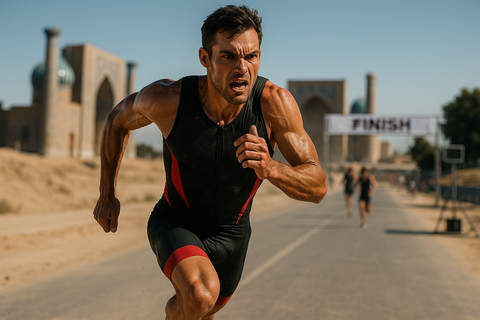
Ironman's New 20-Meter Drafting Rule: A Game-Changer for the 2025 World Championship
Imagine a single rule change that could completely alter the landscape of the Ironman World Championship. Ironman's new 20-meter drafting rule is poised to do just that, and an AI analysis reveals some startling possibilities that every professional triathlete should consider.
Rule change and context
Recently, Ironman announced a pivotal rule change: increasing the permissible drafting distance for professional athletes from 12 to 20 meters. This decision aligns with similar changes by the T100 Tour and Challenge Family series, aiming to reduce the aerodynamic benefits of pack riding.
This change follows comprehensive testing in Tucson, which demonstrated no significant aerodynamic difference between 12 and 16 meters, but a notable drop-off at 20 meters. While some professionals have downplayed the potential impact, many, especially "lone wolf" cyclists like Lionel Sanders, Sam Long, and Matthew Marquardt, have strongly supported the change.
Using Google's advanced Gemini 3 Pro AI, we explored how this rule change might have influenced the 2025 World Championship results. The findings range from modest reshuffling to dramatic podium changes, with significant implications for race strategy, prize money distribution, and the future of professional Ironman racing.
The Science Behind the 20-Meter Rule
To understand the significance of this rule, one must grasp the aerodynamic physics involved. Recent studies estimate that maintaining position at 20 meters versus 12 meters requires an additional 25-30 watts of power output. This seemingly small difference can have massive downstream effects over a 112-mile bike course.
For context, consider these calculations based on scientific drafting calculators developed from peer-reviewed research. Over four-plus hours of racing, the extra energy expenditure translates to approximately:
- 750 additional calories burned
- 900ml more fluid loss
- 1,000mg extra sodium depletion
According to the National Institutes of Health and research published in the International Journal of Sports Physiology and Performance, these metabolic demands significantly increase the risk of dehydration, heat stress, and system failure—especially in Kona's challenging conditions.
Even athletes who manage the additional nutritional and hydration demands will likely experience performance degradation during the marathon portion. The cascading effects include glycogen depletion, neuromuscular fatigue, elevated core temperature, and various physiological stresses that could cost runners 5-15 minutes over the marathon distance.
Why Strong Cyclists Advocate for More Space
The rule change might seem counterintuitive: why would strong cyclists like Lionel Sanders and Sam Long advocate for more space between competitors? The answer lies in strategic implications.
The 20-meter rule forces pack riders to expend significantly more energy to maintain contact with leaders. As Sanders explained, this creates an advantage for athletes who typically ride alone or at the front of groups. While solo riders maintain their normal power output, pack followers must work 25-30 watts harder just to stay in touch.
This dynamic fundamentally alters race strategy. Strong cyclists can either:
- Maintain their normal effort and build larger time gaps
- Reduce their power output to conserve energy for the run while still maintaining competitive positioning
The rule also raises intriguing questions about swim strategy: Will strong swimmers push harder early to create bigger gaps, knowing pack riders will struggle more to close the distance on the bike?
Women's 2025 Kona: Two Dramatic Scenarios
To understand the real-world impact, we asked Gemini to model two scenarios for how the 2025 women's championship in Kona might have unfolded under the new rule.
Quick recap: Solveig Løvseth won dramatically after posting the second-fastest bike split in Kona history (4:31:53). The race was defined by brutal 90-degree temperatures and became a war of attrition that saw pre-race favorites Lucy Charles-Barclay and Taylor Knibb trade the lead on the bike, only to falter on the run. Løvseth, Kat Matthews (who ran a course-record marathon), and Laura Philipp used superior pacing to secure the podium.
Scenario 1: Unchanged Bike Intensity
In this scenario, all athletes maintain their actual race-day power output, accepting a "pack penalty" rather than risking additional fatigue on the run.
Key Results:
- Løvseth's winning margin grows from 35 seconds to 5.5 minutes as Matthews and Philipp lose time due to reduced aerodynamic benefits
- Minimal podium changes but significantly larger time gaps
- Sara Svensk moves up one place to seventh, benefiting from her predominantly solo ride
- Prize money shifts are modest in the top 10
The most striking element is how much larger the time gaps become. Matthews' course-record marathon wouldn't be enough to catch Løvseth, making future victories against solo riders even more challenging.
Scenario 2: Conservative Strategy for DNF Athletes
The most intriguing possibility: What if Taylor Knibb and Lucy Charles-Barclay had raced more conservatively, knowing the pack dynamics would be dramatically different?
Gemini's projection: The closest Kona podium ever with only 30 seconds separating the top three finishers. By riding an estimated three minutes slower over 112 miles, both athletes could have positioned themselves to complete the marathon in three hours, putting them in podium contention.
Major implications:
- Løvseth still wins but barely, catching and passing both athletes in the final miles
- Charles-Barclay edges Knibb by three seconds for second place
- Matthews drops to fourth despite her record marathon
- Massive prize money swings with six-figure gains for Knibb and substantial earnings for Charles-Barclay
This scenario highlights a crucial strategic consideration: the new rule might reward more conservative bike pacing, fundamentally altering how athletes approach Ironman racing.
Men's 2025 Nice: Course Characteristics Matter
The men's championship in Nice provides an interesting contrast due to the climb-heavy course that naturally breaks up packs. Despite this, the AI modeling still predicted significant changes.
Race recap: Norway's Casper Stornes won his debut with a 7:51:39 overall time, including a record-breaking 2:29:25 marathon. Fellow Norwegians Gustav Iden and Kristian Blummenfelt completed the podium sweep, while Sam Laidlow posted the fastest bike split and Patrick Lange ran from 33rd to ninth overall.
Key findings under the 20-meter rule:
- The Norwegian podium sweep remains unchanged due to their predominantly solo riding strategy
- Significant reshuffling in positions 4-18 with massive place gains for solo riders
- Sam Long jumps 8-11 places in different scenarios, highlighting the impact on strong individual cyclists
- Patrick Lange improves 4-6 positions, demonstrating how the rule benefits athletes who ride in the wind
The Nice results reinforce that course characteristics matter, but the 20-meter rule creates measurable advantages for solo riders even on challenging terrain.
Strategic Implications for Future Races
Revised Pacing Strategies
Athletes who traditionally rely on pack riding will need to fundamentally reconsider their approach. The extra 25-30 watts required at 20 meters isn't sustainable for most athletes over 112 miles without compromising run performance.
Enhanced Solo Riding Capabilities
Time trial skills and the ability to ride efficiently in the wind become more valuable. Athletes may need to adjust training to build these capabilities. For those looking to improve their bike performance, investing in proper equipment like quality Shimano components can make a significant difference.
Nutritional and Hydration Adjustments
The increased metabolic demands require careful recalculation of fueling strategies. An extra 750 calories and 900ml of fluid over four hours represents a significant operational challenge. Consider using electrolyte supplements to maintain proper hydration and magnesium citrate to prevent cramping during long rides.
Swim Strategy Evolution
Strong swimmers might push harder to create larger early gaps, knowing followers will struggle more to close the distance under the new rule.
What This Means for Professional Triathlon
While our AI analysis has limitations—we lacked detailed individual athlete data and Race Ranger statistics showing exact drafting patterns—the directional insights are clear and significant:
- The 20-meter rule will measurably impact bike times and overall results, with slower average times and bigger gaps at T2
- Strong cyclists and solo riders will benefit most significantly, gaining both time and strategic advantages
- Pack riders need to fundamentally rethink their race strategy, potentially adopting more conservative bike pacing
- Prize money distribution could see major shifts, with implications for both individual race earnings and Pro Series standings
The Future of Ironman Racing
The 20-meter rule represents more than a minor regulatory adjustment—it's a fundamental shift that rewards self-sufficiency and punishes pack tactics. As athletes adapt their strategies, we may see the emergence of new racing styles, different training approaches, and a reshuffling of competitive hierarchies.
For fans, this could mean more dynamic racing with bigger time gaps and less predictable outcomes. For athletes, it represents both a challenge and an opportunity to differentiate themselves through superior individual racing capabilities.
The AI analysis suggests that success under the new rule will increasingly favor athletes who can combine strong swimming, solo cycling prowess, and intelligent pacing—qualities that have always defined great Ironman champions but will now be more crucial than ever.
Find the perfect race day essentials at TriLaunchpad — your triathlon journey starts here. Shop all collections →
![[WATCH LIVE NOW] Ironman 70.3 World Championship Nice: men battle for the world title](http://triathlon.mx/cdn/shop/articles/6796cb07c17754f5be6b41306bfebb7f.png?v=1789360626&width=480)