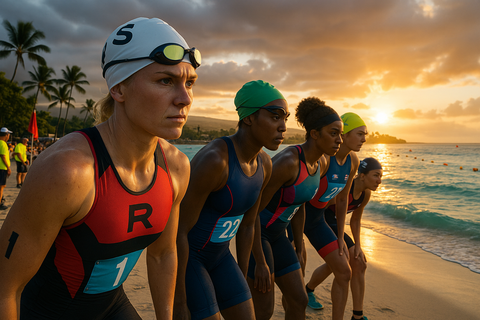
Why a Former SAS Officer Says Triathlon is the Answer to Mental Health Struggles
When a former Special Forces officer, who has survived some of the world's most extreme military operations, calls a triathlon "horrible" and then immediately starts planning his next race, there's a powerful lesson about human psychology at play.
In an era where mental health challenges are reaching crisis levels, particularly among men, the connection between physical challenges and psychological well-being is gaining scientific recognition. The recent Qatar T100 World Championships provided a unique window into this phenomenon through the experience of Ollie Ollerton, SAS veteran and star of "SAS: Who Dares Wins," who competed in the inaugural age group world championship event.
Drawing from exclusive insights captured at the T100 World Championships, plus supporting research from sports psychology and military resilience studies, this exploration reveals the science-backed connection between physical challenges and mental resilience – and offers practical strategies for using endurance sports to improve mental health.
The Paradox of Seeking Discomfort
The human tendency to voluntarily seek out suffering has puzzled psychologists for decades, yet the T100 experience perfectly illustrates this paradox. After crossing the finish line in brutal Qatar conditions with a time of 4:40:25, Ollerton's immediate reaction was telling: "horrible" was his first word to describe the experience, delivered with a laugh and wry smile that every age group triathlete will recognize.
"Give it an hour and ask me again! No, of course as soon as the pain dilutes it'll be on to the next goal."
This rapid transformation from suffering to planning the next challenge reveals something fundamental about human psychology. The post-challenge euphoria isn't just about endorphins – it's evidence of our psychological need for controlled stress exposure. Research in evolutionary psychology suggests that voluntarily engaging with manageable threats helps build resilience for real-world challenges.
The military understands this principle intimately. Stress inoculation training, a cornerstone of special forces preparation, deliberately exposes individuals to controlled stressors to build mental fortitude. When we choose our suffering – whether it's a triathlon or military training – we're essentially practicing resilience in a safe environment.
The Military-Athletic Connection: Lessons in Mental Fortitude
Ollerton's military background provides unique insight into the connection between physical challenges and mental strength. "I may be a Special Forces Soldier but I bleed and breathe just like everyone else," he emphasizes, highlighting that the principles of mental resilience aren't exclusive to elite military personnel.
The mindset that military training instills translates directly to endurance sports. When Ollerton faced a challenging race day – struggling with his swim and experiencing foot problems during the run – his response exemplified military-trained thinking: "It's not a failure, it's growth."
This reframing is crucial for mental health. Rather than viewing setbacks as evidence of personal inadequacy, the military approach treats them as data points for improvement. "Every day is a school day, so you live and learn," Ollerton reflects, demonstrating the growth mindset that both elite military training and endurance sports cultivate.
Military resilience training methodologies
- Progressive overload: Gradually increasing stress tolerance
- Cognitive reframing: Viewing challenges as opportunities rather than threats
- Process focus: Concentrating on actions rather than outcomes
- Community support: Building resilience through shared experience
These same principles naturally emerge in triathlon training and racing, making endurance sports a civilian pathway to military-grade mental toughness.
The Science Behind "Movement as Medicine"
Ollerton's conviction about triathlon's mental health benefits isn't just personal opinion – it's backed by mounting scientific evidence. "This is the answer, I believe, to a lot of people's issues with mental health," he states, pointing to a fundamental insight about the relationship between physical and psychological well-being.
The neurochemical changes during endurance exercise are profound. Extended physical activity triggers the release of brain-derived neurotrophic factor (BDNF), often called "Miracle-Gro for the brain," which promotes neural growth and connectivity. This biological response helps explain why endurance athletes often report improved mental clarity and emotional regulation.
But Ollerton identifies an even more critical mechanism: "If they sit and do nothing, they become very insular and the walls go up. Before they know it, they've become so inhibited."
This observation aligns with research on rumination and depression. When we're sedentary and isolated, our minds tend to spiral into negative thought patterns. Physical challenges provide a powerful circuit breaker for this destructive cycle.
Psychological benefits of endurance sports
- Forced present-moment awareness: The intensity of physical challenge makes it impossible to ruminate on past failures or future anxieties
- Concrete goal achievement: Crossing finish lines provides tangible evidence of capability
- Community connection: Training and racing naturally build supportive relationships
- Identity transformation: Athletes develop a more resilient self-concept
Clinical studies consistently show that structured exercise programs can be as effective as medication for treating mild to moderate depression, with the additional benefits of improved physical health and self-efficacy.
Age is Just Energy: Redefining Limitations
At 55, Ollerton challenges societal expectations about aging and capability with characteristic directness: "Age is demonised in our society and a lot of people just accept it. They accept that their stomach is going to grow out to here and they can't see their feet and they accept that they're probably going to get ill."
His rejection of these limitations reflects a powerful psychological principle: "I don't accept that. We're not our age, we're our energy!"
Master's athletics data supports this perspective. Performance declines with age are far less dramatic than most people assume, and many age-related limitations are actually the result of decreased activity rather than biological inevitability. When people remain physically active through endurance sports, they often maintain capabilities that exceed those of sedentary individuals decades younger.
The psychological benefits of defying age stereotypes extend far beyond physical performance. Research on self-efficacy shows that when people successfully challenge one area of perceived limitation, it creates a ripple effect of increased confidence across other life domains. The 55-year-old who completes a triathlon doesn't just prove they can swim, bike, and run – they prove that perceived limitations might be self-imposed barriers rather than biological realities.
Endurance sports communities also provide powerful counter-narratives to aging stereotypes. When surrounded by fit, active people across age groups, the idea that decline is inevitable becomes much less convincing. This social proof reinforces individual efforts to maintain vitality and challenge assumptions about what's possible at any age.
Practical Application: Getting Started with Challenge-Based Mental Health
For those inspired by Ollerton's approach but uncertain where to begin, the key is progressive implementation. "Maybe it can just be a tap on the shoulder to say 'do something different'," he suggests, emphasizing that transformation doesn't require immediate extreme challenges.
Starting framework
-
Week 1-4: Establish Movement Baseline
- Begin with 20-30 minute walks or easy bike rides
- Focus on consistency rather than intensity
- Notice the immediate mood effects of movement
-
Week 5-8: Introduce Structured Challenge
- Add one slightly uncomfortable session per week
- Could be a longer walk, swimming laps, or a short jog
- Practice the mindset of embracing discomfort
-
Week 9-12: Set Your First Goal
- Register for a local 5K, sprint triathlon, or similar event
- Begin following a basic training plan
- Connect with others who share similar goals
Safety and support considerations
- Consult healthcare providers before beginning intense exercise programs
- Consider working with qualified trainers or coaches
- Recognize when professional mental health support is needed
- Build community connections through clubs or training groups
The "School Day" Mindset: Ollerton's philosophy of treating every experience as learning applies perfectly to this journey. Expect setbacks, celebrate small victories, and remember that the goal isn't perfection – it's growth through consistent challenge.
Building Sustainable Mental Resilience
The true power of Ollerton's approach lies not in any single race or challenge, but in the lifestyle it creates. "If I do nothing, my world falls apart," he acknowledges, highlighting that mental health maintenance requires ongoing effort.
This doesn't mean constant extreme challenges. Instead, it means building a life structure that includes:
- Regular physical challenges that push comfort zones
- Community connections built around shared goals
- Progressive goal-setting that maintains forward momentum
- Mindset practices that reframe setbacks as learning opportunities
The Qatar T100 represented just one data point in Ollerton's ongoing journey. His immediate planning for the next challenge – an Ironman in 2026 and an Olympic distance race in January – demonstrates the sustainable approach of always having something meaningful to work toward.
The Ripple Effect of Personal Challenge
Perhaps the most compelling aspect of Ollerton's message is its accessibility. While his Special Forces background might seem intimidating, his emphasis that he "bleeds and breathes just like everyone else" is crucial. The principles of mental resilience through physical challenge aren't reserved for elite military personnel – they're available to anyone willing to step outside their comfort zone.
The broader implications extend beyond individual mental health. When people transform themselves through physical challenges, they become living examples for others. Ollerton's visibility at events like the T100 provides inspiration for those who might never have considered themselves "athletic" but recognize the need for positive change in their lives.
Conclusion: Embracing the Challenge
The evidence from both scientific research and lived experience points to the same conclusion: physical challenges serve as powerful tools for building mental resilience. Ollerton's journey from the brutal conditions of Qatar T100 to immediate planning for future goals illustrates the transformative cycle of challenge, growth, and renewed purpose.
Key takeaways
- Start where you are: Physical challenges don't require elite fitness levels
- Focus on process over performance: Growth comes from consistent effort, not perfect results
- Build community: Shared challenges create supportive relationships
- Seek professional guidance: Both for training safety and mental health support when needed
- Embrace the "school day" mindset: Every experience offers learning opportunities
Your next steps
- Assess your current relationship with physical challenges – when did you last voluntarily choose discomfort for growth?
- Identify one manageable challenge you could undertake in the next month
- Find your community – locate local clubs, training groups, or online communities aligned with your interests
- Set a meaningful goal that excites and slightly intimidates you
- Begin today – even a single workout or walk can start the momentum
Find the perfect triathlon gear at TriLaunchpad — your triathlon journey starts here. Shop all collections →