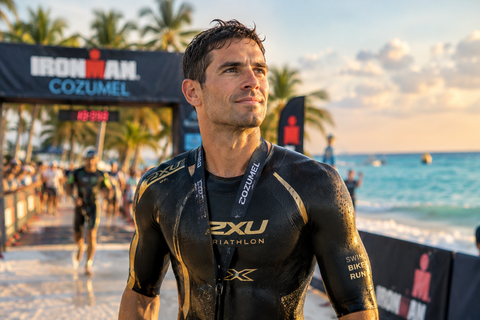
The IRONMAN Draft Zone Debate: A Medical Student's Scientific Proposal for a 20-Meter Trial Season
In the world of triathlon, the debate over the IRONMAN draft zone has reached a critical juncture. With 75% of top professionals advocating for change and technological advancements rendering the current 12-meter rules increasingly outdated, a fresh perspective is needed. Enter Matthew Marquardt, a medical student at Ohio State University College of Medicine and an IRONMAN Lake Placid champion. Marquardt is applying the same scientific rigor he uses in cancer research to address this contentious issue, proposing a systematic, season-long trial that could revolutionize IRONMAN racing.
The Current State of the Draft Zone Debate
The 12-meter versus 20-meter draft zone controversy has long divided the triathlon community. Recent developments, however, have brought the issue to the forefront. Professional athletes, like Canadian superstar Lionel Sanders, have voiced their concerns, stating that "the 12-meter draft zone is no longer, not even remotely, sufficient to make non-drafting biking." This sentiment is echoed by many elite athletes who believe that technological advancements have fundamentally altered the dynamics of aerodynamic advantage in triathlon.
The T100 World Tour has already implemented 20-meter draft zones across its events, offering real-world evidence that the longer distance can work effectively in professional competition. Meanwhile, IRONMAN has conducted preliminary trials testing 12, 16, and 20-meter zones, with results currently under analysis. A survey by Pro Tri News revealed that three-quarters of the top 100 IRONMAN professionals support a move to 20-meter zones. This consensus is rare in professional sports, yet decision-making remains stalled.
With the new IRONMAN Pro Series set to launch in March 2026, starting with IRONMAN New Zealand, the choice of draft zone distance will significantly shape the future of professional long-distance triathlon.
The Medical Research Approach to Sports Decisions
Matthew Marquardt's unique background provides a fresh lens for analyzing this debate. As a medical student working on cancer research, he understands the critical distinction between statistical significance and clinical significance—a concept directly applicable to the draft zone controversy.
"It is obvious that there is a 'statistically significant' difference in draft benefit between 12 meters and 20 meters, but what matters is what we call in medical research a 'clinically significant' difference," Marquardt explains. "In this case, that is the drafting distance that meaningfully impacts race outcomes."
This medical framework offers a sophisticated approach to sports policy that goes beyond simple data analysis. In medical research, treatments that show statistical differences in laboratory settings don't always translate to meaningful improvements in patient outcomes. The same principle applies to triathlon: aerodynamic benefits measured in wind tunnels must be evaluated for their real-world impact on race fairness and competition quality.
The Scientific Case for 20-Meter Zones
The aerodynamic evidence supporting extended draft zones has been building steadily as bike technology continues to advance. Modern time trial bikes, disc wheels, and aerodynamic equipment create significantly greater draft benefits than the equipment available when current 12-meter rules were established.
Marquardt's analysis demonstrates the measurable differences in aerodynamic advantage between 12 and 20-meter zones. "It is unlikely that there is a feasible draft distance where athletes experience zero draft benefit from the person in front of them," he notes. "So the question becomes, what is the minimum distance where drafting does NOT confer an athlete a meaningful advantage?"
The T100 World Tour's successful implementation of 20-meter zones provides crucial real-world validation. Professional races using the extended distance have maintained competitive integrity while reducing concerns about inadvertent drafting violations and aerodynamic advantages. For athletes looking to optimize their own aerodynamic performance, investing in quality equipment like high-performance road bikes can make a significant difference.
The Risk-Benefit Analysis Framework
Marquardt applies medical decision-making frameworks to assess the draft zone debate, emphasizing the relatively low stakes involved compared to his daily work in cancer research.
"I spent a lot of my time in medicine around life and death decisions, so I want to offer my perspective on the Ironman 12 versus 20 meter draft debate," he states. "No one's safety or life is at risk, and it's not a permanent change, which means that if it doesn't work, it can be reversed."
This risk assessment reveals several key factors favoring a trial approach:
- Low Safety Risk: Unlike many sports rule changes, draft zone adjustments pose minimal safety concerns.
- Reversibility: Any implementation can be reversed based on trial results.
- High Information Value: Real-world testing would provide definitive data on competitive impacts.
- Professional Support: The 75% approval rate among top professionals indicates strong stakeholder backing.
- Competitive Precedent: The T100 World Tour's successful implementation demonstrates feasibility.
The Path Forward: A Season-Long Trial
Marquardt's proposal centers on systematic, real-world testing that mirrors medical research methodology. "There is evidence that 20 meters reduces the aerodynamic benefit of being in a group compared to 12 meters, but the only way to know how that actually affects real Ironman racing is to test it in real races."
His recommended approach emphasizes the superiority of real-world data over laboratory studies: "In medicine, research done in the lab is only the start. When the risks are low and the information that could be gained is high, we test in the real world, then argue what is best. This feels like one of those moments."
A season-long trial would provide multiple data points across different race conditions, courses, and athlete fields. This comprehensive approach would generate far more reliable information than limited wind tunnel testing or small-scale experiments. Athletes preparing for IRONMAN 70.3 races would benefit from understanding how these rule changes might affect their race strategies.
"So why not pilot 20 meters for a season, collect the data, then decide?" Marquardt asks, highlighting the logical simplicity of his approach.
Key Takeaways and Future Implications
The draft zone debate represents more than a technical rule change—it's about how professional sports adapt to technological evolution while maintaining competitive integrity. Marquardt's medical research approach offers a clear path forward through evidence-based decision making.
The scientific methodology he proposes emphasizes:
- Real-world testing over theoretical analysis
- Systematic data collection during trial periods
- Risk-benefit assessment prioritizing athlete safety and competitive fairness
- Reversible implementation allowing for course correction
For IRONMAN, the opportunity to lead evidence-based rule making while launching the new Pro Series represents a chance to demonstrate responsive, athlete-centered leadership. The stakes are manageable, the risks are low, and the potential benefits for competitive fairness are significant.
As the triathlon community awaits IRONMAN's next move, Marquardt's scientific approach offers a clear roadmap: pilot the change, collect the data, and let evidence guide the decision. In medicine, this methodology saves lives. In triathlon, it could save the integrity of competition.
Whether you're a professional athlete or an age-grouper training for your next race, staying informed about rule changes and optimizing your equipment setup is crucial. Consider upgrading your training tools with a GPS running watch to track your performance metrics, or explore AI-powered training apps to optimize your preparation for race day.
Find the perfect race day essentials at TriLaunchpad — your triathlon journey starts here. Shop all collections →